
Retirement Planning Saratoga Springs NY | CPA Tax Integration
Most people approaching retirement have two professionals managing their financial life — an investment advisor and a CPA — who rarely talk to each other. The result is investment decisions made without tax context, and tax returns filed without any forward-looking strategy. Bouchey Financial Group solves that problem by bringing CFP® professionals and CPAs together under one roof, fully integrating retirement planning with CPA-level tax planning.
That distinction matters most in the years just before and after retirement — when Roth conversion windows open, RMDs approach, and a single poorly coordinated decision can trigger tax consequences that compound for decades.
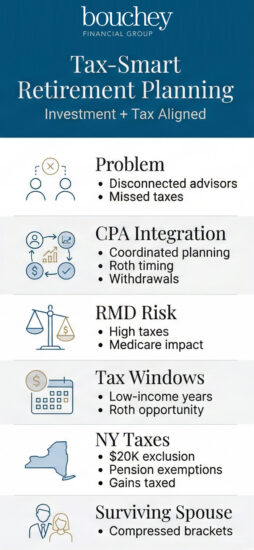
What CPA Tax Integration Actually Changes
Standard retirement planning projects income and portfolio balances. CPA-integrated retirement planning projects tax brackets. The difference is significant.
| Standard Retirement Planning | CPA-Integrated Retirement Planning |
| Investment projections | Multi-year tax projections |
| Withdrawal strategy | Tax bracket management |
| RMD awareness | RMD mitigation strategy |
| General advice | CPA-level tax modeling |
When a CPA or tax professional, and a CFP® work from the same financial plan, decisions like Roth conversions, asset location, and withdrawal sequencing are evaluated against actual projected tax outcomes — not general rules of thumb. That level of coordination is what separates reactive tax filing from proactive tax strategy.
How the Integration Process Works
At Bouchey Financial Group, tax integration is built into the planning calendar — not bolted on at year-end. The process includes tax projections, bracket reviews, and coordination sessions where withdrawal timing and conversion decisions are finalized with both tax and investment outcomes in mind.
This framework ensures that clients don't face April surprises. It also ensures that opportunities — a low-income year ideal for a Roth conversion, for example — are identified and acted on before the window closes.
Managing RMDs Before They Become a Tax Problem
Required Minimum Distributions are one of the most underestimated tax risks in retirement. The IRS guide to required minimum distributions details when distributions must begin and how they're calculated — but the real planning challenge is managing the tax impact of growing RMD amounts over time.
For clients who have accumulated significant balances in tax-deferred accounts, RMDs can force large taxable distributions in their 70s and 80s — pushing them into higher brackets and triggering IRMAA surcharges on Medicare premiums. The solution is to reduce pre-tax account balances before RMDs begin, through Roth conversions and strategic withdrawals in earlier years.
IRA Tax Rules and Roth Conversion Planning
Understanding how traditional and Roth accounts are taxed is foundational to this planning. IRS Publication 590-A on IRA tax rules outlines contribution rules, tax treatment, and rollover mechanics in detail. The practical implication for most pre-retirees is that every dollar converted to Roth today is a dollar of future RMD — and future tax — eliminated.
For a Saratoga Springs couple in their early 60s with $1.5M in traditional IRA assets and a projected pension income beginning at 65, the Roth conversion window between now and pension start may represent the lowest-bracket years they'll see for the rest of their lives. Missing that window is a permanent cost.
New York State Retirement Tax Considerations
New York has a retirement tax profile unlike most states. IRA and 401(k) distributions are subject to NY State income tax, but qualified New York State and local government pension income is fully exempt. NY also offers a $20,000 retirement income exclusion for taxpayers age 59½ or older on other qualified retirement income — a meaningful benefit that must be factored into distribution planning.
Capital gains are taxed as ordinary income in New York, which affects how and when investment gains are realized in retirement. For Saratoga Springs clients with significant taxable investment accounts, coordinating gain realization with other income sources is an important part of minimizing state tax exposure across the retirement years.
Who This Planning Matters Most For
Saratoga Springs attracts a financially diverse population — medical professionals, small business owners, executives, and retirees relocating from downstate New York. Many arrive with complex income pictures: deferred compensation plans, closely held business interests, concentrated stock positions, or multiple retirement account types accumulated across different employers.
For these clients, the tax-smart retirement income planning strategies that generic advisors apply simply don't address the full picture. Tax planning with your financial advisor and tax professional does.
Social Security Timing as a Tax Decision
Most people think about Social Security timing as a longevity bet — claim early and take the sure thing, or delay and maximize the monthly benefit. In reality, it's also a tax decision. The Social Security Administration's retirement planning guidance outlines how benefits are calculated and when they begin, but the tax interaction requires a separate layer of analysis.
Delaying Social Security to 70 while drawing from IRAs in the intervening years reduces future RMD balances and allows Roth conversions to occur at lower combined income levels. Each of those decisions reinforces the others — which is why they must be modeled together, not in isolation.
Planning for the Surviving Spouse
When one spouse dies, the survivor faces a compressed tax environment that can significantly increase their annual burden. Filing status shifts from married jointly to single, bracket thresholds narrow, and one Social Security benefit is lost — while RMDs and investment income remain largely unchanged.
The most effective mitigation is pre-emptive: Roth conversions during the joint-filing years, proper beneficiary designations, and life insurance structured to provide tax-efficient income to the surviving spouse. This planning is most valuable when done well before it's needed.
Practical Tax Strategies Retirees Can Use Now
For retirees already in distribution mode, tax tips for retirement income outline concrete moves that can reduce annual tax liability — including timing distributions, managing capital gains, and using Qualified Charitable Distributions (QCDs) to satisfy RMDs tax-free for those who are charitably inclined.
QCDs allow IRA holders age 70½ or older to transfer up to $110,000 in 2026 (indexed for inflation) per year directly to a qualified charity, satisfying RMD requirements without the distribution appearing as taxable income. For retirees who give charitably, this is one of the most tax-efficient strategies available — and one that is frequently overlooked.
Tax-Advantaged Accounts Across the Retirement Timeline
The IRS retirement plans overview provides a comprehensive look at how different account types — traditional IRAs, Roth IRAs, 401(k)s, SEP-IRAs — are taxed at contribution, growth, and distribution. Understanding each account's role allows a CPA-integrated team to build a withdrawal sequence that minimizes lifetime tax, not just annual liability.
The Right Plan Starts With the Right Team
If your current retirement strategy doesn't include multi-year tax projections, Roth conversion modeling, and CPA-level coordination, there's a strong chance you're leaving money on the table. The Bouchey Financial Group team includes CFP® professionals, CPAs, and an IRS Enrolled Agent working together on every client's retirement plan.
Schedule a free consultation at our Saratoga Springs office at 340 Broadway to see what a fully integrated retirement plan looks like for your specific situation.
Frequently Asked Questions
What is the difference between a CPA and a CFP® when it comes to retirement planning?
A CFP® focuses on investment strategy, retirement income planning, tax planning, estate planning, and long-term wealth management. A CPA specializes in tax law, tax filing, and tax strategy. In retirement planning, the most powerful outcomes come when both disciplines are applied to the same financial plan simultaneously — which is what CPA integration provides.
How does Bouchey Financial Group coordinate tax and investment planning?
The firm’s financial advisors, consisting of CPAs and CFP® professionals, take a holistic approach when working with clients. Our financial planning encompasses all areas of a client’s financial situation, specifically taxes. This begins with reviewing a client’s most recent tax return and structuring tax recommendations based on their financial goals and current and future income situations.
What is a Qualified Charitable Distribution and who should consider it?
A QCD allows IRA holders age 70½ or older to transfer up to $110,000 in 2026 (indexed for inflation) annually directly to a qualified charity, satisfying RMD requirements without the distribution counting as taxable income. It is one of the most tax-efficient giving strategies available and is particularly valuable for retirees who give regularly and want to reduce their taxable income.
How does New York State tax IRA withdrawals in retirement?
New York taxes most IRA and 401(k) distributions as ordinary income, subject to state income tax rates. However, NY offers a $20,000 exclusion on qualified retirement income for those age 59½ or older, and NY State and local government pension income is fully exempt from state tax — making NY's retirement tax environment more favorable for public employees than many assume.
At what age should I start Roth conversion planning?
Ideally, Roth conversion planning begins in the early-to-mid 60s — after earned income drops but before Social Security and RMDs begin. This window often represents the lowest combined income years a retiree will see, making it the most tax-efficient time to convert. The exact timing depends on projected income, account balances, and NY State tax considerations.
What happens to my Medicare premiums if my income spikes in retirement?
Medicare Part B and D premiums increase at certain income thresholds through IRMAA surcharges, and they are based on income from two years prior. A large Roth conversion or asset sale today can trigger higher premiums in the future. CPA-integrated planning models these thresholds in advance to avoid unnecessary surcharge exposure.
Can I coordinate my existing CPA with Bouchey Financial Group's planning process?
Yes. For clients who have an established CPA relationship they want to maintain, Bouchey Financial Group can work collaboratively with your tax preparer — sharing tax projections, coordinating strategies, and ensuring both sides are aligned. The goal is always the best outcome for the client.
IMPORTANT DISCLOSURE INFORMATION
Please remember that past performance is no guarantee of future results. Different types of investments involve varying degrees of risk, and there can be no assurance that the future performance of any specific investment, investment strategy, or product (including the investments and/or investment strategies recommended or undertaken by Bouchey Financial Group, Ltd. [“Bouchey Financial”]), or any non-investment related content, made reference to directly or indirectly in this blog will be profitable, equal any corresponding indicated historical performance level(s), be suitable for your portfolio or individual situation, or prove successful. Due to various factors, including changing market conditions and/or applicable laws, the content may no longer be reflective of current opinions or positions. Moreover, no portion of this discussion or information contained in this blog serves as the receipt of, or as a substitute for, personalized investment advice from Bouchey Financial. To the extent that a reader has any questions regarding the applicability of any specific issue discussed above to his/her individual situation, he/she is encouraged to consult with the professional advisor of his/her choosing. Neither Bouchey Financial’s investment adviser registration status, nor any amount of prior experience or success, should be construed that a certain level of results or satisfaction will be achieved if Bouchey Financial is engaged, or continues to be engaged, to provide investment advisory services. Bouchey Financial is neither a law firm nor a certified public accounting firm and no portion of the blog content should be construed as legal or accounting advice. A copy of the Bouchey Financial’s current written disclosure Brochure and Form CRS discussing our advisory services and fees is available for review upon request or at www.bouchey.com. Please Note: Bouchey Financial does not make any representations or warranties as to the accuracy, timeliness, suitability, completeness, or relevance of any information prepared by any unaffiliated third party, whether linked to Bouchey Financial’s web site or blog or incorporated herein, and takes no responsibility for any such content. All such information is provided solely for convenience purposes only and all users thereof should be guided accordingly. Please Remember: If you are a Bouchey Financial client, please contact Bouchey Financial, in writing, if there are any changes in your personal/financial situation or investment objectives for the purpose of reviewing/evaluating/revising our previous recommendations and/or services, or if you would like to impose, add, or to modify any reasonable restrictions to our investment advisory services. Unless, and until, you notify us, in writing, to the contrary, we shall continue to provide services as we do currently. Please Also Remember to advise us if you have not been receiving account statements (at least quarterly) from the account custodian.