
Retirement Planning Albany NY | Tax-Optimized Strategies
Retirement planning is not just a savings exercise — it's a tax puzzle. When you withdraw, which accounts you draw from first, and how you time Social Security can mean hundreds of thousands of dollars in lifetime tax exposure. Bouchey Financial Group works with pre-retirees and retirees across the Albany area to build tax-optimized strategies that go far beyond the basics.
For Albany residents, that planning must account for New York State's unique tax rules, public pensions, deferred compensation plans, and the multi-variable complexity that makes retirement income planning so consequential to get right.
How Retirement Income Is Taxed — and Why It Matters
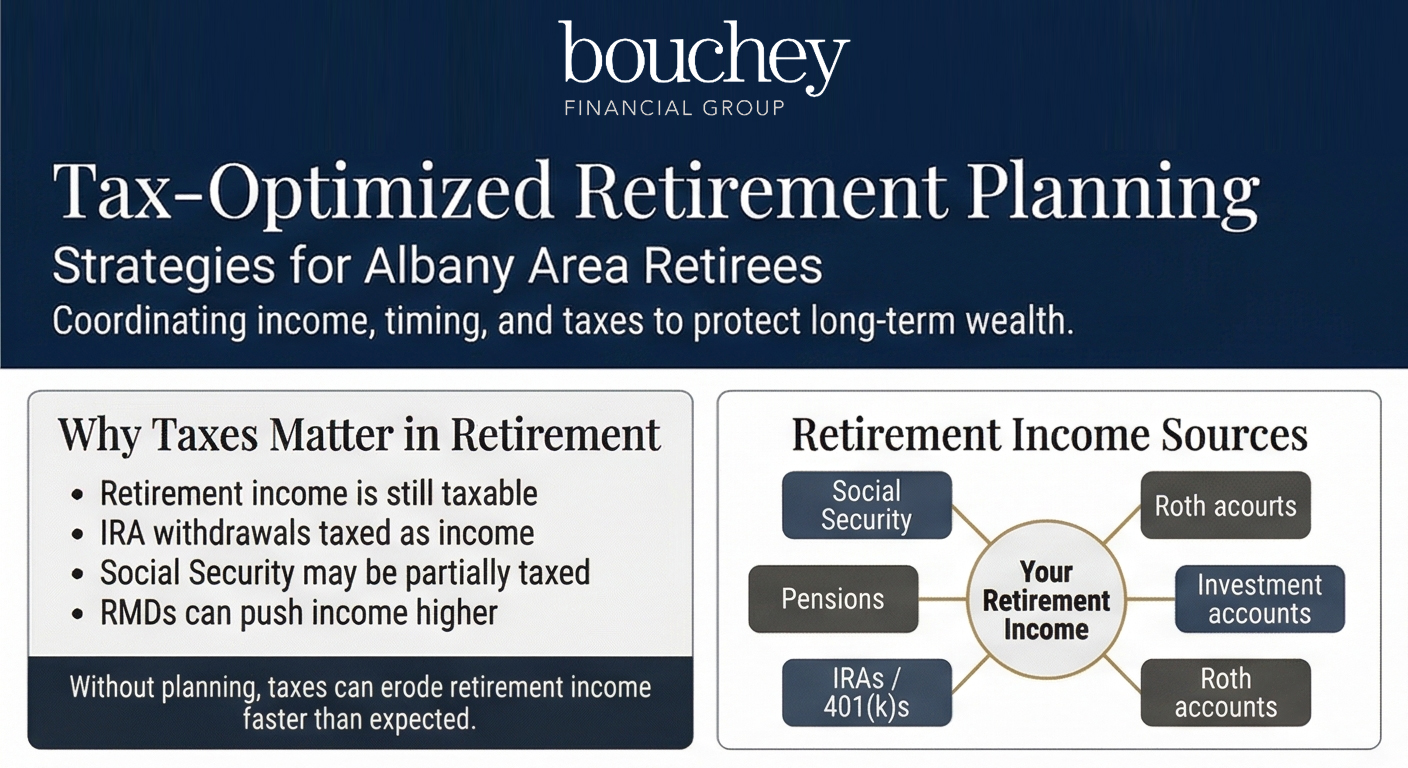
Most people entering retirement are surprised to find that their income is still heavily taxed — sometimes more than during their working years. Social Security can be partially taxable, IRA withdrawals are taxed as ordinary income, and RMDs can push retirees into higher brackets unexpectedly. The IRS tax information for retirees outlines how each income source is treated.
New York State adds another layer. While NY does not tax Social Security benefits, it does tax most IRA and 401(k) distributions — with a $20,000 exclusion available for qualified retirement income for those 59½ or older. For retirees with multiple income sources, coordinating those streams to stay within favorable brackets is an essential part of the plan.
New York Public Pensions and the Albany Advantage
Albany has a higher concentration of state government employees, SUNY faculty, and public sector workers than almost any other metro in the country. Many of these individuals retire with defined benefit pensions — and New York State is one of the few states that fully exempts New York State and local government pension income from state income tax.
That exemption changes the planning calculus significantly. For a retired state employee collecting a substantial pension, the tax burden may be lower than expected at the state level — but federal taxation still applies, and coordination with IRA distributions and Social Security timing becomes critical.
The Roth Conversion Window: A Planning Opportunity Most Miss

For many pre-retirees between ages 60 and 70, there exists a valuable planning window — the years between retirement and the start of Social Security and RMDs. During this period, income is often at its lowest, creating an opportunity to convert traditional IRA funds to a Roth IRA at reduced tax rates.
A Roth conversion means paying tax now at a known rate rather than later at an unknown, potentially higher rate. Future Roth withdrawals are tax-free and not subject to RMDs, which reduces the risk of forced distributions pushing retirees into higher brackets in their 70s and 80s. For Albany-area clients, this strategy must be modeled carefully against NY State income tax as well as federal brackets.
Filling the Tax Bracket Intentionally
One of the most effective — and underused — retirement tax strategies is deliberately filling lower tax brackets each year. Rather than withdrawing only what's needed, a coordinated plan identifies how much room exists below the next bracket threshold and draws additional income — through Roth conversions, capital gains harvesting, or IRA distributions — to use that space efficiently.
The IRS guide to retirement plans provides detailed guidance on account types, contribution rules, and distribution requirements that form the foundation of this kind of planning. Done consistently over several years, bracket-filling can meaningfully reduce lifetime tax exposure.
Social Security Timing and Tax Coordination
Claiming Social Security is one of the most consequential retirement decisions a person can make — and it's deeply intertwined with tax planning. Claiming at 62 reduces the monthly benefit permanently, while delaying to 70 increases it by 8% per year beyond full retirement age. The right answer depends on health, other income sources, and how Social Security interacts with taxable withdrawals.
Up to 85% of Social Security benefits are taxable federally depending on combined income. A poorly timed IRA withdrawal in the same year Social Security begins can trigger IRMAA — surcharges that increase Medicare Part B and D premiums. Avoiding IRMAA requires multi-year income projection, not just single-year tax preparation.
The Widow Tax Trap
One of the most significant and least-discussed retirement tax risks is what happens when one spouse dies. The surviving spouse loses one Social Security benefit, must file as a single taxpayer the following year, and faces compressed tax brackets — meaning the same income that was taxed at a lower rate for a married couple now faces higher rates. This is sometimes called the widow tax trap.
Planning for this scenario requires modeling retirement income under both two-person and one-person assumptions — adjusting withdrawal sequencing, Roth conversion timing, and life insurance coverage accordingly. It's a planning conversation that should happen well before it becomes urgent.
Tax-Efficient Withdrawal Sequencing
The order in which you draw from different account types has a significant impact on lifetime taxes. Tax-savvy retirement withdrawal strategies outline how sequencing withdrawals from taxable, tax-deferred, and tax-free accounts — rather than drawing from all simultaneously — can reduce tax drag and extend portfolio longevity.
A common framework draws from taxable accounts first, then tax-deferred accounts, with Roth funds preserved for later years when RMDs or other income sources push brackets higher. But the right sequence depends on individual circumstances — account balances, pension income, Social Security timing, and NY State tax treatment all factor in.
Tax-Advantaged Accounts and Their Role
Understanding the tax characteristics of each account type is foundational to this planning. The IRS guidance on retirement accounts and tax incentives explains how traditional and Roth IRAs differ in their tax treatment — contributions, growth, and distributions all carry different implications depending on account type.
For Albany-area clients with 403(b)s, deferred compensation plans, or multiple account types accumulated over a career in public service, coordinating these accounts requires careful sequencing that a generic online calculator simply cannot provide.
Annual Tax Planning: What Retirees Should Review Every Year
Retirement tax planning is not a one-time event. Income levels shift, tax laws change, and RMD amounts grow as account balances fluctuate. Kiplinger's year-end retirement tax planning moves outline key actions retirees should revisit each year — including RMD review, income timing, and tax-loss harvesting decisions.
At Bouchey Financial Group, this annual planning is built into the client relationship — not treated as an add-on. The firm's webinars and videos library includes dedicated content on year-end tax planning and retirement income strategy, updated regularly to reflect current rules and market conditions.
What Tax-Optimized Retirement Planning Costs When You Skip It
The value of coordinated retirement tax planning is most visible in the mistakes it prevents. An unplanned Roth conversion that crosses an IRMAA threshold can cost thousands in Medicare premiums. A poorly sequenced withdrawal that triggers a higher Social Security tax rate can erode income for years. An estate that arrives to heirs without Roth assets or a step-up in basis creates unnecessary tax burden for the next generation.
Managing those variables proactively, across multiple years and income sources, is precisely where a team of CFP professionals and CPAs delivers the most measurable value. The more complex your income picture, the more a coordinated plan pays for itself.
Start Building Your Tax-Optimized Retirement Plan
Retirement tax planning is most effective when it starts years before the first withdrawal. If you're approaching retirement — or already in it — and want a clearer picture of how to minimize taxes across your lifetime income, we'd welcome the conversation.
Schedule a free consultation with the Bouchey Financial Group team at our Troy or Saratoga Springs office. You can also find weekly retirement and tax planning insights on our Let's Talk Money page.
Frequently Asked Questions
Does New York State tax Social Security benefits?
No — New York State does not tax Social Security benefits, which is a meaningful advantage for retirees compared to many other states. However, federal taxation still applies depending on combined income, and up to 85% of benefits can be taxable at the federal level.
What is IRMAA and how do I avoid it?
IRMAA stands for Income-Related Monthly Adjustment Amount — a surcharge added to Medicare Part B and D premiums when income exceeds certain thresholds. It is triggered by income from two years prior, meaning a large Roth conversion or IRA withdrawal today can increase Medicare costs in the future. Multi-year income projections are essential to managing this exposure.
How does a Roth conversion affect my New York State taxes?
A Roth conversion is treated as ordinary income at both the federal and New York State level in the year it occurs. However, all future qualified withdrawals from the Roth account are tax-free at both levels. Modeling the break-even point — when future tax savings outweigh the upfront cost — is a key part of conversion planning.
What is the NY State pension income exclusion?
New York allows taxpayers age 59½ or older to exclude up to $20,000 of qualified pension and retirement income from state taxable income each year. New York State and local government pension income is fully exempt from state tax — a significant benefit for Albany-area public employees.
When is the best time to claim Social Security?
There is no single right answer — it depends on health, other income sources, spousal benefits, and tax planning goals. Delaying to age 70 maximizes the monthly benefit, but the optimal strategy must be coordinated with IRA withdrawals, Roth conversions, and Medicare premium thresholds to avoid unintended tax consequences.
What is the widow tax trap and how can I plan for it?
When a spouse dies, the survivor transitions from married filing jointly to single status — compressing tax brackets and raising the rate on the same income. Planning for this includes Roth conversions while both spouses are living, proper life insurance structuring, and withdrawal sequencing that reduces the surviving spouse's taxable income.
How often should my retirement tax plan be reviewed?
At minimum, annually — and any time a significant life event occurs, such as a change in income, a spouse's death, a pension decision, or new tax legislation. RMD amounts change each year, tax brackets adjust for inflation, and Medicare thresholds shift — all of which require ongoing plan updates rather than a set-it-and-forget-it approach.
IMPORTANT DISCLOSURE INFORMATION
Please remember that past performance is no guarantee of future results. Different types of investments involve varying degrees of risk, and there can be no assurance that the future performance of any specific investment, investment strategy, or product (including the investments and/or investment strategies recommended or undertaken by Bouchey Financial Group, Ltd. [“Bouchey Financial”]), or any non-investment related content, made reference to directly or indirectly in this blog will be profitable, equal any corresponding indicated historical performance level(s), be suitable for your portfolio or individual situation, or prove successful. Due to various factors, including changing market conditions and/or applicable laws, the content may no longer be reflective of current opinions or positions. Moreover, no portion of this discussion or information contained in this blog serves as the receipt of, or as a substitute for, personalized investment advice from Bouchey Financial. To the extent that a reader has any questions regarding the applicability of any specific issue discussed above to his/her individual situation, he/she is encouraged to consult with the professional advisor of his/her choosing. Neither Bouchey Financial’s investment adviser registration status, nor any amount of prior experience or success, should be construed that a certain level of results or satisfaction will be achieved if Bouchey Financial is engaged, or continues to be engaged, to provide investment advisory services. Bouchey Financial is neither a law firm nor a certified public accounting firm and no portion of the blog content should be construed as legal or accounting advice. A copy of the Bouchey Financial’s current written disclosure Brochure and Form CRS discussing our advisory services and fees is available for review upon request or at www.bouchey.com. Please Note: Bouchey Financial does not make any representations or warranties as to the accuracy, timeliness, suitability, completeness, or relevance of any information prepared by any unaffiliated third party, whether linked to Bouchey Financial’s web site or blog or incorporated herein, and takes no responsibility for any such content. All such information is provided solely for convenience purposes only and all users thereof should be guided accordingly. Please Remember: If you are a Bouchey Financial client, please contact Bouchey Financial, in writing, if there are any changes in your personal/financial situation or investment objectives for the purpose of reviewing/evaluating/revising our previous recommendations and/or services, or if you would like to impose, add, or to modify any reasonable restrictions to our investment advisory services. Unless, and until, you notify us, in writing, to the contrary, we shall continue to provide services as we do currently. Please Also Remember to advise us if you have not been receiving account statements (at least quarterly) from the account custodian.