
Equity Compensation Planning: Yes, the Stock Price Can Also Decline
Written by: Martin X. Shields, CFP®, AIF®
When I work with clients who receive equity compensation, three primary areas guide our conversations:
-
The investment opportunity within the equity holdings
-
The tax implications associated with those holdings
-
Mitigating risk tied to concentrated equity positions
The final area is often the most challenging. Many executives are passionate about their companies and naturally focus on upside potential. However, comprehensive equity compensation planning requires evaluating multiple scenarios, including those where stock prices decline.
For executives in Saratoga Springs and throughout the Capital Region, thoughtful planning around concentrated stock exposure is a critical component of long-term wealth management.
Concentration Risk and Equity Holdings
Planning discussions vary depending on:
-
The type of company
-
Current stock price and valuation
-
Price-to-earnings ratios
-
Size of the holding
-
Concentration risk
-
Career stage and position within the company
Given the complexity of stock options, restricted stock units (RSUs), and other equity compensation benefits, a structured and disciplined process can help executives pursue long-term financial success regardless of market direction.
At Bouchey Financial Group, an independent fiduciary wealth management firm serving Saratoga Springs and the greater Capital Region, we work with executives to align equity compensation planning with broader financial goals.
Learn more about our approach to wealth management here:
https://bouchey.com/our-services
Recent Examples Highlight the Importance of Planning
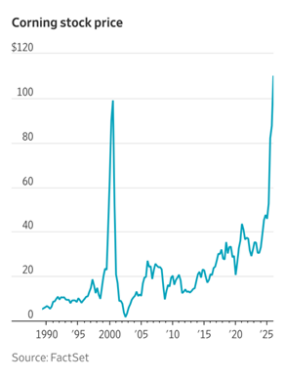
Two recent stock charts reinforce the need for disciplined planning.
Walmart (WMT)
Walmart’s stock has quadrupled over the past six years and increased sevenfold over the past ten years. Its current price-to-earnings ratio sits well above its historical average.
While Walmart has successfully evolved as a company, history shows that dramatic increases can sometimes be followed by extended periods of plateau or volatility. For individuals with significant equity compensation exposure, this may be an appropriate time to reassess allocation strategy.
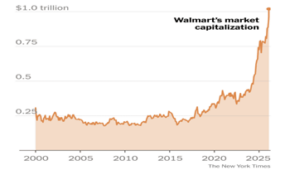
Selling shares at elevated valuations is often about risk mitigation rather than making a statement about the company’s future. A disciplined strategy allows investors to reduce concentration risk while maintaining long-term exposure.
Corning (GLW)
Corning has experienced strong demand driven by fiber production supporting AI data centers. The company is positioned well within a growing sector.
However, history demonstrates how quickly conditions can change. In the late 1990s, Corning saw similar demand during the expansion of internet infrastructure. After the technology bubble burst, the stock declined dramatically and did not reach new highs for many years.
This example illustrates an important principle of equity compensation planning: even strong companies operating in promising industries can experience substantial volatility.
For additional investor education on equity risk and market volatility, visit:
https://www.sec.gov
https://www.finra.org
The Broader Risk for Executives
Equity compensation risk is often compounded because an executive’s salary, bonuses, and future career trajectory are tied to the same company as their stock holdings.
When income, career, and investment assets are interconnected, concentration risk increases significantly.
While executives may understand many of the internal opportunities and risks within their organization, external variables such as industry disruption, regulatory change, or macroeconomic shifts remain outside their control.
These unknown risks are frequently the most consequential.
A Disciplined Approach to Equity Compensation Planning
Effective equity compensation planning is not about predicting stock prices. It is about:
-
Managing concentration risk
-
Integrating tax planning
-
Protecting long-term financial goals
-
Creating flexibility across market cycles
As a fiduciary wealth management firm serving executives throughout the Capital Region, Bouchey Financial Group emphasizes structured, scenario-based planning designed to support long-term financial stability.
Explore more insights here:
https://bouchey.com/insights-perspectives
Important Disclosure
This article is provided for informational purposes only and should not be considered investment advice or a recommendation to buy or sell any security. Investment decisions should be made based on individual circumstances and in consultation with qualified financial and tax professionals.

IMPORTANT DISCLOSURE INFORMATION
Please remember that past performance is no guarantee of future results. Different types of investments involve varying degrees of risk, and there can be no assurance that the future performance of any specific investment, investment strategy, or product (including the investments and/or investment strategies recommended or undertaken by Bouchey Financial Group, Ltd. [“Bouchey Financial”]), or any non-investment related content, made reference to directly or indirectly in this blog will be profitable, equal any corresponding indicated historical performance level(s), be suitable for your portfolio or individual situation, or prove successful. Due to various factors, including changing market conditions and/or applicable laws, the content may no longer be reflective of current opinions or positions. Moreover, no portion of this discussion or information contained in this blog serves as the receipt of, or as a substitute for, personalized investment advice from Bouchey Financial. To the extent that a reader has any questions regarding the applicability of any specific issue discussed above to his/her individual situation, he/she is encouraged to consult with the professional advisor of his/her choosing. Neither Bouchey Financial’s investment adviser registration status, nor any amount of prior experience or success, should be construed that a certain level of results or satisfaction will be achieved if Bouchey Financial is engaged, or continues to be engaged, to provide investment advisory services. Bouchey Financial is neither a law firm nor a certified public accounting firm and no portion of the blog content should be construed as legal or accounting advice. A copy of the Bouchey Financial’s current written disclosure Brochure and Form CRS discussing our advisory services and fees is available for review upon request or at www.bouchey.com. Please Note: Bouchey Financial does not make any representations or warranties as to the accuracy, timeliness, suitability, completeness, or relevance of any information prepared by any unaffiliated third party, whether linked to Bouchey Financial’s web site or blog or incorporated herein, and takes no responsibility for any such content. All such information is provided solely for convenience purposes only and all users thereof should be guided accordingly. Please Remember: If you are a Bouchey Financial client, please contact Bouchey Financial, in writing, if there are any changes in your personal/financial situation or investment objectives for the purpose of reviewing/evaluating/revising our previous recommendations and/or services, or if you would like to impose, add, or to modify any reasonable restrictions to our investment advisory services. Unless, and until, you notify us, in writing, to the contrary, we shall continue to provide services as we do currently. Please Also Remember to advise us if you have not been receiving account statements (at least quarterly) from the account custodian.