
November Market Insights: The Missing Jobs Report
Written by: Ryan Bouchey, Chief Investment Officer
I’ve been thinking a lot about the economy and, more specifically, the missing jobs reports from September and soon to be October. Many headlines over the past few weeks have included job cuts from major U.S. employers – Amazon slashing 34,000 jobs and almost 10% of their office workforce, UPS cutting 48,000 positions, and META cutting 20% of their AI division. Despite all of this, the market continues its rise. What’s driving this and should we be concerned?
More than ever, it would be helpful to get one piece of the economic puzzle to help fit into our overall review – and that’s jobs data. Remember, we had three months of slowing jobs, with some revisions even showing negative job growth back in June. Now with the Government shutdown fully in place, it looks like we could miss out on our second monthly jobs number. The positive in this trend is that from a high level, this feels more like a slow hiring / low firing environment, driven primarily by three forces: 1) AI trends; 2) Less workers due to a crackdown on the borders and 3) demographic trends. All of which we touched upon in our latest quarterly market update.
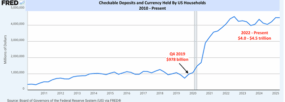
The rest of the economy, so far at least, seems to be doing quite well. Consumer spending continues its strength, earnings have been strong to very strong, and we continue to get an accommodative Fed which should continue to help stimulate economic growth. The other aspect of this, and why even a slowdown in jobs could be navigated within the markets, is the growth of wealth over the last five years. Take the following chart as an example for our chart of the week: checking account balances are up near FIVEFOLD since 2019 accounting for close to $4.5 Trillion in checkable deposits. This is a substantial increase, and while the markets feel like they are on a strong ride up, there is still plenty of cash on the sidelines which mirrors our assessment that we aren’t quite in the euphoric stages of a bull market.
*DataTrek
The St. Louis Fed posted an interesting research paper last week outlining how common it is to have job losses during an economic expansion. Over the course of the past 70 years, we’ve had 10 different economic expansions. Surprisingly, during these expansions we’ve averaged a 14% rate of job losses for the monthly payroll reports. So even with the negativity and potential for slowing job growth right now, it’s not uncommon to see actual jobs being lost while the economy continues to grow.
Only time will tell where we stand in the current environment, but there is enough good news out there to help substantiate a lot of what we’re seeing in the economy today. Even though we have experienced some volatility this week, we felt this may be the case given some short-term technical trends and underlying market data. Even in bull markets, the market averages a 14% intra-year decline annually, so short-term volatility is part of the price of being good long-term investors.
As always, if you have any questions or concerns, please contact an advisor to discuss your situation.
IMPORTANT DISCLOSURE INFORMATION
Please remember that past performance is no guarantee of future results. Different types of investments involve varying degrees of risk, and there can be no assurance that the future performance of any specific investment, investment strategy, or product (including the investments and/or investment strategies recommended or undertaken by Bouchey Financial Group, Ltd. [“Bouchey Financial”]), or any non-investment related content, made reference to directly or indirectly in this blog will be profitable, equal any corresponding indicated historical performance level(s), be suitable for your portfolio or individual situation, or prove successful. Due to various factors, including changing market conditions and/or applicable laws, the content may no longer be reflective of current opinions or positions. Moreover, no portion of this discussion or information contained in this blog serves as the receipt of, or as a substitute for, personalized investment advice from Bouchey Financial. To the extent that a reader has any questions regarding the applicability of any specific issue discussed above to his/her individual situation, he/she is encouraged to consult with the professional advisor of his/her choosing. Neither Bouchey Financial’s investment adviser registration status, nor any amount of prior experience or success, should be construed that a certain level of results or satisfaction will be achieved if Bouchey Financial is engaged, or continues to be engaged, to provide investment advisory services. Bouchey Financial is neither a law firm nor a certified public accounting firm and no portion of the blog content should be construed as legal or accounting advice. A copy of the Bouchey Financial’s current written disclosure Brochure and Form CRS discussing our advisory services and fees is available for review upon request or at www.bouchey.com. Please Note: Bouchey Financial does not make any representations or warranties as to the accuracy, timeliness, suitability, completeness, or relevance of any information prepared by any unaffiliated third party, whether linked to Bouchey Financial’s web site or blog or incorporated herein, and takes no responsibility for any such content. All such information is provided solely for convenience purposes only and all users thereof should be guided accordingly. Please Remember: If you are a Bouchey Financial client, please contact Bouchey Financial, in writing, if there are any changes in your personal/financial situation or investment objectives for the purpose of reviewing/evaluating/revising our previous recommendations and/or services, or if you would like to impose, add, or to modify any reasonable restrictions to our investment advisory services. Unless, and until, you notify us, in writing, to the contrary, we shall continue to provide services as we do currently. Please Also Remember to advise us if you have not been receiving account statements (at least quarterly) from the account custodian.