
Now You Too Can Expect Fiduciary Guidance on Your Retirement!

Written by: Nicole Gobel CPA, CDFA
Is your advisor a fiduciary? Do you know whether the advice you’re being given around retirement is in your best interest? A new Department of Labor rule was recently released that aims to protect many more individuals from conflicts of interest.
- What is a fiduciary?
- How has the Retirement Security Rule changed who is held to this standard?
- Why is this important to me?
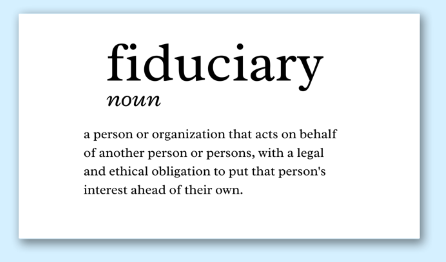
What is a fiduciary?
The term fiduciary is used to define a number of roles across multiple industries. The underlying theme is the relationship is one of trust between the individual acting as the fiduciary to the end client or beneficiary.
As part of a registered investment advisory firm here at Bouchey Financial Group, each of our team members must act in our clients’ best interest rather than our own. Taking this a step further, a fee-only financial advisor eliminates any conflicts of interest by not selling any products or receiving any commissions. For those of us that may have earned professional designations such as a Certified Public Accountant license or Certified Financial Planner(tm) certification we are also individually held to a specific ethical code to retain that credential. Therefore, each of the advisors on our team is held to these three layers of conduct that produce the best outcomes for our clients.
However, not all “advisors” are held to this same standard and many are only required to sell products or services that are considered “suitable” to the end client. This can result in individuals purchasing expensive products with up-front commissions, high fees and lock-up periods that they may not fully understand. This can result in disastrous results for an individual’s retirement.
How has the new rule changed who is held to this standard?
You may recall in 2016 there was an attempt to hold many more financial professionals to the higher fiduciary standard, but many financial professionals fought against this rule that never passed. The intention of the new Retirement Security Rule, set to be effective September 23rd of this year, is to define who is a fiduciary for the purpose of investment advice under the Employee Retirement Income Security Act (ERISA).
Per the Department of Labor a financial services provider will be considered an investment advice fiduciary if:
- The provider makes an investment recommendation to a retirement investor;
- The recommendation is provided for a fee or other compensation, such as commissions; and
- The financial services provider holds itself out as a trusted advisor by
- Specifically stating that it is acting as a fiduciary under Title I or II of ERISA; or
- Making the recommendation in a way that would indicate to a reasonable investor that it is acting as a trusted advisor making individualized recommendations based on the investor’s best interest.(1)
The new rule and updated list of prohibited transaction exemptions will protect investors by requiring investment professionals to follow fiduciary standards of care when making investment recommendations related to retirement as outlined below.
- Meet a professional standard of care when making recommendations (give prudent advice);
- Never put their financial interests ahead of the retirement investor's when making recommendations (give loyal advice);
- Avoid misleading statements about conflicts of interest, fees, and investments;
- Charge no more than what is reasonable for their services; and
- Give the retirement investor basic information about the adviser's conflicts of interest.
One very important feature of the new regulation is its’ effect on one-time advice. Previously an “advisor” could make a recommendation to roll over assets from an employer retirement plan to an IRA or an annuity and not be held to the fiduciary standard. The new rule covers this one-time transaction with the goal that the end result of those funds, whether an annuity or investments within the receiving IRA would also be in the clients’ best interest.
Why is this important to me?
Workplace retirement accounts are often the largest savings an individual has amassed to support themselves later in life. When making a pivotal decision such as rolling over a retirement plan into an IRA or an annuity it is important to work with someone who will make recommendations that are right for the person and situation. Whether this affects you personally or someone you care about, The Retirement Security Rule holds more investment professionals, such as broker-dealers and insurance agents, to the higher fiduciary standard during this process.
As an advisor holding the Certified Public Accountant (CPA) and Certified Divorce Financial Analyst (CDFA) designations I know that I am personally providing my clients with guidance that is in their best interest. Belonging to a fee-only registered investment advisory firm I take pride in the fact that all of my colleagues are also held to this standard along with their own professional designations. I take comfort that the Retirement Security Rule will allow more individuals, that may not have the opportunity to work with advisors in our position, to still be able to receive recommendations that are in their best interest.
Moving our financial profession forward in an ethical and fair manner is the right course of action. We want to attract more individuals into our industry that are here for the right reasons, to help people achieve their financial goals and help those they care about. If you have questions and would like to discuss what it means to be fiduciary, please reach out to the team at Bouchey Financial Group.
Bouchey Financial Group has offices in Saratoga Springs and Historic Downtown Troy, NY as well as Boston, MA and Jupiter, FL.
*(1) Footnote
-
In the specific words of the rule, the investment professional meets this test with respect to a compensated recommendation if the provider "makes professional investment recommendations to investors on a regular basis as part of their business and the recommendation is made under circumstances that would indicate to a reasonable investor in like circumstances that the recommendation is based on review of the retirement investor's particular needs or individual circumstances, reflects the application of professional or expert judgment to the retirement investor's particular needs or individual circumstances, and may be relied upon by the retirement investor as intended to advance the retirement investor's best interest[.]"
IMPORTANT DISCLOSURE INFORMATION
Please remember that past performance is no guarantee of future results. Different types of investments involve varying degrees of risk, and there can be no assurance that the future performance of any specific investment, investment strategy, or product (including the investments and/or investment strategies recommended or undertaken by Bouchey Financial Group, Ltd. [“Bouchey Financial”]), or any non-investment related content, made reference to directly or indirectly in this blog will be profitable, equal any corresponding indicated historical performance level(s), be suitable for your portfolio or individual situation, or prove successful. Due to various factors, including changing market conditions and/or applicable laws, the content may no longer be reflective of current opinions or positions. Moreover, no portion of this discussion or information contained in this blog serves as the receipt of, or as a substitute for, personalized investment advice from Bouchey Financial. To the extent that a reader has any questions regarding the applicability of any specific issue discussed above to his/her individual situation, he/she is encouraged to consult with the professional advisor of his/her choosing. Neither Bouchey Financial’s investment adviser registration status, nor any amount of prior experience or success, should be construed that a certain level of results or satisfaction will be achieved if Bouchey Financial is engaged, or continues to be engaged, to provide investment advisory services. Bouchey Financial is neither a law firm nor a certified public accounting firm and no portion of the blog content should be construed as legal or accounting advice. A copy of the Bouchey Financial’s current written disclosure Brochure and Form CRS discussing our advisory services and fees is available for review upon request or at www.bouchey.com. Please Note: Bouchey Financial does not make any representations or warranties as to the accuracy, timeliness, suitability, completeness, or relevance of any information prepared by any unaffiliated third party, whether linked to Bouchey Financial’s web site or blog or incorporated herein, and takes no responsibility for any such content. All such information is provided solely for convenience purposes only and all users thereof should be guided accordingly. Please Remember: If you are a Bouchey Financial client, please contact Bouchey Financial, in writing, if there are any changes in your personal/financial situation or investment objectives for the purpose of reviewing/evaluating/revising our previous recommendations and/or services, or if you would like to impose, add, or to modify any reasonable restrictions to our investment advisory services. Unless, and until, you notify us, in writing, to the contrary, we shall continue to provide services as we do currently. Please Also Remember to advise us if you have not been receiving account statements (at least quarterly) from the account custodian.