
Hudson Valley Wealth Management | Serving NY & New England
For individuals and families in the Hudson Valley, finding the right wealth management firm means finding one that understands your financial life in full — not just your investment account. Bouchey Financial Group is an independent, SEC Registered Investment Advisor serving clients across New York and New England with fee-only, fiduciary wealth management built around each client's specific goals and circumstances.
Whether you are a business owner planning an exit, a family navigating multi-generational wealth, or a professional managing New York's demanding tax environment, this guide will help you evaluate your options and find the right fit with confidence.
What a Fee-Only Fiduciary RIA Actually Means
Not every wealth manager is held to the same standard — and the structure of a firm has a direct impact on the advice you receive. SEC statutes and regulations governing Registered Investment Advisers establish a fiduciary standard that requires advisors to act in the client's best interest at all times — not just when it is convenient.
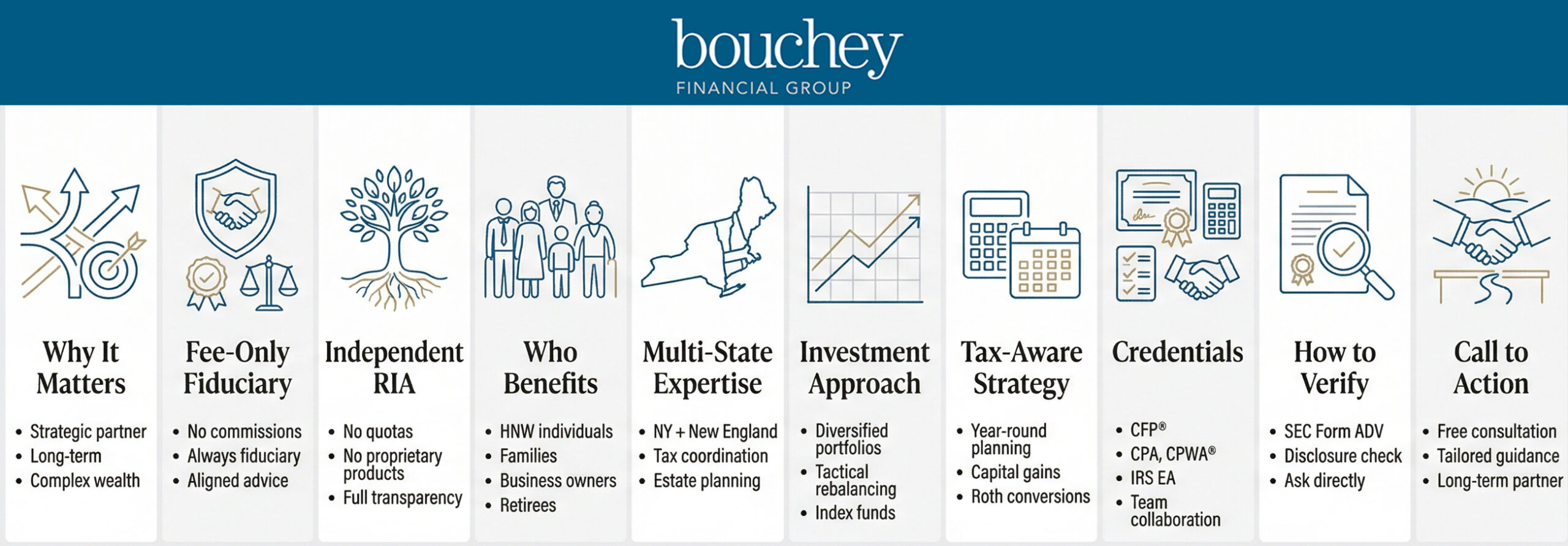
Fee-only means the firm earns no commissions, no referral fees, and no third-party compensation of any kind. Every recommendation is made purely in the client's interest with no financial incentive to steer you toward any particular product or strategy.
Independent RIA vs. Wirehouse: Why It Matters
National wirehouses operate under a different regulatory framework — one with more room for conflicts of interest. An independent RIA has no proprietary products to sell and no corporate quotas driving advice.
The SEC's Division of Investment Management oversees regulatory policy for investment advisers, ensuring RIAs are held to investor-protection rules that broker-dealers are not required to follow. That structural difference is not a technicality — it shapes every recommendation your advisor makes.
How the Regulatory Framework Protects You
A U.S. Treasury risk assessment of the investment adviser sector highlights why government-level oversight matters — identifying the risks that arise when advisory firms operate without adequate accountability. Firms that meet RIA standards and maintain strong compliance programs are operating within a framework specifically designed to protect clients.
The SEC's modernized marketing rule for investment advisers also governs how firms represent their services — meaning any credible RIA must be accurate and transparent in how it describes its offerings. Firms subject to anti-money laundering compliance standards demonstrate an additional layer of accountability that serious investors should look for when vetting any firm.
Who This Type of Firm Serves Best
Fee-only fiduciary wealth management is designed for those with complex financial lives who need more than a quarterly statement. Bouchey Financial Group's client focus includes high-net-worth individuals, business owners, multi-generational families, retirees, and professionals navigating significant wealth transitions.
The firm also manages assets for institutions and nonprofits through its Endowments & Foundations practice, and serves businesses through 401(k) and 403(b) plan management — fulfilling fiduciary obligations to plan participants.
Who This Is Not the Right Fit For
Transparency about fit is itself a sign of a credible firm. Fee-only fiduciary management is not well-suited for investors who prefer to self-direct without advisory input, those seeking commission-based product recommendations, or those whose financial situation does not yet require comprehensive planning.
High-net-worth clients benefit most when they are seeking a long-term strategic partner — not a transactional relationship. If that is what you are looking for, the structure and approach of an independent RIA is likely the right match.
The Hudson Valley and New York Financial Landscape
New York presents a financial planning environment unlike most states. The state estate tax threshold sits well below the federal exemption, which means families with moderate wealth can face meaningful state estate tax liability that proactive planning can significantly reduce.
SALT deduction limitations, high property taxes, and New York's income tax structure add further complexity for Hudson Valley residents — particularly those with income from business ownership, equity compensation, or investment portfolios.
Multi-State Planning for NY and New England Clients
Many Hudson Valley families have financial ties that cross state lines — whether through second homes in Connecticut or Vermont, business interests in Massachusetts, or family members in multiple states. Each state carries its own tax treatment, estate rules, and filing requirements.
Bouchey Financial Group serves clients across 34 states, bringing experience with multi-state tax coordination, residency planning, and wealth transfer strategies that apply directly to the New York and New England region.
Investment Philosophy for Hudson Valley Investors
Vague statements about "customized portfolios" do not answer the questions serious investors are asking. Bouchey Financial Group's investment management approach begins with broad strategic diversification across global asset classes — building portfolios designed to maximize risk-adjusted returns over the long term.
Tactical rebalancing based on valuation — systematically buying undervalued asset classes and trimming overvalued ones — adds discipline that goes beyond passive indexing. Index funds are used for the majority of holdings to minimize expense drag, and the firm's trading platform allows many transactions at no cost to clients.
Tax-Aware Investing Throughout the Year
For New York investors facing elevated state and local tax rates, investment decisions cannot be separated from tax strategy. Bouchey Financial Group's in-house CPAs and CFP® professionals coordinate portfolio decisions with tax planning year-round — not just at filing time.
This integration covers capital gains management, Roth conversion planning, charitable giving strategy, and estate planning coordination — all delivered by a team that includes nine CFP® professionals, three CPAs, and one IRS Enrolled Agent working together on each client's behalf.
What Working With Bouchey Financial Group Actually Looks Like
The process begins before any investment is made. Every new client relationship starts with a comprehensive discovery phase — understanding income needs, time horizon, tax situation, risk tolerance, and long-term goals before a single recommendation is offered.
From there, a detailed financial plan is built, reviewed with the client, and used as the foundation for all ongoing investment and planning decisions. Clients receive proactive communication, regular portfolio reviews, and direct access to the advisors managing their accounts — not a call center.
Credentials and Track Record
Bouchey Financial Group has been advising clients since 1990, managing over $1.6 billion in assets for clients across the country. The full advisory team brings together CFP® professionals, CPAs, a Certified Private Wealth Advisor®, and an Accredited Investment Fiduciary® — all focused on one outcome: each client's long-term financial success.
Verified client reviews are published through Wealthtender, an independent third-party platform where clients voluntarily share their experiences. This level of transparency reflects a firm culture built on accountability — a standard you can explore further through the firm's client testimonials and webinar library.
Start the Conversation on Your Terms
If you are a Hudson Valley or New England investor ready to work with a fee-only fiduciary team that understands the New York financial landscape, the next step is a conversation — not a commitment. Contact Bouchey Financial Group to schedule a free consultation and find out whether the firm is the right fit for your goals, your family, and your financial future.
You can also tune in to Let's Talk Money with Steven Bouchey every Saturday at 10:00am and Sunday at 8:00am on News Talk Radio 810AM and 103.1FM WGY for ongoing insight into wealth management, tax strategy, and investing.
Frequently Asked Questions
How does New York's estate tax affect Hudson Valley families differently than the federal estate tax?
New York's exemption threshold is considerably lower than the federal exemption, and the state applies a "cliff" that eliminates the exemption entirely once an estate exceeds a certain threshold — making proactive planning especially critical for NY residents.
What is the difference between an independent RIA and a wirehouse advisor?
An independent RIA has no proprietary products, no internal sales quotas, and a fiduciary obligation to act in the client's interest at all times. Wirehouse advisors operate within structures that may incentivize certain product recommendations over others.
How does working with an in-house CPA differ from a referral-based model?
When tax professionals work within the same firm as your investment advisors, planning decisions are coordinated in real time. Referral-based models rely on two separate firms communicating, which can create gaps around capital gains, Roth conversions, and business transactions.
What should Hudson Valley business owners look for before planning a business exit?
Look for a firm with in-house tax expertise, experience with liquidity events, and a process that begins planning well before the transaction closes — including timing strategies for capital gains and integration with your broader retirement plan.
How does multi-state residency affect wealth management for NY and New England clients?
Each state carries its own income tax rates, estate tax rules, and domicile requirements. Clients with ties to multiple states need a wealth manager experienced in navigating those overlapping frameworks to avoid unintended tax exposure.
What does "tax-aware investing" mean in practice for a high-income New York investor?
Every portfolio decision — from asset location to rebalancing to loss harvesting — is evaluated through the lens of your tax situation. For NY investors facing combined federal and state rates that can exceed 50%, coordinating investment and tax strategy at the firm level is essential.
How often should I expect to meet with my wealth management team?
At minimum, a comprehensive annual review covering your financial plan, portfolio, and tax planning updates. Quality firms also reach out proactively around life events, market changes, and planning opportunities — not just on a fixed schedule.
IMPORTANT DISCLOSURE INFORMATION
Please remember that past performance is no guarantee of future results. Different types of investments involve varying degrees of risk, and there can be no assurance that the future performance of any specific investment, investment strategy, or product (including the investments and/or investment strategies recommended or undertaken by Bouchey Financial Group, Ltd. [“Bouchey Financial”]), or any non-investment related content, made reference to directly or indirectly in this blog will be profitable, equal any corresponding indicated historical performance level(s), be suitable for your portfolio or individual situation, or prove successful. Due to various factors, including changing market conditions and/or applicable laws, the content may no longer be reflective of current opinions or positions. Moreover, no portion of this discussion or information contained in this blog serves as the receipt of, or as a substitute for, personalized investment advice from Bouchey Financial. To the extent that a reader has any questions regarding the applicability of any specific issue discussed above to his/her individual situation, he/she is encouraged to consult with the professional advisor of his/her choosing. Neither Bouchey Financial’s investment adviser registration status, nor any amount of prior experience or success, should be construed that a certain level of results or satisfaction will be achieved if Bouchey Financial is engaged, or continues to be engaged, to provide investment advisory services. Bouchey Financial is neither a law firm nor a certified public accounting firm and no portion of the blog content should be construed as legal or accounting advice. A copy of the Bouchey Financial’s current written disclosure Brochure and Form CRS discussing our advisory services and fees is available for review upon request or at www.bouchey.com. Please Note: Bouchey Financial does not make any representations or warranties as to the accuracy, timeliness, suitability, completeness, or relevance of any information prepared by any unaffiliated third party, whether linked to Bouchey Financial’s web site or blog or incorporated herein, and takes no responsibility for any such content. All such information is provided solely for convenience purposes only and all users thereof should be guided accordingly. Please Remember: If you are a Bouchey Financial client, please contact Bouchey Financial, in writing, if there are any changes in your personal/financial situation or investment objectives for the purpose of reviewing/evaluating/revising our previous recommendations and/or services, or if you would like to impose, add, or to modify any reasonable restrictions to our investment advisory services. Unless, and until, you notify us, in writing, to the contrary, we shall continue to provide services as we do currently. Please Also Remember to advise us if you have not been receiving account statements (at least quarterly) from the account custodian.