
Best Wealth Management Firms Boston | Fee-Only Fiduciary RIA
Selecting a wealth management firm in Boston is one of the most consequential financial decisions you will make. For executives, business owners, and families managing significant assets, the right firm is not just a service provider — it is a long-term strategic partner.
Bouchey Financial Group is an independent, SEC Registered Investment Advisor serving Boston-area clients with fee-only, fiduciary wealth management built around each client's unique financial picture. This guide breaks down what separates a true fee-only fiduciary RIA from the rest and how to find the right fit for your situation.
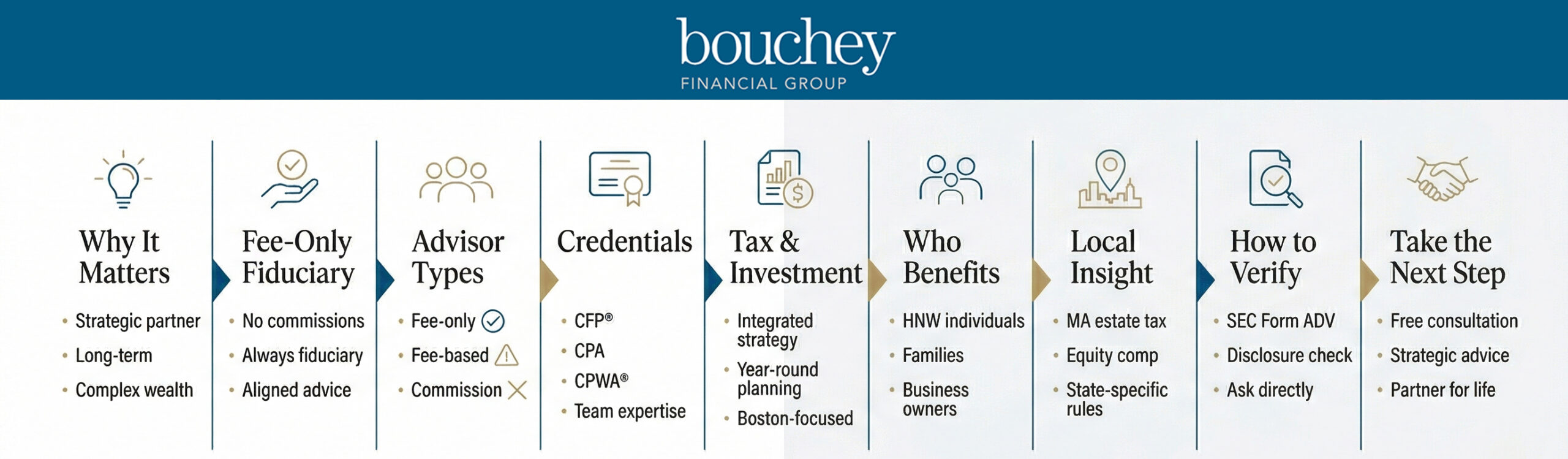
What Makes a Firm a True Fee-Only Fiduciary RIA
The terms "fee-only" and "fiduciary" are used widely in wealth management — but not always accurately. Under U.S. law, Registered Investment Advisers must comply with federal fiduciary obligations outlined by the SEC, governing their conduct and duties to clients at all times.
The SEC's official interpretation of the fiduciary standard confirms this duty includes both a duty of care — recommending what is genuinely best — and a duty of loyalty — eliminating or disclosing conflicts of interest. Fee-only means no commissions, no product sales, and no third-party compensation of any kind.
How Adviser Standards Are Enforced
RIAs are regulated at the federal and state level depending on the size of assets they manage. The NASAA Investment Adviser Guide outlines how advisers are defined and licensed at the state level — relevant for Boston clients navigating Massachusetts-specific requirements.
Beyond regulatory duty, RIAs are also held to professional ethical standards. The Investment Adviser Association's Standards of Practice define obligations including care, loyalty, and honesty — the benchmark that distinguishes quality RIAs from the broader advisory market.
Fee-Only vs. Fee-Based vs. Commission-Based: Know the Difference
Not all advisors are structured the same way, and the differences have real consequences for your portfolio. The table below clarifies the three most common compensation models:
| Compensation Model | How the Advisor Is Paid | Fiduciary Standard? |
| Fee-Only | Solely by the client — flat fee or % of AUM | ✅ Always |
| Fee-Based | Client fee + commissions on products sold | ⚠️ Sometimes |
| Commission-Based | Entirely through product sales | ❌ Suitability only |
Fee-based advisors may appear similar to fee-only on the surface, but the ability to earn commissions introduces conflicts that a true fee-only structure eliminates entirely. Always ask directly — and verify the answer in Form ADV.
How to Verify a Firm's Credentials Before You Commit
Verifying a firm's credentials should happen before any conversation goes further. The SEC's public database of registered investment advisers publishes Form ADV filings for all registered RIAs, disclosing compensation structure, services offered, and any disciplinary history.
Reviewing Form ADV Part 2 tells you exactly how the firm is compensated and where potential conflicts exist. A fee-only firm will show no commission-based compensation in this document — if it does, the firm is fee-based, not fee-only.
Questions to Ask Before Hiring Any Wealth Manager
Not all advisors are forthcoming about structure unless directly asked. These questions cut through ambiguity quickly:
- Are you a fiduciary 100% of the time — not just during certain services?
- Do you or your firm receive any compensation from third parties or fund companies?
- Are all team members who advise me CFP® professionals or credentialed specialists?
- Who specifically will manage my account day to day, and what are their qualifications?
What Sets a High-Quality Firm Apart
Credentials matter. The strongest wealth management firms employ CERTIFIED FINANCIAL PLANNER™ professionals, CPAs, and other specialists working as an integrated team. Bouchey Financial Group's advisory team includes nine CFP® professionals, three CPAs, one IRS Enrolled Agent, and one Certified Private Wealth Advisor® — all collaborating on each client's financial picture.
Years in business and depth of client relationships are equally telling. A firm managing over $1.6 billion across 34 states, with relationships spanning decades, signals a level of trust that marketing language alone cannot manufacture.
Investment Philosophy and Tax Integration
Boston investors — many working in biotech, finance, technology, and academia — expect evidence-based, institutionally disciplined investment management. The most effective firms combine strategic asset allocation with ongoing tax coordination as a unified approach, not two separate services.
Bouchey Financial Group's investment management process integrates tax planning directly into portfolio strategy. With in-house CPAs and tax planners, decisions around Roth conversions, equity compensation, and capital gains management are coordinated year-round — not addressed only at tax season.
Who This Type of Firm Serves Best
Fee-only fiduciary wealth management is designed for individuals and families with complex financial lives — those who need more than an investment account and a quarterly statement. Bouchey Financial Group's client focus includes high-net-worth individuals, business owners, multi-generational families, and those navigating retirement.
The firm also serves institutions through its Endowments & Foundations practice and provides 401(k) and 403(b) plan management for businesses seeking to fulfill their fiduciary obligations to employees.
Who This Is Not the Right Fit For
Transparency about fit is itself a sign of a trustworthy firm. Fee-only fiduciary management is not well-suited for every investor — and the best firms are honest about that.
This model is generally not the right match for investors who prefer to self-direct portfolios without advisory input, those who value commission-based product recommendations, or those whose financial situation does not yet require comprehensive planning. High-net-worth clients benefit most when seeking a long-term partner, not a transactional relationship.
Local Expertise in the Boston and Massachusetts Market
Massachusetts carries unique financial planning considerations that national firms may not fully address. The state's estate tax threshold, high cost of living, concentration of equity compensation in tech and life sciences, and specific income tax treatment all affect how wealth is built, managed, and transferred.
Bouchey Financial Group has a Boston-area office and serves clients throughout Massachusetts with the same comprehensive, fiduciary approach that has guided clients since 1995 — bringing local knowledge of the Massachusetts tax and financial landscape to every client relationship.
How to Evaluate a Firm's Track Record and Credibility
Credentials and regulatory status are the floor, not the ceiling. Beyond Form ADV, look for signs that a firm is genuinely embedded in its clients' financial lives over the long term. How long has the firm been in business? Does it publish educational content consistently? Are its advisors visible in the community and media?
Bouchey Financial Group has been advising clients since 1990 and managing assets as a registered firm since 1995. Founder Steven Bouchey shares financial insights every weekend on Let's Talk Money on News Talk Radio 810AM and 103.1FM WGY — a decades-long commitment to client education that extends well beyond office hours.
Third-Party Reviews and Transparency Signals
Client reviews published through independent platforms add another layer of accountability. Bouchey Financial Group publishes verified client feedback through Wealthtender, a third-party review platform where clients voluntarily share their experiences. This level of transparency is a meaningful trust signal in an industry where feedback is often hidden.
Regular webinars, market updates, and tax planning resources — accessible through the firm's Webinars & Videos library — further demonstrate a firm culture built around keeping clients informed, not dependent.
Start With a Conversation, Not a Commitment
If you are evaluating wealth management firms in the Boston area and want to speak with a fee-only fiduciary team managing over $1.6 billion for clients across the country, the next step is simple. Contact Bouchey Financial Group to schedule a free consultation and find out whether the firm is the right fit for your goals and financial life.
The right firm will not pressure you. It will educate you, answer your questions directly, and let the quality of its process speak for itself.
Frequently Asked Questions
What is the difference between a fee-only and fee-based wealth manager?
Fee-only advisors are compensated solely by their clients — no commissions, no product incentives, no third-party payments. Fee-based advisors charge a client fee but may also earn commissions on products they recommend, creating conflicts that fee-only structures eliminate by design.
How do I verify that a Boston wealth management firm is a registered RIA?
Search any firm through the SEC's public adviser database and review its Form ADV disclosures. Form ADV Part 2 details compensation structure, services, and disciplinary history — all publicly available before you engage a single conversation.
What credentials should I look for in a Boston wealth management team?
The CFP® designation is the baseline for comprehensive financial planning. Additional credentials such as CPA for tax planning, CPWA® for complex wealth strategies, and AIF® for fiduciary investment oversight signal a team equipped for multi-dimensional financial needs.
Does a fiduciary advisor have to disclose conflicts of interest?
Yes — the SEC's fiduciary standard requires advisors to either eliminate conflicts or fully disclose them. Fee-only advisors eliminate the most common conflict — product-based compensation — by design. Any remaining conflicts must appear in Form ADV.
What makes Boston a distinct market for wealth management?
Massachusetts has its own estate tax with a lower threshold than the federal exemption, a high concentration of equity compensation from biotech and tech employers, and above-average income and cost of living. These factors make state-aware tax planning and equity compensation strategy especially important for Boston-area investors.
How is a fiduciary RIA different from a broker-dealer?
A broker-dealer is held to a suitability standard — recommendations must be appropriate, but not necessarily optimal. A fiduciary RIA is held to a higher legal standard requiring every recommendation to serve the client's best interest. The two operate under fundamentally different regulatory frameworks.
What should I look for in a firm's Form ADV before hiring a wealth manager?
Focus on Part 2 for services, compensation structure, and conflicts of interest. Confirm no commission-based compensation is listed if the firm claims to be fee-only. Review Part 1 for any disciplinary disclosures, and verify the firm's registration status is current and active.
IMPORTANT DISCLOSURE INFORMATION
Please remember that past performance is no guarantee of future results. Different types of investments involve varying degrees of risk, and there can be no assurance that the future performance of any specific investment, investment strategy, or product (including the investments and/or investment strategies recommended or undertaken by Bouchey Financial Group, Ltd. [“Bouchey Financial”]), or any non-investment related content, made reference to directly or indirectly in this blog will be profitable, equal any corresponding indicated historical performance level(s), be suitable for your portfolio or individual situation, or prove successful. Due to various factors, including changing market conditions and/or applicable laws, the content may no longer be reflective of current opinions or positions. Moreover, no portion of this discussion or information contained in this blog serves as the receipt of, or as a substitute for, personalized investment advice from Bouchey Financial. To the extent that a reader has any questions regarding the applicability of any specific issue discussed above to his/her individual situation, he/she is encouraged to consult with the professional advisor of his/her choosing. Neither Bouchey Financial’s investment adviser registration status, nor any amount of prior experience or success, should be construed that a certain level of results or satisfaction will be achieved if Bouchey Financial is engaged, or continues to be engaged, to provide investment advisory services. Bouchey Financial is neither a law firm nor a certified public accounting firm and no portion of the blog content should be construed as legal or accounting advice. A copy of the Bouchey Financial’s current written disclosure Brochure and Form CRS discussing our advisory services and fees is available for review upon request or at www.bouchey.com. Please Note: Bouchey Financial does not make any representations or warranties as to the accuracy, timeliness, suitability, completeness, or relevance of any information prepared by any unaffiliated third party, whether linked to Bouchey Financial’s web site or blog or incorporated herein, and takes no responsibility for any such content. All such information is provided solely for convenience purposes only and all users thereof should be guided accordingly. Please Remember: If you are a Bouchey Financial client, please contact Bouchey Financial, in writing, if there are any changes in your personal/financial situation or investment objectives for the purpose of reviewing/evaluating/revising our previous recommendations and/or services, or if you would like to impose, add, or to modify any reasonable restrictions to our investment advisory services. Unless, and until, you notify us, in writing, to the contrary, we shall continue to provide services as we do currently. Please Also Remember to advise us if you have not been receiving account statements (at least quarterly) from the account custodian.