
Wealth Management Near Norwood MA | Boston Metro Fee-Only Advisors
Finding a wealth manager in the Norwood area shouldn’t feel like navigating a high-pressure sales pitch. While the Route 1 and I-95 corridors are home to incredible financial success, the local market is also crowded with complex financial products—and advisors eager to sell them. For high-earning professionals and families in the Boston Metro, securing truly objective advice means looking for a critical distinction: a 100% fee-only fiduciary.
As an independent Registered Investment Advisor (RIA) managing over $1.6 billion in assets, our integrated team of 9 CERTIFIED FINANCIAL PLANNER™ professionals and 3 CPAs is built to solve your complex tax, estate, and investment challenges with absolute transparency. We operate under a simple premise: our clients pay us, and no one else does.
What "Fee-Only" Means
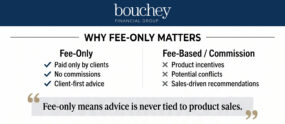
By NAPFA standards, a fee-only advisor is compensated solely by the client, with neither the advisor nor any related party receiving compensation contingent on the purchase or sale of a financial product. No commissions, no 12b-1 fees, no referral payments, no insurance rebates.
This matters because most financial professionals are not fee-only. Many operate on a fee-based model, collecting both client fees and third-party commissions—which creates compensation incentives that can influence which products get recommended.
Fee-Only vs. Fee-Based vs. Commission: What's the Difference
The distinction between these three compensation structures has real consequences for the advice a client receives:
| Model | How the Advisor Is Paid | Conflict of Interest |
| Fee-only | Client fees only (AUM %, flat, or hourly) | Lowest — no product incentives |
| Fee-based | Client fees + product commissions | Moderate — dual compensation creates bias risk |
| Commission-based | Product sales only | Highest — advice tied directly to sales revenue |
Bouchey Financial Group operates exclusively under the fee-only model. Every recommendation is evaluated against client interests, not product revenue.
Why Boston-Metro Households Specifically Seek Fee-Only Advisors
Fee-only structure and fiduciary duty go together. As the SEC's guidance on investment adviser standards makes clear, registered investment advisers owe clients both a duty of care. recommendations must reflect the client's best interest, and a duty of loyalty—the adviser's interests cannot take precedence.
Neither obligation can be waived or contracted away.
Commission-based advisors operate under a suitability standard, which requires only that a product be broadly appropriate, not optimal. The gap between "suitable" and "best interest" is where conflicts of interest tend to fester. As fiduciary advisors, our interests are fundamentally tied to your success in a way that commission-based advisors are not.
Massachusetts Tax Planning for Norwood Professionals
Massachusetts imposes a 5% flat income tax rate on most earned and unearned income, with an additional 4% surtax on taxable income exceeding the inflation-adjusted threshold — $1,107,750 for tax year 2026, per the Massachusetts Department of Revenue. For Boston-metro professionals who realize a significant capital gain or receive a large bonus, this surtax can apply in a single year even if ordinary income is typically below the threshold.
Managing this exposure requires planning at the portfolio level — not just at tax filing time. Bouchey Financial Group's in-house CPAs integrate capital gains timing, tax-loss harvesting, and Roth conversion modeling into the advisory relationship year-round.
Estate Planning and the Massachusetts $2 Million Threshold
Massachusetts maintains one of the country's lowest estate tax exemptions. Per Mass.gov's estate tax guidance, estates exceeding $2 million are subject to state-level tax at graduated rates up to 16% — far below the federal exemption of $15 million. For Norwood-area households with real estate, retirement accounts, and investment assets approaching or exceeding that threshold, coordinating trust structures and beneficiary designations is an active planning priority, not a deferred one.
Investment Management Built Around Individual Circumstances
At Bouchey Financial Group, investment management begins with a full picture of each client's risk tolerance, income needs, time horizon, and tax position. Portfolios are built using a strategic asset allocation framework across multiple global asset classes, with index funds making up the majority of holdings to minimize expense ratios and reduce tax drag from turnover.
Asset location — placing tax-inefficient holdings in retirement accounts and tax-efficient holdings in taxable accounts — is one of the most reliable drivers of after-tax returns for high-income households. It requires coordination between the investment portfolio and the tax plan, which is why in-house CPA expertise compounds in value for clients with both taxable and tax-deferred accounts.
Retirement Income Sequencing for High-Earning Households
The transition from accumulation to distribution is where most wealth plans face their first real stress test. For Norwood-area professionals approaching retirement, the core decisions involve: which accounts to draw from first, when to begin Social Security, how to manage Roth conversions before required minimum distributions begin, and how to sequence distributions in a way that minimizes lifetime Massachusetts and federal tax liability.
The IRS 401(k) contribution limit for 2026 is $24,500, with an $8,000 catch-up for those 50 and older. Maximizing pre-tax contributions in high-earning years reduces both federal and Massachusetts taxable income — one of the few planning levers that works in both directions simultaneously.
Planning for Women and Wealth in the Boston Metro
Norfolk County has a high concentration of dual-income professional households and a growing share of women who manage significant financial assets independently — whether through career earnings, business ownership, or major life transitions. Bouchey Financial Group's Women and Wealth initiative addresses these planning needs directly, led by Harmony Wagner, CFP®, CPWA®, Samantha Masey, CFP®, and Catherine Buck, CFP®.
Women in the Greater Boston area face distinct planning variables — including longer average life expectancy, higher likelihood of managing wealth independently later in life, and, for business owners, the specific challenges of succession and liquidity planning.
What Comprehensive Wealth Management Includes
For Norwood-area households evaluating their options, "comprehensive wealth management" should mean a fully integrated planning relationship — not just a portfolio. The CFP Board's standards describe the scope of a CERTIFIED FINANCIAL PLANNER™ professional's obligations as encompassing financial planning, investment management, tax strategy, retirement planning, estate coordination, and risk management within a fiduciary framework.
The following services are included in Bouchey Financial Group's client relationships:
- Personalized portfolio construction and ongoing investment management
- Annual tax planning with in-house CPAs and IRS Enrolled Agent
- Retirement income modeling and distribution sequencing
- Estate plan coordination with clients' attorneys
- Social Security timing analysis
- Risk and insurance review
The Right Advisory Relationship for the Boston Metro
Norwood-area households who have built meaningful wealth deserve an advisory relationship that starts from the right foundation — transparent fees, no conflicts, and a team credentialed to handle every dimension of the financial plan. Bouchey Financial Group's fee-only, fiduciary structure and in-house CPA expertise make it one of the few firms in the Boston metro where investment management and tax strategy are genuinely integrated.
To explore whether Bouchey Financial Group is the right fit, contact the team at the Medfield office to schedule a complimentary consultation.
Frequently Asked Questions
Are all fee-only advisors fiduciaries?
Fee-only compensation and fiduciary duty are related but distinct. All registered investment advisers are held to a fiduciary standard by the SEC, and most fee-only advisors are RIAs. The combination of fee-only compensation and RIA fiduciary status eliminates both the financial incentive and the legal permission to put anything other than the client's interests first.
What percentage do wealth managers typically charge?
The AUM model means the advisor's revenue grows only when the client's portfolio grows — directly aligning both parties' interests. Bouchey Financial Group's $500,000 minimum reflects the depth of the integrated planning relationships the firm manages.
Should I use a robo-advisor or work with a local advisor?
For households with Massachusetts tax exposure, estate planning needs, equity compensation, or retirement income coordination, the value of a human advisory relationship is in integrating all those variables — something automated platforms aren't designed to do.
How often should a financial plan be updated?
At a minimum, formally once per year, and after any meaningful life event — a job change, business sale, inheritance, or major market shift. The FINRA Foundation's National Financial Capability Study consistently finds that households with active advisory relationships report higher financial confidence than those managing finances independently.
How do high-income Boston-area households minimize taxes on investments?
The most effective strategies include maximizing pre-tax retirement contributions, timing capital gain realizations to avoid the Massachusetts surtax threshold, directing rebalancing through tax-deferred accounts, and using qualified charitable distributions from IRAs after age 70½. Each strategy's value depends on the full income picture — which is why CPA integration at the advisory level matters.
What should I look for when evaluating a wealth management firm?
Confirm fiduciary status and a strictly fee-only compensation model. Check for CFP® certification and in-house CPA credentials. Ask whether tax planning is integrated into the advisory relationship or outsourced. Finally, verify the firm has genuine capacity for estate coordination, retirement income modeling, and the planning areas specific to your situation.
IMPORTANT DISCLOSURE INFORMATION
Please remember that past performance is no guarantee of future results. Different types of investments involve varying degrees of risk, and there can be no assurance that the future performance of any specific investment, investment strategy, or product (including the investments and/or investment strategies recommended or undertaken by Bouchey Financial Group, Ltd. [“Bouchey Financial”]), or any non-investment related content, made reference to directly or indirectly in this blog will be profitable, equal any corresponding indicated historical performance level(s), be suitable for your portfolio or individual situation, or prove successful. Due to various factors, including changing market conditions and/or applicable laws, the content may no longer be reflective of current opinions or positions. Moreover, no portion of this discussion or information contained in this blog serves as the receipt of, or as a substitute for, personalized investment advice from Bouchey Financial. To the extent that a reader has any questions regarding the applicability of any specific issue discussed above to his/her individual situation, he/she is encouraged to consult with the professional advisor of his/her choosing. Neither Bouchey Financial’s investment adviser registration status, nor any amount of prior experience or success, should be construed that a certain level of results or satisfaction will be achieved if Bouchey Financial is engaged, or continues to be engaged, to provide investment advisory services. Bouchey Financial is neither a law firm nor a certified public accounting firm and no portion of the blog content should be construed as legal or accounting advice. A copy of the Bouchey Financial’s current written disclosure Brochure and Form CRS discussing our advisory services and fees is available for review upon request or at www.bouchey.com. Please Note: Bouchey Financial does not make any representations or warranties as to the accuracy, timeliness, suitability, completeness, or relevance of any information prepared by any unaffiliated third party, whether linked to Bouchey Financial’s web site or blog or incorporated herein, and takes no responsibility for any such content. All such information is provided solely for convenience purposes only and all users thereof should be guided accordingly. Please Remember: If you are a Bouchey Financial client, please contact Bouchey Financial, in writing, if there are any changes in your personal/financial situation or investment objectives for the purpose of reviewing/evaluating/revising our previous recommendations and/or services, or if you would like to impose, add, or to modify any reasonable restrictions to our investment advisory services. Unless, and until, you notify us, in writing, to the contrary, we shall continue to provide services as we do currently. Please Also Remember to advise us if you have not been receiving account statements (at least quarterly) from the account custodian.