
Financial Advisor Utica NY | Fee-Only Fiduciary Serving CNY
If you've been searching for a financial advisor in the Utica area who is genuinely fee-only and fiduciary, you already know what you're looking for — and why it matters. Bouchey Financial Group is an independent, SEC Registered Investment Advisor serving clients throughout Central New York and beyond.
With a team of CFP™ professionals, CPAs, and tax planners, the firm delivers comprehensive, client-first financial planning without the conflicts of interest that commission-based models create. Understanding how advisors are compensated is one of the most important steps you can take before trusting anyone with your financial future.
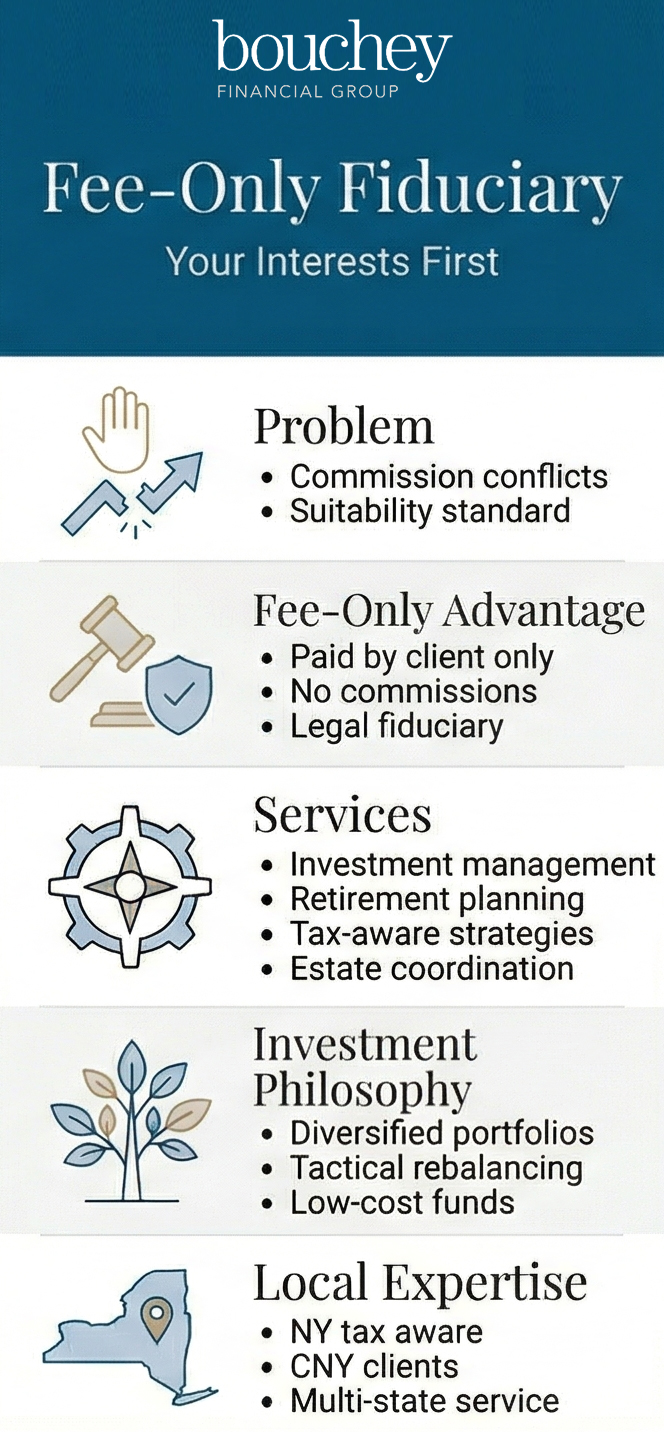
What "Fiduciary" Actually Means
The term fiduciary describes a legal and ethical obligation to act entirely in another person's best interest. In financial advising, this means your advisor is required — not just encouraged — to put your needs above their own financial gain.
Not every financial professional operates under this standard. Many are held only to a "suitability" standard, which requires that a recommendation be appropriate but not necessarily optimal for you. That distinction can quietly cost clients thousands of dollars over time.
How Registered Investment Advisors Are Regulated
A Registered Investment Adviser (RIA) is registered with the SEC or state regulators and is legally required to act as a fiduciary at all times. This sets RIAs apart from broker-dealers, who operate under a different regulatory framework with fewer restrictions on conflicts of interest.
The Investment Advisers Act of 1940 established the legal foundation for RIA regulation, including required disclosures through Form ADV — a document that details an advisor's background, fees, and potential conflicts. Reviewing a firm's Form ADV is one of the most effective ways to evaluate transparency before engaging.
Fee-Only Compensation: What It Means for You
Fee-only means the advisor is compensated solely by you, the client — not by product providers, insurance companies, or fund managers. The National Association of Personal Financial Advisors (NAPFA) defines fee-only advising as a model that eliminates commissions, referral fees, and third-party compensation entirely.
This matters because commission-based advisors have a financial incentive to recommend specific products. Fee-only advisors have no such incentive — their only motivation is helping your financial plan succeed.
Why This Structure Removes Conflicts of Interest
When your advisor earns nothing from what they recommend, the advice you receive is genuinely aligned with your goals. There's no pressure to steer you toward higher-commission funds or unnecessary insurance products.
The NAPFA standards for fee-only advising exist precisely because this compensation model is the clearest path to unbiased guidance. Bouchey Financial Group operates on this model — compensated by fee, not by commission.
Fee-Only vs. Fee-Based: Understanding the Difference
Many people confuse fee-only with fee-based, but the distinction is significant. A fee-only vs. fee-based comparison shows that fee-based advisors charge clients a fee but may also earn commissions on products they sell — creating a dual compensation structure that can introduce subtle conflicts.
Fee-only advisors earn nothing beyond what the client directly pays. For CNY residents evaluating advisors in the Utica area, asking directly "are you fee-only or fee-based?" is one of the most clarifying questions you can ask.
| Feature | Fee-Only Advisor | Fee-Based Advisor |
| Payment Source | Paid exclusively by the client. They do not accept money from any other parties. | Paid by the client plus commissions from third-party companies. |
| Outside Incentives | Forbidden from taking kickbacks, referral fees, or commissions from fund companies. | May earn extra income by selling specific insurance or investment products. |
| Legal Standard | Held to a Fiduciary Standard, requiring them by law to act in your best interest. | Held to a Suitability Standard, meaning products must be "appropriate" but not necessarily the best or cheapest. |
Services Available to CNY Clients
Comprehensive wealth management means more than managing an investment portfolio. Clients working with Bouchey Financial Group's wealth advisors have access to an integrated range of services designed to address every dimension of their financial life:
- Investment management — Strategic and tactical asset allocation across globally diversified portfolios, with a focus on minimizing costs and tax drag
- Retirement planning — Income projections, Social Security strategy, distribution planning, and transition guidance for those approaching or entering retirement
- Tax-aware planning — Coordinated strategies developed alongside the firm's in-house CPAs and tax planners to minimize your annual tax burden
- Estate planning coordination — Working in tandem with your estate attorney to ensure your wealth transfer goals are properly structured
Investment Philosophy for Long-Term Wealth
Sound investing begins with broad diversification across multiple global asset classes with different risk and return characteristics. This approach — the foundation of Bouchey Financial Group's investment management process — ensures portfolios are not over-concentrated in any single market or sector.
The firm also employs tactical rebalancing based on valuation, using a disciplined "buy low, sell high" framework. This means increasing exposure to undervalued asset classes and trimming those that appear overvalued — a process that requires discipline but produces strong risk-adjusted returns over time.
Keeping Costs Low for Maximum Return
One of the clearest ways to improve investment performance is to reduce what you pay in fees and expenses. Bouchey Financial Group uses index funds for the majority of holdings, which carry substantially lower expense ratios than actively managed funds.
Transaction costs are also minimized through the firm's trading platform, which allows many holdings to be bought and sold at no cost to the client. Every dollar not lost to fees stays invested and working toward your financial goals.
Serving Utica and Central New York
Clients throughout CNY face financial planning needs shaped by New York's specific tax environment, regional cost-of-living considerations, and local retirement systems. Whether you're a business owner in Utica, a public sector employee navigating pension decisions, or a family planning for multi-generational wealth, the right advisor understands the full picture.
Bouchey Financial Group's team includes professionals who regularly work with clients on New York State tax planning, retirement income coordination, and complex financial transitions. You can also hear founder Steven Bouchey discuss financial topics every weekend on Let's Talk Money on News Talk Radio 810AM and 103.1FM WGY.
How to Verify a Fiduciary Advisor Before You Commit
Before engaging any financial advisor, it pays to do your own due diligence. Verifying fiduciary status is straightforward: check the SEC's Investment Adviser Public Disclosure (IAPD) database, review the firm's Form ADV, and ask directly whether the advisor is a fiduciary at all times — not just during certain services.
Look for firms with CFP® professionals, CPAs, and other credentialed team members. Reviewing their client communication materials and published educational content signals that a firm prioritizes client knowledge over client dependence.
Finding the Right Fee-Only Advisor in CNY Is Within Reach
If you're ready to work with an advisor who is legally and ethically required to act in your best interest — and who earns nothing beyond what you directly pay — the next step is a conversation. Contact Bouchey Financial Group to schedule a free consultation and find out how a fee-only fiduciary approach can be applied to your specific goals and timeline.
The right advisor doesn't push products or generate commissions. They sit on your side of the table — and everything they recommend reflects that.
Frequently Asked Questions
What is the difference between a fiduciary and a non-fiduciary financial advisor?
A fiduciary is legally required to act in your best interest at all times, while a non-fiduciary advisor is only held to a "suitability" standard — meaning their recommendations must be appropriate, but not necessarily optimal for you. This distinction can meaningfully affect the quality of advice you receive and the costs embedded in the products you're guided toward.
How do I know if a financial advisor in Utica is truly fee-only?
Ask directly whether the advisor earns any commissions, referral fees, or third-party compensation of any kind. You can also review their Form ADV disclosure on the SEC's IAPD database, which outlines all compensation arrangements. If an advisor earns money from anything other than client fees, they are fee-based — not fee-only.
Does working with a fee-only advisor cost more than a commission-based one?
Not necessarily — and over time, it often costs significantly less. Commission-based advisors may appear to work for free, but their compensation is embedded in the products they sell, often through higher expense ratios or surrender charges. Fee-only advisors are transparent about what you pay, and the absence of product-driven recommendations typically improves long-term outcomes.
What credentials should I look for in a CNY financial advisor?
The CERTIFIED FINANCIAL PLANNER™ (CFP®) designation is one of the most respected in the industry, requiring rigorous education, examination, and ethical standards. Additional credentials like CPA, AIF®, and CPWA® signal depth of expertise in specific areas. A team that combines these credentials offers truly integrated planning.
Do fee-only fiduciary advisors serve clients outside their immediate area?
Yes. Most fee-only RIAs serve clients across multiple states through virtual meetings and digital planning tools. Bouchey Financial Group manages assets for clients in 34 states in addition to serving the Capital Region and CNY locally. Geographic proximity is no longer a prerequisite for high-quality fiduciary advice.
How often should I expect to meet with my financial advisor?
A comprehensive wealth management relationship typically includes at least one annual financial plan review, with additional check-ins around major life events, market changes, or tax planning milestones. Quality firms proactively reach out — not just when you call. Frequency and format should be clearly established before you engage any advisor.
What is the first step when starting a relationship with a fee-only fiduciary advisor?
Most fee-only firms begin with a no-cost introductory consultation to understand your financial situation, goals, and timeline before making any recommendations. This discovery phase typically covers income needs, risk tolerance, tax considerations, and existing assets. It's also an opportunity for you to evaluate the firm's communication style and approach before committing.
IMPORTANT DISCLOSURE INFORMATION
Please remember that past performance is no guarantee of future results. Different types of investments involve varying degrees of risk, and there can be no assurance that the future performance of any specific investment, investment strategy, or product (including the investments and/or investment strategies recommended or undertaken by Bouchey Financial Group, Ltd. [“Bouchey Financial”]), or any non-investment related content, made reference to directly or indirectly in this blog will be profitable, equal any corresponding indicated historical performance level(s), be suitable for your portfolio or individual situation, or prove successful. Due to various factors, including changing market conditions and/or applicable laws, the content may no longer be reflective of current opinions or positions. Moreover, no portion of this discussion or information contained in this blog serves as the receipt of, or as a substitute for, personalized investment advice from Bouchey Financial. To the extent that a reader has any questions regarding the applicability of any specific issue discussed above to his/her individual situation, he/she is encouraged to consult with the professional advisor of his/her choosing. Neither Bouchey Financial’s investment adviser registration status, nor any amount of prior experience or success, should be construed that a certain level of results or satisfaction will be achieved if Bouchey Financial is engaged, or continues to be engaged, to provide investment advisory services. Bouchey Financial is neither a law firm nor a certified public accounting firm and no portion of the blog content should be construed as legal or accounting advice. A copy of the Bouchey Financial’s current written disclosure Brochure and Form CRS discussing our advisory services and fees is available for review upon request or at www.bouchey.com. Please Note: Bouchey Financial does not make any representations or warranties as to the accuracy, timeliness, suitability, completeness, or relevance of any information prepared by any unaffiliated third party, whether linked to Bouchey Financial’s web site or blog or incorporated herein, and takes no responsibility for any such content. All such information is provided solely for convenience purposes only and all users thereof should be guided accordingly. Please Remember: If you are a Bouchey Financial client, please contact Bouchey Financial, in writing, if there are any changes in your personal/financial situation or investment objectives for the purpose of reviewing/evaluating/revising our previous recommendations and/or services, or if you would like to impose, add, or to modify any reasonable restrictions to our investment advisory services. Unless, and until, you notify us, in writing, to the contrary, we shall continue to provide services as we do currently. Please Also Remember to advise us if you have not been receiving account statements (at least quarterly) from the account custodian.