
October Market Insights: Growing Our Way Out – Why AI Productivity Compounds
Growing Our Way Out: Why AI Productivity Compounds
You've probably seen the headlines: the 10-year Treasury yield just hit its highest level since 2007, only days after the Fed raised rates for the first time in more than three years. Add oil back above $100 and a national debt north of $40 trillion, and it's easy to feel like the walls are closing in. We see it a little differently. There's a quieter story in the data that we think matters more over the long run, and it's about productivity.
Why Things Feel Messy
The short version is that prices are still running too hot. The standoff around the Strait of Hormuz has kept energy expensive, and in mid-September the Fed decided it couldn't wait any longer, lifting its benchmark rate to a range of 3.75% to 4.00%. When inflation and government borrowing are both elevated, bond investors ask for more interest to lend, so long-term rates have climbed. That's what has been weighing on stocks lately.
The Easy Way Out
When a country owes a lot, there are only a few exits. It can raise taxes and cut spending, which is painful and politically hard. It can let inflation quietly shrink what the debt is worth, which hurts savers. Or it can grow faster than the debt does. That last path is the only one where nobody has to lose, and the engine behind it is productivity: getting more done with each hour of work.
The Congressional Budget Office puts a price tag on it. By its math, productivity growing just a tenth of a point faster each year than expected would shave roughly $317 billion off deficits over the next decade. Half a point faster would be worth well over a trillion. A more productive economy also takes heat out of inflation, because businesses can pay people more without raising prices to cover it.
Why Productivity Compounds
This is the part we find most exciting. Productivity works like interest on your savings: each year's gain builds on a bigger base than the last. A one-point difference barely registers in a single year. Stretch it over two decades and it adds up to a much bigger economy.
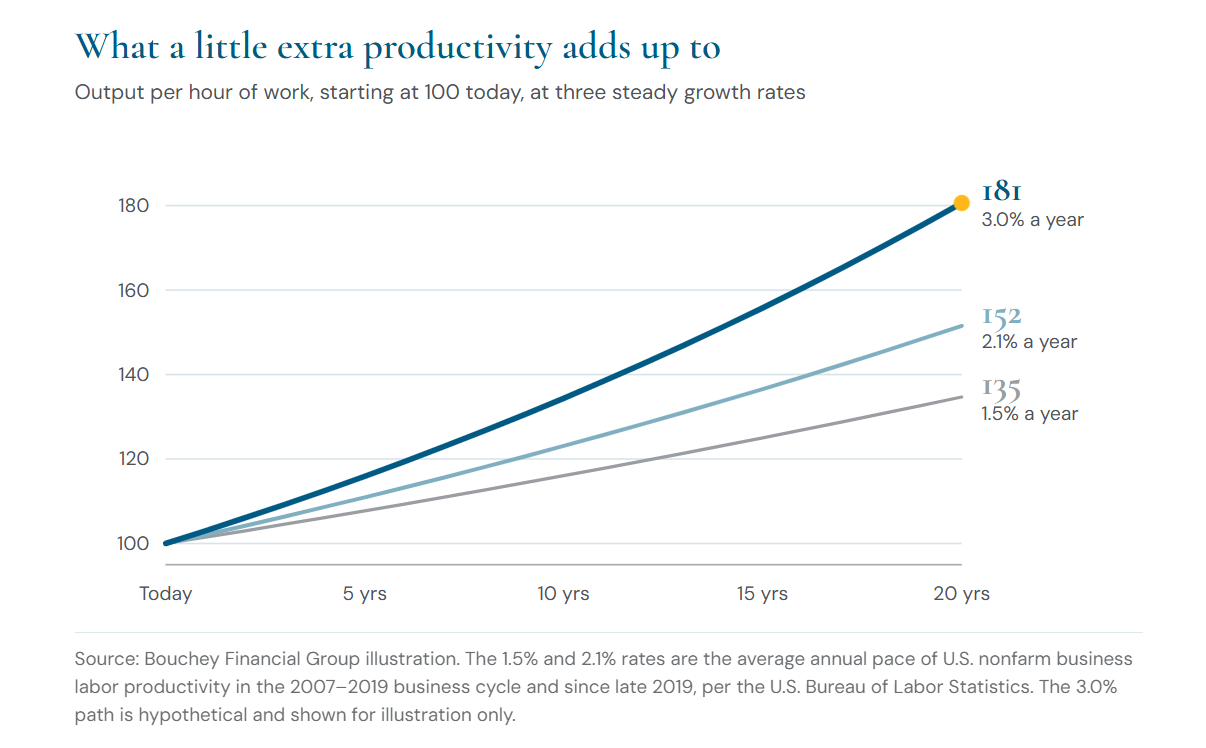
AI adds a second layer of compounding. The tools keep getting better, companies keep getting better at using them, and AI is increasingly helping build the next generation of software and AI itself. Early on, much of the effort goes into rethinking how work gets done, so the payoff looks small. Once new workflows settle in, the gains start stacking. We saw a version of this with the PC and the internet: years of people asking where the gains were, followed by a burst of fast growth in the late 1990s.
It's Already Showing Up
The early evidence is encouraging. Over the past year the economy produced noticeably more while total hours worked barely moved, which is what it looks like when the same people are able to do more. This cycle's productivity pace is running ahead of the last one, and a March survey of roughly 750 executives by the Atlanta Fed found AI-driven gains picking up this year, led by finance and professional services. Outside estimates of the long-run boost vary widely, from under half a point a year to more than a full point, but even the low end compounds into something meaningful.
So Where Does This Leave Us
Our honest take: AI won't bring down the price of oil or settle Washington's budget fights this quarter, and it may take a few years for the full payoff to show up in the numbers. The bond market is impatient, and that can make for some bumpy stretches along the way. The direction is what matters most to us, and the direction is good. Growing faster is the least painful way through a heavy debt load, and the early signs say that's the road we're on.
One bright spot is already here: labor costs per unit of output are rising slowly, a sign productivity is helping keep a lid on inflation even as the Fed tightens.
We'll be watching the quarterly productivity reports, those labor cost numbers, and whether companies' AI spending shows up in their profit margins. We'll keep an eye on it so you don't have to.
As always, reach out with any questions.
Bouchey Financial Group | For Discussion Purposes Only | September 2026
Sources: U.S. Bureau of Labor Statistics, Productivity and Costs, Second Quarter 2026, Revised (September 3, 2026); Congressional Budget Office, How Changes in Economic Conditions Might Affect the Federal Budget: 2026 to 2036 (April 2026); Federal Reserve Bank of Atlanta, Artificial Intelligence, Productivity, and the Workforce: Evidence from Corporate Executives (March 2026); Federal Open Market Committee statement (September 16, 2026); U.S. Treasury par yield curve (September 28, 2026).
This commentary reflects the views of Bouchey Financial Group as of the date shown and is provided for informational purposes only. It is not a recommendation to buy or sell any security. Illustrations are hypothetical and do not represent actual or future results. Past performance does not guarantee future results.

IMPORTANT DISCLOSURE INFORMATION
Please remember that past performance is no guarantee of future results. Different types of investments involve varying degrees of risk, and there can be no assurance that the future performance of any specific investment, investment strategy, or product (including the investments and/or investment strategies recommended or undertaken by Bouchey Financial Group, Ltd. [“Bouchey Financial”]), or any non-investment related content, made reference to directly or indirectly in this blog will be profitable, equal any corresponding indicated historical performance level(s), be suitable for your portfolio or individual situation, or prove successful. Due to various factors, including changing market conditions and/or applicable laws, the content may no longer be reflective of current opinions or positions. Moreover, no portion of this discussion or information contained in this blog serves as the receipt of, or as a substitute for, personalized investment advice from Bouchey Financial. To the extent that a reader has any questions regarding the applicability of any specific issue discussed above to his/her individual situation, he/she is encouraged to consult with the professional advisor of his/her choosing. Neither Bouchey Financial’s investment adviser registration status, nor any amount of prior experience or success, should be construed that a certain level of results or satisfaction will be achieved if Bouchey Financial is engaged, or continues to be engaged, to provide investment advisory services. Bouchey Financial is neither a law firm nor a certified public accounting firm and no portion of the blog content should be construed as legal or accounting advice. A copy of the Bouchey Financial’s current written disclosure Brochure and Form CRS discussing our advisory services and fees is available for review upon request or at www.bouchey.com. Please Note: Bouchey Financial does not make any representations or warranties as to the accuracy, timeliness, suitability, completeness, or relevance of any information prepared by any unaffiliated third party, whether linked to Bouchey Financial’s web site or blog or incorporated herein, and takes no responsibility for any such content. All such information is provided solely for convenience purposes only and all users thereof should be guided accordingly. Please Remember: If you are a Bouchey Financial client, please contact Bouchey Financial, in writing, if there are any changes in your personal/financial situation or investment objectives for the purpose of reviewing/evaluating/revising our previous recommendations and/or services, or if you would like to impose, add, or to modify any reasonable restrictions to our investment advisory services. Unless, and until, you notify us, in writing, to the contrary, we shall continue to provide services as we do currently. Please Also Remember to advise us if you have not been receiving account statements (at least quarterly) from the account custodian.