
Retirement Planning in Palm Beach Gardens | Tax-Optimized Strategies
Most retirement planning conversations start with a number: how much do I need to retire? That's the wrong place to start. The right place is the tax picture, because how income is structured, timed, and drawn from different accounts determines what that number actually produces in take-home income. For Palm Beach Gardens retirees, that picture has more favorable starting conditions than most states offer. Using them well requires a plan, not assumptions.
Bouchey Financial Group serves Palm Beach Gardens and the broader Palm Beach County area as a fee-only fiduciary firm. The firm's CERTIFIED FINANCIAL PLANNER™ professionals and CPAs work together on retirement income planning, treating tax strategy and investment management as one coordinated decision.
Why Florida Residency Changes the Retirement Tax Equation
Florida imposes no individual income tax. According to the Florida Department of Revenue, Florida does not require individuals to file a state personal income tax return. That eliminates a layer of tax that residents of New York, Massachusetts, and most other states pay on IRA withdrawals, Roth conversions, and investment gains.
Federal taxes apply in full. But the absence of a state income layer meaningfully changes the math on Roth conversions and withdrawal sequencing. A $100,000 IRA withdrawal in New York carries both federal and state income tax. In Palm Beach Gardens, it carries only the federal portion.
Florida's Estate Tax Advantage
Florida's estate tax was eliminated for individuals dying after December 31, 2004, according to the Florida Department of Revenue. Combined with the 2026 federal estate tax exemption of $15 million per individual per IRS guidance, most Palm Beach Gardens households face no state or federal estate tax exposure.
This does not mean estate planning is unnecessary. Large retirement accounts, real estate holdings, and business interests all require coordination between the retirement income plan and the legacy plan. The 2026 annual gift tax exclusion is $19,000 per recipient, or $38,000 per couple, per IRS gift tax guidance.
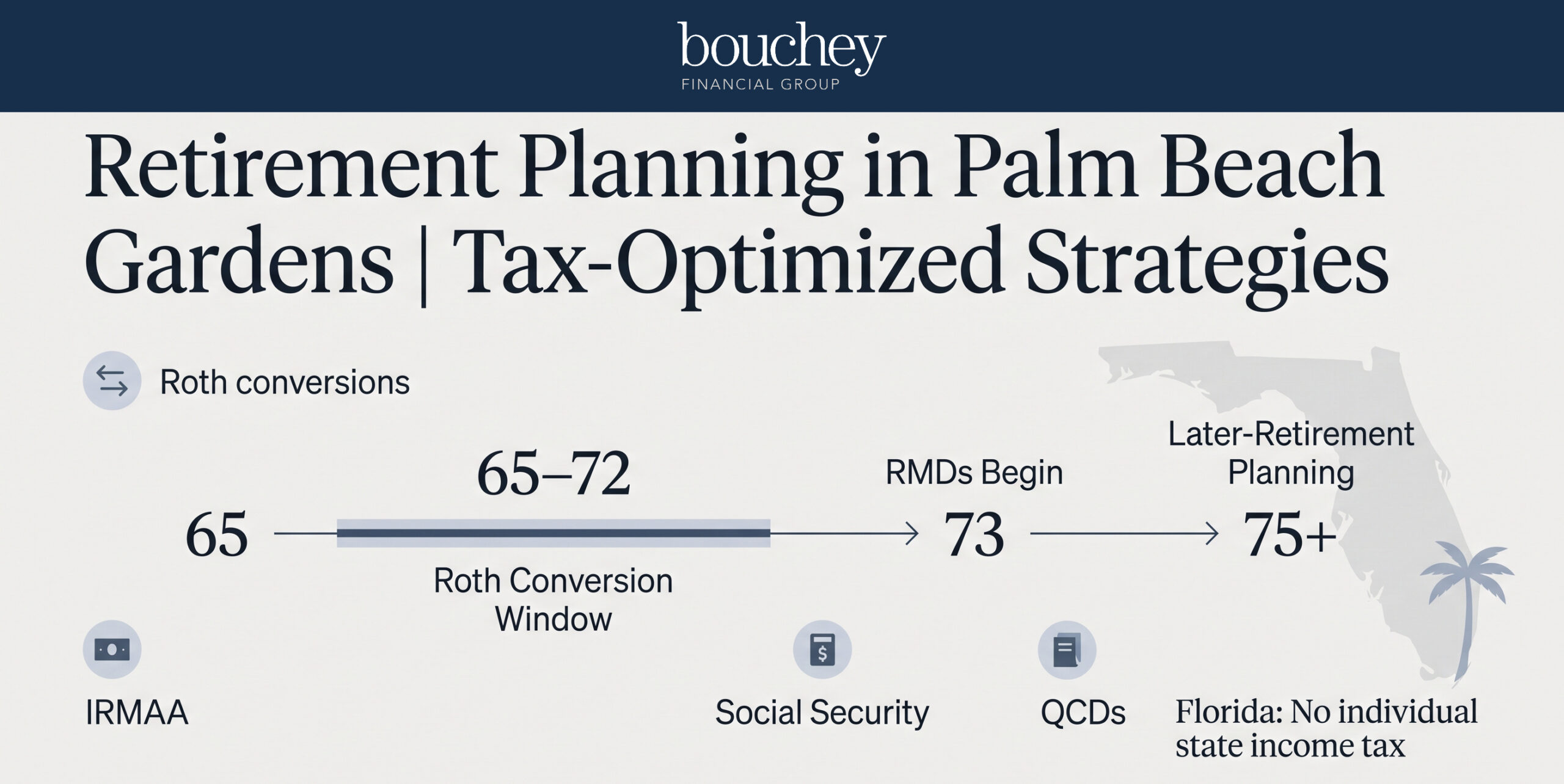
The Palm Beach Gardens Retirement Tax Timeline
Tax-optimized retirement planning is not about minimizing this year's tax bill. It is about managing taxes across the full retirement arc.
| Retirement Stage | Tax Planning Focus |
| Final working years | Maximize 401(k) / IRA contributions; identify future account mix |
| Early retirement, pre-RMD | Evaluate Roth conversions; harvest capital gains at lower rates |
| Medicare enrollment | Manage MAGI to control IRMAA surcharges |
| RMD age (73, or 75 after 2033) | Coordinate mandatory withdrawals with other income |
| Later retirement | QCDs, annual gifting, estate and legacy coordination |
Sources: IRS RMD guidance, IRS SECURE 2.0 guidance, IRS 2026 contribution limits
The pre-RMD window is where most planning leverage lives. Income tends to be lower between retirement and age 73, bracket room is available, and Roth conversions made during those years reduce the future required distribution burden and create tax-free assets for heirs.
The Roth Conversion Window
Required minimum distributions from traditional IRAs begin at age 73, taxed as ordinary income at the federal level. Once RMDs begin, the size and timing of withdrawals becomes less discretionary. The window before age 73 is where intentional Roth conversion planning can redirect the trajectory.
A Palm Beach Gardens retiree with $2 million in a traditional IRA who retires at 65 has eight years of potential conversion opportunity. Converting $100,000 to $150,000 per year during that window, sized to stay within a favorable federal bracket, reduces future mandatory distributions and creates a Roth balance that grows tax-free for both the retiree and their heirs.
The IRMAA Problem Most Retirees Discover Too Late
Medicare Part B premiums in 2026 start at $202.90 per month, according to the Centers for Medicare and Medicaid Services. IRMAA surcharges begin for individuals with MAGI above $109,000 and for married couples above $218,000, calculated on tax returns from two years prior.
A large Roth conversion raises MAGI, which increases Medicare premiums two years later. Sizing conversions with IRMAA thresholds in mind, not just federal tax brackets, is where multi-year planning separates from single-year optimization.
Withdrawal Sequencing and Social Security Coordination
The order in which retirement accounts are drawn down determines the household's effective tax rate across retirement. The three account types are taxed differently:
- Traditional IRA and 401(k): Withdrawals are ordinary income at the federal level
- Taxable brokerage: Subject to capital gains rates; long-term gains taxed more favorably
- Roth IRA and Roth 401(k): Withdrawals are generally tax-free
The right sequence depends on the household's full income picture. For retirees with large traditional IRA balances, deferring those withdrawals allows future RMDs to grow larger, potentially pushing taxable income into higher brackets later in retirement.
The Social Security Administration's 2026 data shows average retired-worker benefits of $2,071 per month and a maximum benefit of $4,152 per month at full retirement age. Social Security provisional income calculations interact directly with Roth conversions and portfolio withdrawals. Coordinating the claiming decision with the conversion strategy, rather than deciding each independently, typically produces better lifetime outcomes.
Charitable Giving as a Withdrawal Strategy
The IRS QCD limit for 2026 is $111,000 per person. A QCD transfers funds directly from a traditional IRA to a qualifying charity, excluding the amount from taxable income entirely. It satisfies Required Minimum Distributions without increasing AGI, which protects IRMAA thresholds and the provisional income calculation for Social Security.
For Palm Beach Gardens households with philanthropic goals, the QCD is one of the most efficient charitable giving tools available in retirement. The Net Investment Income Tax of 3.8% applies when MAGI exceeds $200,000 for single filers and $250,000 for married couples. Portfolio decisions including rebalancing, concentrated stock sales, and real estate dispositions need to account for this exposure when modeling after-tax outcomes.
Palm Beach Gardens Property Tax: What Retirees Should Know
Palm Beach Gardens carries an effective property tax rate of approximately 1.13% of assessed value, slightly above the Florida state median. Florida's Homestead Exemption reduces taxable value by $51,411 for 2026, with the Save Our Homes cap limiting annual assessed value increases to 3% or the change in CPI, whichever is lower.
Retirees moving from another Florida homestead may port their existing Save Our Homes protection to the new property, preserving the accumulated assessment gap. That portability benefit is worth calculating before selling a prior Florida residence. The official Florida property tax methodology: Just Value minus Assessment Limits equals Assessed Value; Assessed Value minus Exemptions equals Taxable Value; Taxable Value multiplied by the Millage Rate equals Tax Liability.
Bringing It Together
The tax decisions made in the first five years of retirement tend to shape the tax picture for the following twenty. Roth conversions before RMDs begin. Social Security claimed with provisional income in mind. QCDs used to satisfy charitable goals and reduce taxable income. Portfolio withdrawals sequenced to manage brackets and IRMAA thresholds year by year.
Bouchey Financial Group offers a free initial consultation for prospective clients throughout Palm Beach Gardens. The firm's advisory team of CFP® professionals, CPAs, and an IRS Enrolled Agent coordinates these decisions as a single integrated strategy.
Contact the team to discuss how retirement tax planning fits your situation, or explore recent planning discussions through the firm's Webinars and Videos library.
Frequently Asked Questions
I thought Florida had no taxes. Why do I still owe federal tax on my IRA withdrawals?
Florida's lack of a state income tax removes one layer, not all of them. IRA and 401(k) withdrawals are still ordinary income at the federal level, Social Security can still be partially taxable depending on provisional income, and the Net Investment Income Tax still applies above certain thresholds. Florida makes the math better. It doesn't make the planning unnecessary.
My neighbor said she ported her property tax assessment when she moved within Florida. How does that work?
Florida's Save Our Homes cap limits annual assessed value increases to 3% or the change in CPI. Over years, that creates a gap between assessed and market value. When you move to a new Florida homestead, you can apply to transfer that accumulated gap to the new property. The application is typically due by March 1 of the year following your move. If you're planning a downsize or relocation within Palm Beach County, calculate this before selling.
Should I take my first RMD the year I turn 73 or wait until April of the following year?
Take it in the year you turn 73. Delaying to April 1 of the following year means two taxable RMDs land in the same calendar year, which tends to push income into a higher bracket. Most retirees are better off taking the first one on schedule.
I have an HSA from my working years. Can I still use it in retirement?
Yes, and it's one of the most underused accounts in retirement planning. You can no longer contribute once you're on Medicare, but the balance carries over indefinitely. Qualified medical expenses can be paid from the HSA completely tax-free. The 2026 limits for current contributors are $4,400 for self-only and $8,750 for families, so the years before Medicare enrollment are worth maxing out if you're eligible.
We want to start gifting to our kids. Does that affect our retirement plan?
It can, if you're not modeling it in. The annual gift exclusion is $19,000 per recipient in 2026, or $38,000 per couple. Regular gifting reduces the assets available to generate retirement income, so it's worth building into the withdrawal projection rather than treating it as separate from the financial plan.
What is a QCD and why would I use one instead of just writing a check to a charity?
A qualified charitable distribution sends money directly from your IRA to a qualifying charity without the withdrawal counting as income. Writing a check means taking a taxable distribution first, then donating from after-tax money. The QCD skips that entirely, satisfies your RMD, and protects your IRMAA thresholds. For retirees who give regularly and hold significant IRA balances, it is almost always the better structure.
Do capital gains get taxed differently in Florida than in other states?
Yes, favorably. Florida has no state capital gains tax, so long-term gains are taxed only at the federal rate: 0%, 15%, or 20% depending on income, with the 3.8% NIIT applying above certain thresholds. For retirees who relocated from New York or Massachusetts, the difference on a large portfolio transaction can be substantial.

IMPORTANT DISCLOSURE INFORMATION
Please remember that past performance is no guarantee of future results. Different types of investments involve varying degrees of risk, and there can be no assurance that the future performance of any specific investment, investment strategy, or product (including the investments and/or investment strategies recommended or undertaken by Bouchey Financial Group, Ltd. [“Bouchey Financial”]), or any non-investment related content, made reference to directly or indirectly in this blog will be profitable, equal any corresponding indicated historical performance level(s), be suitable for your portfolio or individual situation, or prove successful. Due to various factors, including changing market conditions and/or applicable laws, the content may no longer be reflective of current opinions or positions. Moreover, no portion of this discussion or information contained in this blog serves as the receipt of, or as a substitute for, personalized investment advice from Bouchey Financial. To the extent that a reader has any questions regarding the applicability of any specific issue discussed above to his/her individual situation, he/she is encouraged to consult with the professional advisor of his/her choosing. Neither Bouchey Financial’s investment adviser registration status, nor any amount of prior experience or success, should be construed that a certain level of results or satisfaction will be achieved if Bouchey Financial is engaged, or continues to be engaged, to provide investment advisory services. Bouchey Financial is neither a law firm nor a certified public accounting firm and no portion of the blog content should be construed as legal or accounting advice. A copy of the Bouchey Financial’s current written disclosure Brochure and Form CRS discussing our advisory services and fees is available for review upon request or at www.bouchey.com. Please Note: Bouchey Financial does not make any representations or warranties as to the accuracy, timeliness, suitability, completeness, or relevance of any information prepared by any unaffiliated third party, whether linked to Bouchey Financial’s web site or blog or incorporated herein, and takes no responsibility for any such content. All such information is provided solely for convenience purposes only and all users thereof should be guided accordingly. Please Remember: If you are a Bouchey Financial client, please contact Bouchey Financial, in writing, if there are any changes in your personal/financial situation or investment objectives for the purpose of reviewing/evaluating/revising our previous recommendations and/or services, or if you would like to impose, add, or to modify any reasonable restrictions to our investment advisory services. Unless, and until, you notify us, in writing, to the contrary, we shall continue to provide services as we do currently. Please Also Remember to advise us if you have not been receiving account statements (at least quarterly) from the account custodian.