
Financial Advisor in Wellesley MA | Fee-Only Fiduciary Wealth Management
Financial complexity tends to accumulate quietly. A Wellesley household with a physician's income, a spouse's equity compensation, a mortgage on a $1.5 million home, and college approaching for two children isn't struggling — but they're also managing more moving parts than a single financial account can capture.
Bouchey Financial Group serves Wellesley and the Greater Boston area through a fee-only fiduciary model. The firm's team includes CERTIFIED FINANCIAL PLANNER™ professionals, CPAs, and an IRS Enrolled Agent who work together on the same accounts. That combination is the point — Massachusetts tax law, equity compensation decisions, estate exposure, and investment management are the same conversation here, not separate ones.
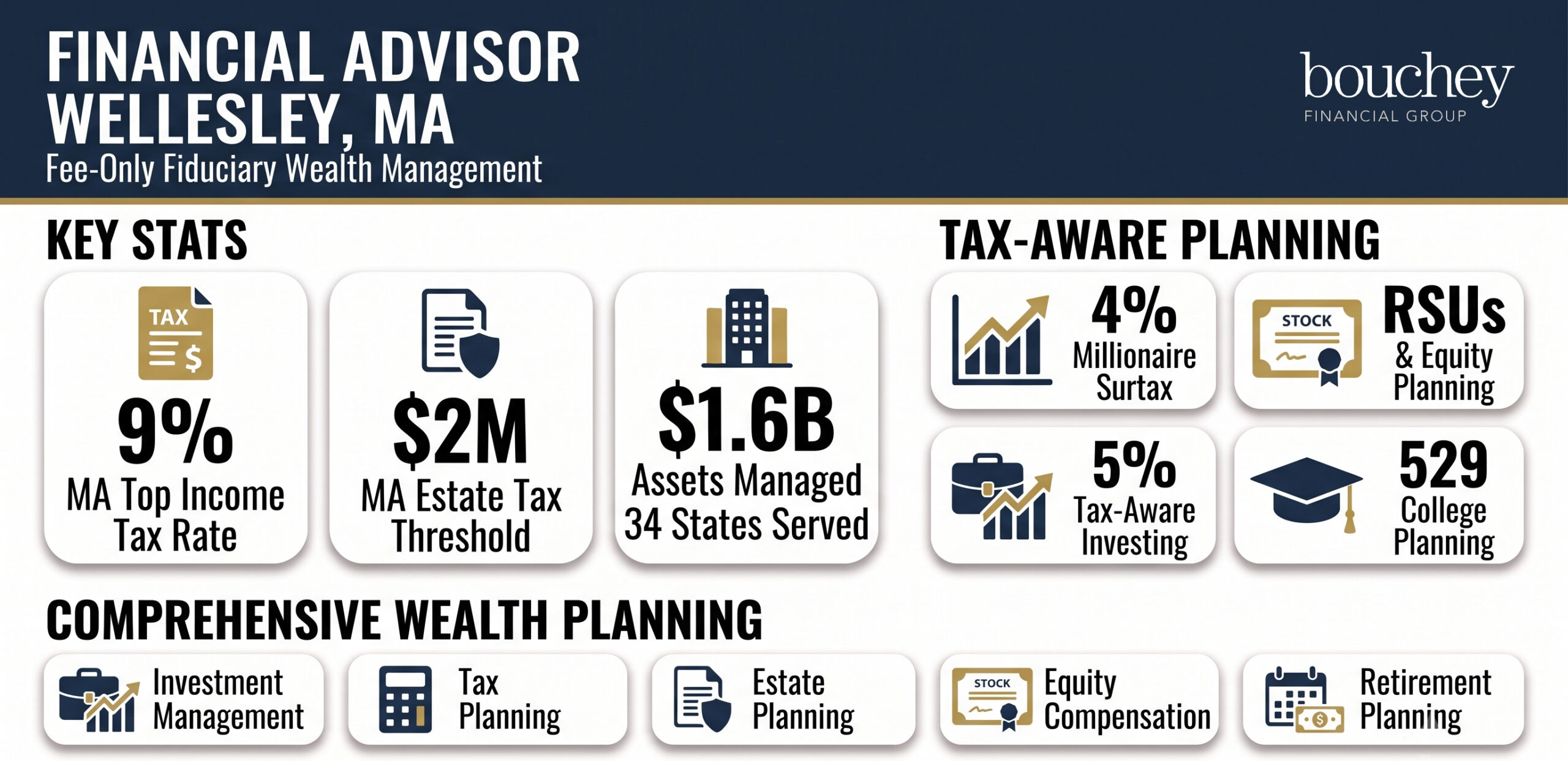
The Massachusetts Tax Picture Is More Complex Than Most Families Realize
Massachusetts taxes most income at a flat 5%. That part is simple.
What isn't simple: the state imposes an additional 4% surtax on taxable income exceeding $1,107,750 in 2026, according to mass.gov. That brings the combined marginal rate to 9% on dollars above the threshold. For a Wellesley executive receiving a large RSU vest or option exercise in a single tax year, the timing of that event relative to other income determines whether it crosses the surtax line.
Short-term capital gains can have a bigger tax impact than many investors expect. In Massachusetts, gains on assets held for less than one year are taxed at 8.5%, compared to the state's 5% tax rate on most ordinary income. As a result, the timing of a sale can make a meaningful difference in after-tax returns, particularly for investors with large positions or frequent trading activity.
The Massachusetts Estate Tax Cliff
For many Wellesley families, estate planning deserves closer attention than it often receives. Massachusetts imposes an estate tax on estates valued above $2 million, with rates ranging from 0.8% to 16%. What makes the state's system unique is that crossing the $2 million threshold can trigger estate tax exposure on the entire estate, making careful planning especially important for higher-net-worth households.
While the federal estate tax exemption is $15 million per individual in 2026, Massachusetts operates under its own rules. A family with a $1.8 million home, retirement accounts, and taxable investments can exceed the state's $2 million threshold more easily than they might expect.
Strategies such as credit shelter trusts and other estate planning tools can help address that exposure, but they're generally most effective when implemented well before additional asset growth occurs.
Equity Compensation: Where Most of the Complexity Lives
Many Wellesley professionals work in industries such as technology, biotech, financial services, and healthcare, where equity compensation can represent a significant portion of total earnings. While these benefits can be a powerful wealth-building tool, they often introduce planning challenges that go far beyond a traditional paycheck.
RSUs, stock options, and employee stock purchase plans (ESPPs) each come with their own tax rules, vesting schedules, and risks. For example, RSUs are generally taxed as ordinary income when they vest, even if the shares aren't sold, while exercising incentive stock options can trigger alternative minimum tax considerations.
These decisions can become even more important when combined with Massachusetts's surtax threshold. An executive who receives a $400,000 RSU vest in a year when other income already totals $800,000 may find themselves crossing that threshold unexpectedly. Coordinating these events across multiple tax years can help manage tax exposure and reduce the risks that come with concentrated stock positions.
What Fee-Only Fiduciary Means Here
Fee-only means the firm is paid exclusively by the client. No commissions. No revenue from fund recommendations or insurance products.
Fiduciary means the firm is legally required to act in the client's interest — not the firm's. A registered investment advisor operates under a fiduciary standard. A broker-dealer does not.
Prospective clients can verify any advisor's registration, compensation structure, and disciplinary history for free through FINRA's BrokerCheck and the SEC's IAPD database. Form ADV Part 2A contains full compensation disclosures. It takes ten minutes to read and removes any ambiguity about how the firm actually operates.
Tax-Aware Investing in a High-Tax State
In Massachusetts, taxes can have a meaningful impact on investment outcomes. Short-term capital gains are taxed at 8.5%, making the difference between holding an investment for 11 months versus 13 months more than just a timing decision.
For many investors, understanding the tax implications of when assets are sold is just as important as deciding what to invest in.
Tax-aware investing focuses on keeping more of what you earn. Strategies such as asset location, tax-loss harvesting, and thoughtful capital gains management can help reduce unnecessary tax drag over time.
For households near or above the state's surtax threshold, timing also matters. Coordinating investment sales, equity compensation events, and charitable giving strategies across multiple years can help manage both state and federal tax exposure while supporting long-term financial goals.
College Planning for Wellesley Families
Massachusetts has a substantial 529 plan deduction, and for families with children approaching college, the interaction between 529 distributions, taxable income, and financial aid calculations is worth thinking through before the accounts are structured.
For households likely above federal financial aid thresholds, the 529 strategy is primarily a tax and investment question rather than an aid question. Funding the accounts earlier, maximizing the Massachusetts deduction over multiple years, and coordinating distributions with other income in the year of use each affect the after-tax cost of education.
Who the Firm Serves
Bouchey Financial Group works with individuals and families with $500,000 or more in investable assets. The firm manages approximately $1.6 billion for clients across 34 states. The 22-person team includes 9 CFP® professionals, 3 CPAs, and 1 IRS Enrolled Agent.
The Wellesley and Greater Boston client base includes executives managing equity compensation, professionals with high and variable annual income, families navigating the Massachusetts estate tax, and business owners working through succession or a sale.
The Right Time to Have These Conversations
Massachusetts's surtax threshold, estate tax cliff, and short-term capital gains rate each create planning windows that close as income is earned and assets appreciate. The conversations worth having are the ones that happen before a large vest, before an estate review is overdue, before a business sale is under negotiation.
Bouchey Financial Group offers a free initial consultation for prospective clients in Wellesley and the Greater Boston area. Contact the team to schedule, or explore the firm's thinking through recent Webinars & Videos before reaching out.
Frequently Asked Questions
How does the Massachusetts estate tax affect Wellesley families?
Massachusetts imposes an estate tax on estates exceeding $2 million, with rates from 0.8% to 16%. The cliff effect means the entire estate — not just the excess — is taxed once the threshold is crossed. There is no portability between spouses, and property values alone can push many Wellesley households above the threshold. Credit shelter trusts and structured gifting can reduce exposure with standard planning tools.
What is the Massachusetts 4% surtax and who does it affect?
Massachusetts imposes an additional 4% tax on income exceeding $1,107,750 in 2026, bringing the combined marginal rate to 9% on dollars above the threshold. It applies to wages, investment income, RSU vests, and capital gains. For executives with large equity compensation events, timing those events relative to other income can determine whether the surtax applies.
How does equity compensation get taxed in Massachusetts?
RSUs are taxed as ordinary income when they vest, subject to both federal and Massachusetts income tax. Incentive stock options may trigger the federal alternative minimum tax upon exercise. Short-term capital gains from shares sold within a year are taxed at 8.5% in Massachusetts, compared to 5% for ordinary income. Coordinating vest timing, holding periods, and income levels across tax years reduces the combined tax cost meaningfully.
What is a fee-only fiduciary advisor and how do I verify one?
A fee-only advisor is paid only by the client — no commissions or third-party compensation of any kind. A fiduciary is legally required to act in the client's best interest. Verify any advisor's compensation structure through Form ADV Part 2A at adviserinfo.sec.gov and their registration through FINRA BrokerCheck at brokercheck.finra.org. Both are free and publicly available.
What college planning strategies apply to high-income Wellesley families?
Households above federal financial aid thresholds benefit most from treating 529 planning as a tax and investment decision. Massachusetts offers a 529 contribution deduction, and funding accounts early, maximizing the deduction across multiple years, and coordinating distributions with other income in the distribution year each reduce the after-tax cost of education. The financial aid calculation is largely irrelevant for high-income households, so the focus belongs on tax efficiency.
What tax planning matters most for Wellesley executives?
The interaction between W-2 income, RSU vests, and the Massachusetts surtax threshold is the most consequential ongoing planning question for many executives. Large vests in high-income years push total income above $1,107,750, triggering 9% Massachusetts tax on the excess. Spreading vests across years, timing the exercise of options, and using tax-loss harvesting and charitable strategies to offset gains each reduce the cumulative tax burden.
How does the Massachusetts short-term capital gains rate affect portfolio decisions?
Massachusetts taxes short-term capital gains — positions held less than one year — at 8.5%, compared to 5% for long-term gains. For a taxable portfolio generating significant turnover, the difference compounds materially over time. Asset location strategies that hold actively traded or income-generating assets in tax-deferred accounts, combined with discipline around holding periods for equities, reduce the Massachusetts short-term rate's drag on after-tax returns.
IMPORTANT DISCLOSURE INFORMATION
Please remember that past performance is no guarantee of future results. Different types of investments involve varying degrees of risk, and there can be no assurance that the future performance of any specific investment, investment strategy, or product (including the investments and/or investment strategies recommended or undertaken by Bouchey Financial Group, Ltd. [“Bouchey Financial”]), or any non-investment related content, made reference to directly or indirectly in this blog will be profitable, equal any corresponding indicated historical performance level(s), be suitable for your portfolio or individual situation, or prove successful. Due to various factors, including changing market conditions and/or applicable laws, the content may no longer be reflective of current opinions or positions. Moreover, no portion of this discussion or information contained in this blog serves as the receipt of, or as a substitute for, personalized investment advice from Bouchey Financial. To the extent that a reader has any questions regarding the applicability of any specific issue discussed above to his/her individual situation, he/she is encouraged to consult with the professional advisor of his/her choosing. Neither Bouchey Financial’s investment adviser registration status, nor any amount of prior experience or success, should be construed that a certain level of results or satisfaction will be achieved if Bouchey Financial is engaged, or continues to be engaged, to provide investment advisory services. Bouchey Financial is neither a law firm nor a certified public accounting firm and no portion of the blog content should be construed as legal or accounting advice. A copy of the Bouchey Financial’s current written disclosure Brochure and Form CRS discussing our advisory services and fees is available for review upon request or at www.bouchey.com. Please Note: Bouchey Financial does not make any representations or warranties as to the accuracy, timeliness, suitability, completeness, or relevance of any information prepared by any unaffiliated third party, whether linked to Bouchey Financial’s web site or blog or incorporated herein, and takes no responsibility for any such content. All such information is provided solely for convenience purposes only and all users thereof should be guided accordingly. Please Remember: If you are a Bouchey Financial client, please contact Bouchey Financial, in writing, if there are any changes in your personal/financial situation or investment objectives for the purpose of reviewing/evaluating/revising our previous recommendations and/or services, or if you would like to impose, add, or to modify any reasonable restrictions to our investment advisory services. Unless, and until, you notify us, in writing, to the contrary, we shall continue to provide services as we do currently. Please Also Remember to advise us if you have not been receiving account statements (at least quarterly) from the account custodian.