
Wealth Management Near Needham MA | Fee-Only Fiduciary Serving Greater Boston
Needham carries a median household income of $214,308 and a median home value exceeding $1 million, per Census Reporter — placing it among the highest-income communities in the Boston metro. For executives, finance professionals, and business owners here, searching specifically for a "fee-only fiduciary" is a deliberate choice. Bouchey Financial Group serves Needham and Greater Boston from its Medfield office as a fee-only, fiduciary RIA with 9 CERTIFIED FINANCIAL PLANNER™ professionals, 3 CPAs, 1 IRS Enrolled Agent, and a Certified Private Wealth Advisor®.
Fee-Only and Fiduciary: Why Both Terms Matter
The terms "fee-only" and "fiduciary" are often used interchangeably, but they describe different things. Fiduciary is a legal standard — registered investment advisers are required by the SEC to act in the client's best interest at all times, with a duty of care and a duty of loyalty that cannot be waived. Fee-only is a compensation structure — the advisor is paid exclusively by the client, with no commissions or third-party product revenue of any kind.
An advisor can be a fiduciary without being fee-only (if they hold fiduciary status but also earn commissions). And some non-fiduciary advisors charge fees. According to NAPFA's definition of fee-only advising, neither the advisor nor any related party may receive compensation contingent on the purchase or sale of a financial product. The combination of fee-only compensation and fiduciary legal standard — which describes Bouchey Financial Group — provides the strongest available protection against conflicts of interest.
Why Trust in the Advisory Relationship Is Foundational
The CFA Institute's Investor Trust Study finds that 69% of retail investors with a financial adviser report high trust in financial services, compared to only 45% of those without one — and that fee transparency is consistently cited as a primary driver of that trust. For Needham-area households with significant assets and complex financial situations, the advisory relationship's structure matters as much as any individual planning decision.
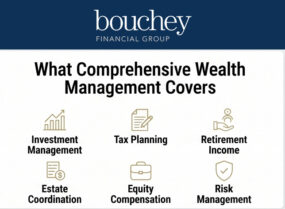
What Comprehensive Wealth Management Includes
For Greater Boston professionals with incomes above $200,000, household financial complexity typically spans multiple dimensions simultaneously. A genuine wealth management relationship addresses all of them through integration — not as separate engagements.
| Planning Area | What It Covers |
| Investment management | Portfolio construction, asset allocation, rebalancing, asset location |
| Tax planning | Roth conversions, capital gains timing, loss harvesting, equity compensation |
| Retirement income | Distribution sequencing, Social Security timing, RMD planning |
| Estate coordination | Trust structures, beneficiary reviews, titling aligned with the estate plan |
| Equity compensation | RSU/option vesting strategy, diversification timing, concentration risk |
| Risk management | Insurance review, asset protection analysis |
Bouchey Financial Group's team includes 3 CPAs who integrate tax strategy directly into every investment and planning decision — not as a year-end add-on, but as a continuous part of the advisory relationship.
Tax-Aware Investing for Needham Professionals
Massachusetts imposes a 5% flat income tax rate with an additional 4% surtax on taxable income above $1,107,750 in 2026, per the Massachusetts Department of Revenue. For Needham professionals with equity compensation, carried interest, or large capital gain events, the surtax can apply in a single year even when ordinary income typically falls below the threshold.
Equity Compensation Planning
The Federal Reserve Bank of Boston's regional economic research documents Greater Boston's concentration of high-earning industries — technology, financial services, healthcare, and professional services — producing households where RSU vesting cycles, M&A exits, and IPO lockup expirations require multi-year strategies, not reactive tax filings. The planning challenge isn't just minimizing tax in the year of vesting — it's managing concentration risk and timing diversification across years.
Bouchey Financial Group's in-house CPAs model equity compensation events across a rolling three-to-five-year horizon, evaluating vesting schedules against projected income and Massachusetts surtax thresholds to avoid unnecessary tax events in any single year.
Estate Planning at Needham's Wealth Level
With home values exceeding $1 million and professional incomes funding retirement accounts for decades, many Needham households approach the Massachusetts $2 million estate tax threshold from real estate alone — before investment assets are considered.
Per Mass.gov's estate tax guidance, Massachusetts applies graduated rates up to 16% on estates above $2 million, well below the federal exemption. Coordinating trust structures and beneficiary designations is an active planning priority for most Needham households at the $500,000+ advisory level.
The Value of an Advisor Beyond Investment Returns
Research consistently shows that advisor value is concentrated not in investment selection but in the behavioral, tax, and planning dimensions of the relationship. The DALBAR Quantitative Analysis of Investor Behavior found that the average equity investor underperformed the S&P 500 by 848 basis points in 2024 — primarily through timing mistakes and behavioral reactions to market volatility.
For Needham-area professionals managing high-income careers alongside significant portfolios, the advisory relationship provides the structure and accountability to maintain investment discipline during market uncertainty — one of the highest-value services a fiduciary firm provides.
Retirement Planning for Greater Boston Executives
The Boston College Center for Retirement Research tracks retirement readiness across income levels, finding that planning complexity — not income insufficiency — is the primary risk factor for high-income households. For Needham professionals with multiple retirement accounts, non-qualified deferred compensation, and Massachusetts-specific tax exposure, coordinating the distribution strategy across all those sources is where years of tax savings are either realized or lost.
Per the IRS's required minimum distribution rules, traditional IRA and most retirement plan owners must begin withdrawals at age 73 — a mandatory income event that interacts directly with the Massachusetts surtax, Medicare premium calculations, and Roth conversion windows. For Needham-area executives with substantial deferred compensation, modeling how RMDs layer onto other income sources — starting 10 to 15 years before they begin — is one of the most consequential planning exercises a fiduciary team can perform.
Bouchey Financial Group's investment management approach integrates these distribution decisions with each client's portfolio strategy — ensuring that asset allocation, tax planning, and income sequencing move together rather than independently.
Women, Wealth, and the Greater Boston Planning Context
Greater Boston's high concentration of dual-income professional households and women in senior leadership positions means that many Needham-area women manage significant assets — through career income, business ownership, or transitions including divorce and inheritance. Harmony Wagner, CFP®, CPWA®, Samantha Masey, CFP®, and Catherine Buck, CFP®, lead Bouchey Financial Group's Women and Wealth initiative, bringing focused expertise to women navigating long-term financial independence in one of the country's most affluent metropolitan areas.
A Fee-Only Relationship for Greater Boston's Most Financially Sophisticated Households
Needham-area households evaluating advisory firms deserve a relationship built on the strongest available foundation: fee-only compensation that eliminates product conflicts, and fiduciary legal status that requires every recommendation to serve the client's best interest. Bouchey Financial Group's in-house CPA and CFP® team brings the depth to handle planning complexity at every level.
To schedule a complimentary consultation at the Medfield office, contact the team directly.
Frequently Asked Questions
What does "fee-only" actually mean?
Fee-only means the advisor is compensated exclusively by the client — through AUM fees, flat retainers, or hourly rates — with no commissions or third-party product payments. Neither the advisor nor any affiliated party receives compensation tied to what products are recommended or sold.
Are all fiduciary advisors fee-only?
No. Fiduciary status is a legal standard — RIAs are required by the SEC to act in the client's best interest. Fee-only is a compensation structure. A fiduciary advisor can still earn commissions on products if they are "fee-based" rather than fee-only. The combination of both — fiduciary legal obligation and fee-only compensation — provides the strongest protection against conflicts of interest.
What is an RIA?
A Registered Investment Advisor is a firm registered with the SEC and legally required to meet a fiduciary standard of care. RIAs are distinct from broker-dealers, whose recommendations need only be suitable or meet a best-interest standard under Regulation Best Interest. Bouchey Financial Group is a fee-only RIA.
How often should portfolios be reviewed?
Formally at least once per year, with additional reviews triggered by life events — equity compensation vesting, job changes, business liquidity events, or significant market shifts. For Greater Boston executives with equity-heavy compensation structures, quarterly monitoring of concentration risk and vesting schedules is often warranted.
How do wealthy families preserve wealth across generations?
The most effective strategies combine estate planning documents (wills, trusts, POAs) with beneficiary designations that align with those documents, coordinated gifting strategies that use the annual exclusion and lifetime exemption efficiently, and a portfolio structure designed for both the current generation's income needs and the next generation's eventual inheritance. Each element needs to be reviewed together — not in isolation.
Should I hire a local Greater Boston financial advisor?
Local advisors with Massachusetts-specific expertise understand the state's 5% income tax, 4% surtax, $2 million estate tax threshold, and pension exclusion rules in ways that national platforms applying standardized models typically do not. For Needham-area households where Massachusetts tax planning is a material part of the wealth management value, local advisory depth is a practical advantage.
What tax strategies help executives and business owners?
The most impactful strategies typically include: deferring equity compensation events across tax years to manage the Massachusetts surtax threshold; using qualified opportunity zone investments to defer capital gains from liquidity events; executing Roth conversions during low-income years before RMDs begin; maximizing solo 401(k) or SEP-IRA contributions for business owners; and directing rebalancing through tax-deferred accounts to avoid triggering taxable events in taxable portfolios.
IMPORTANT DISCLOSURE INFORMATION
Please remember that past performance is no guarantee of future results. Different types of investments involve varying degrees of risk, and there can be no assurance that the future performance of any specific investment, investment strategy, or product (including the investments and/or investment strategies recommended or undertaken by Bouchey Financial Group, Ltd. [“Bouchey Financial”]), or any non-investment related content, made reference to directly or indirectly in this blog will be profitable, equal any corresponding indicated historical performance level(s), be suitable for your portfolio or individual situation, or prove successful. Due to various factors, including changing market conditions and/or applicable laws, the content may no longer be reflective of current opinions or positions. Moreover, no portion of this discussion or information contained in this blog serves as the receipt of, or as a substitute for, personalized investment advice from Bouchey Financial. To the extent that a reader has any questions regarding the applicability of any specific issue discussed above to his/her individual situation, he/she is encouraged to consult with the professional advisor of his/her choosing. Neither Bouchey Financial’s investment adviser registration status, nor any amount of prior experience or success, should be construed that a certain level of results or satisfaction will be achieved if Bouchey Financial is engaged, or continues to be engaged, to provide investment advisory services. Bouchey Financial is neither a law firm nor a certified public accounting firm and no portion of the blog content should be construed as legal or accounting advice. A copy of the Bouchey Financial’s current written disclosure Brochure and Form CRS discussing our advisory services and fees is available for review upon request or at www.bouchey.com. Please Note: Bouchey Financial does not make any representations or warranties as to the accuracy, timeliness, suitability, completeness, or relevance of any information prepared by any unaffiliated third party, whether linked to Bouchey Financial’s web site or blog or incorporated herein, and takes no responsibility for any such content. All such information is provided solely for convenience purposes only and all users thereof should be guided accordingly. Please Remember: If you are a Bouchey Financial client, please contact Bouchey Financial, in writing, if there are any changes in your personal/financial situation or investment objectives for the purpose of reviewing/evaluating/revising our previous recommendations and/or services, or if you would like to impose, add, or to modify any reasonable restrictions to our investment advisory services. Unless, and until, you notify us, in writing, to the contrary, we shall continue to provide services as we do currently. Please Also Remember to advise us if you have not been receiving account statements (at least quarterly) from the account custodian.