
Wealth Management Ithaca NY | Fee-Only Fiduciary Financial Planning
Ithaca's demographic profile looks simple on paper and misleading in practice. The city's median age of 23.3 reflects a student population that dominates the census count. The professionals who need wealth management in the Ithaca area, Cornell faculty, university administrators, healthcare professionals, attorneys, and business owners in Tompkins County, look very different. The Town of Ithaca, which surrounds the city and houses most of that professional population, carries a median household income of $105,978, roughly 25% above the New York State median, according to Census Reporter data.
Bouchey Financial Group serves Ithaca and the Tompkins County area as a fee-only fiduciary firm. The firm's CERTIFIED FINANCIAL PLANNER™ professionals, CPAs, and IRS Enrolled Agent work together on financial planning, investment management, and tax strategy as one coordinated process.
Planning for Cornell and Ithaca College Faculty and Staff
The Ithaca area's largest employers are Cornell University and Ithaca College. Faculty and professional staff at both institutions often accumulate retirement assets through TIAA-CREF accounts alongside personal IRAs, taxable accounts, and potential equity in Ithaca-area real estate that has appreciated considerably over long tenures.
TIAA-CREF accounts have distinct distribution rules that differ from standard IRA rollovers. Some TIAA Traditional annuity balances are subject to transfer restrictions and payout schedules that require planning well before retirement. Understanding the interaction between TIAA distributions, Social Security timing, and New York's income tax treatment requires familiarity with the specific account structures university employees hold.
New York's Pension and Retirement Income Exclusions
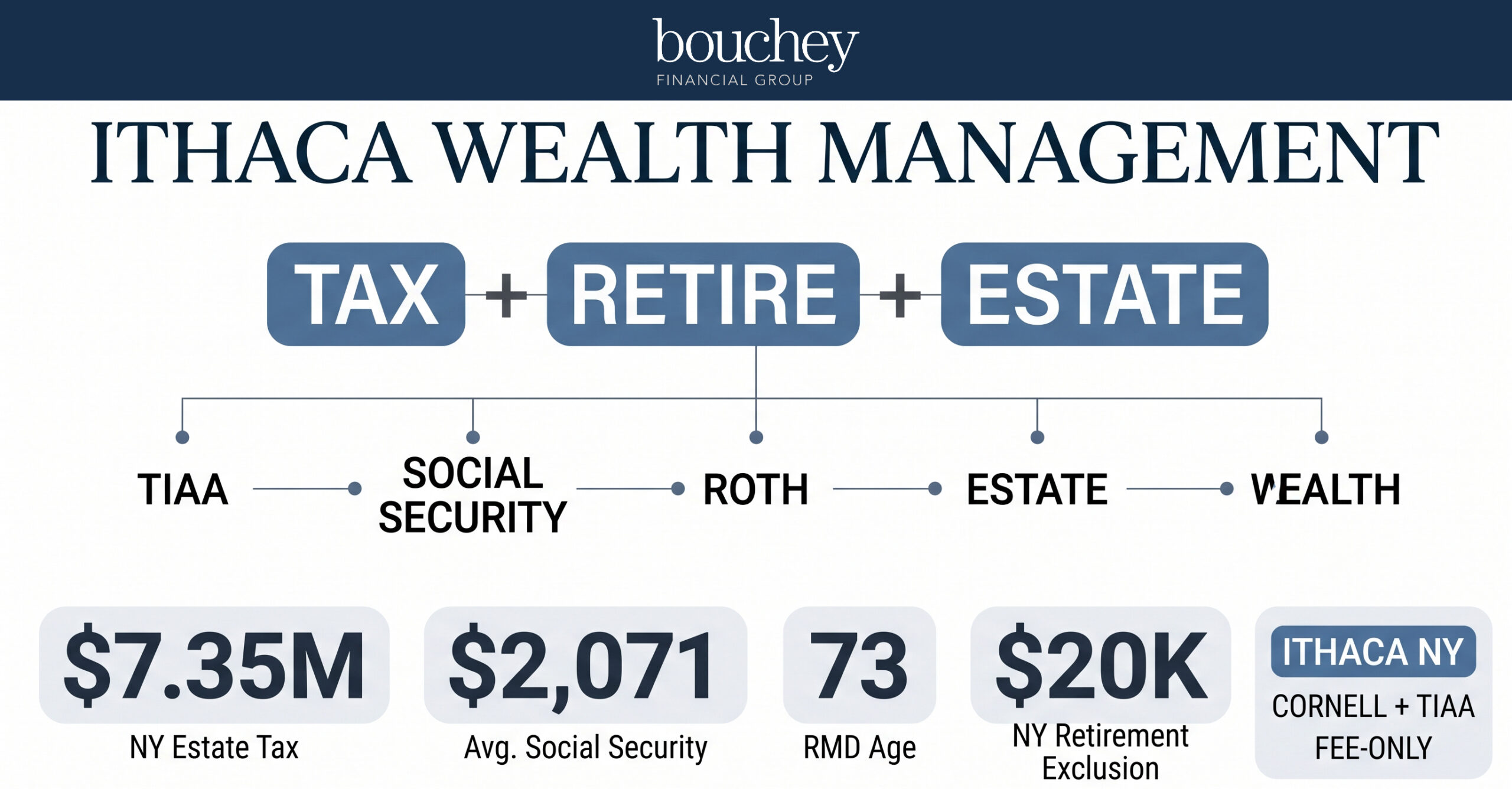
New York provides partial exclusions for certain retirement income, per NY Tax Law guidance. Pension income from NYSLRS fully qualifies for the exclusion. Other qualified pension and retirement income may qualify for a partial exclusion up to $20,000 per taxpayer. For Ithaca-area retirees with TIAA distributions alongside Social Security, knowing which income sources receive favorable state treatment changes the withdrawal sequencing decision.
What Fee-Only Fiduciary Means for Ithaca Households
Fee-only means the firm is paid exclusively by the client. No commissions, no product revenue, no third-party compensation. A fee-only structure eliminates commission-based incentives tied to product sales.
Fiduciary is a legal obligation. According to Investor.gov, registered investment advisers must act in the client's best interest. Broker-dealers recommending investments to retail customers are subject to Regulation Best Interest, a different standard with different conflict-handling requirements. Verify which applies to any advisor you're considering before committing.
Verifying an Advisor in Ithaca
The SEC's Investment Adviser Public Disclosure database and FINRA BrokerCheck provide free public access to adviser registration, Form ADV disclosures, and disciplinary history. Form ADV Part 2A covers fees, services, and conflicts of interest in plain language. Reading it takes ten minutes and answers more than a first meeting will.
New York Tax Planning for Tompkins County Professionals
New York's income tax runs from 4% to 10.9% at the top bracket, per NYS Department of Taxation and Finance. The state taxes long-term capital gains at ordinary income rates rather than the federal preferential structure. A Tompkins County professional realizing a significant gain faces the federal rate plus the applicable New York bracket on the same amount.
The practical consequence for Ithaca-area households: every tax-aware investing decision, asset location, tax-loss harvesting, Roth conversion sizing, capital gains timing, carries a higher combined return than it would for investors in lower-tax states. Decisions made without accounting for the combined state and federal rate often look far less efficient than they appeared.
The Roth Conversion Opportunity in the Pre-RMD Window
Required minimum distributions can begin at age 73 (Dependent upon an individual’s birth year), per IRS RMD guidance. The years between retirement and RMD Age typically represent lower income than working years and lower than the post-RMD Age period when mandatory distributions begin. That window is where Roth conversions, sized to stay within favorable federal and state brackets, can permanently reduce the future RMD burden and create tax-free assets for heirs.
For an Ithaca faculty member retiring at 65 with $1.5 million in TIAA and IRA accounts, the eight-year window before RMDs begin is the most valuable tax planning period of their financial life. The conversion decision requires modeling New York state tax, IRMAA thresholds, Social Security provisional income, and the projected size of future mandatory distributions simultaneously.
Social Security Timing for the Ithaca Area
The SSA's 2026 COLA fact sheet shows a 2.8% adjustment, with the average retired-worker benefit at $2,071 per month and the maximum at full retirement age at $4,152. Delaying from full retirement age to 70 increases benefits by roughly 8% per year.
For Ithaca-area professionals who retire with substantial retirement account balances, the ability to fund spending from those accounts while delaying Social Security is often present. Delay typically makes sense when health is good, portfolio assets can bridge the gap, and the household expects to live into their late 70s or beyond. For married couples, the higher earner's decision also sets the survivor benefit, which can matter for decades after the first death.
The Earnings Test If Still Working
In 2026, someone below full retirement age who claims Social Security and earns above $24,480 will see benefits reduced, per SSA guidance. The test disappears after full retirement age. For Ithaca-area professionals who consult or teach part-time after formal retirement, this interaction between earned income and Social Security benefits is a planning variable worth modeling before claiming.
Estate Planning for Tompkins County Families
New York's 2026 estate tax exclusion is $7,350,000, per the NY Department of Taxation and Finance. For Tompkins County households with appreciated real estate, significant retirement account balances, and life insurance, total estate value can approach that threshold without the household recognizing it.
The exclusion phases out between 100% and 105% of the threshold and disappears entirely above 105%. An estate modestly over the line owes significantly more in New York estate taxes than one just below it. Annual gifting using the $19,000 per recipient exclusion ($38,000 per couple), per IRS gift tax guidance, reduces estate size incrementally over time. For households with children and grandchildren, systematic gifting is one of the most straightforward estate reduction tools available.
Ithaca Real Estate and Basis Planning
Tompkins County real estate has appreciated significantly over the past two decades, driven partly by the university employment base and housing constraints in the area. Long-tenured homeowners and those holding investment property may have substantial embedded gains.
Per IRS Publication 551, inherited property's basis is generally adjusted to fair market value at the date of death, which eliminates embedded gains for heirs. Gifted property carries the original basis. For households with appreciated real estate and estates below the New York exclusion, the decision of how to eventually transfer that property has significant capital gains implications.
Who Bouchey Financial Group Serves in Ithaca
The firm's 22-person team includes 9 CFP® professionals, 3 CPAs, and 1 IRS Enrolled Agent. Bouchey Financial Group manages approximately $1.6 billion for clients across 34 states, with a minimum of $1,000,000 in investable assets. The Ithaca area client base includes university faculty and administrators, healthcare professionals, business owners, and families coordinating multi-generational wealth.
For Ithaca and Tompkins County households ready to build a coordinated financial plan, the Contact Us page is where to start. Recent planning discussions on tax strategy, retirement income, and estate planning are available through the Webinars and Videos library.
Frequently Asked Questions
What makes wealth management different for Cornell or Ithaca College employees?
University employees often hold TIAA-CREF accounts with distribution rules and transfer restrictions that differ from standard IRAs. Some TIAA Traditional balances are subject to payout schedules requiring advance planning. Coordinating TIAA distributions with Social Security timing, Roth conversions, and New York's retirement income exclusions requires familiarity with those account structures specifically.
How does New York's retirement income exclusion affect withdrawal planning?
New York provides a partial exclusion of up to $20,000 per taxpayer for qualifying retirement income other than NYSLRS pensions, which are fully excluded. Knowing which income sources qualify affects withdrawal sequencing — drawing from a qualifying source may produce a lower combined federal and state tax cost than drawing from one that doesn't qualify.
When does it make sense to delay Social Security in the Ithaca area?
Delay generally makes sense when health is reasonable, portfolio assets can cover spending during the bridging period, and the household expects longevity into their late 70s or beyond. For married couples, the higher earner delaying to 70 maximizes the survivor benefit. The claiming decision should be modeled alongside the Roth conversion strategy and portfolio withdrawal sequencing.
What is the New York estate tax cliff and how does it affect Tompkins County homeowners?
New York's 2026 exclusion is $7,350,000. It phases out between 100% and 105% of that amount and disappears entirely above 105%. For Tompkins County households with appreciated real estate, retirement accounts, and life insurance, total estate value can approach or cross the threshold without the household realizing it. Annual gifting and trust structures reduce exposure with advance planning.
Why does inherited property often produce a better tax outcome than gifted property?
Inherited property generally receives a basis adjustment to fair market value at death, eliminating embedded capital gains for heirs. Gifted property carries the donor's original basis to the recipient, who pays capital gains tax on the full appreciation when they eventually sell. For long-tenured Ithaca homeowners with significant appreciation, leaving property in the estate rather than gifting it often produces a better combined tax outcome.
What is the Roth conversion window and why does it matter for Ithaca-area retirees?
The years between retirement and when RMDs begin, often represent the lowest-income period in a professional's financial life. Converting traditional IRA or TIAA assets to Roth during this window pays tax now at a lower rate and permanently reduces future mandatory distributions. For households with large pre-tax balances, the conversion decision made during this window can meaningfully reduce lifetime tax exposure.
How do I verify a fee-only fiduciary advisor in Ithaca?
Search the adviser's registration and Form ADV through the SEC's IAPD at adviserinfo.sec.gov, and check disciplinary history through FINRA BrokerCheck at brokercheck.finra.org. Form ADV Part 2A covers fees, conflicts, and services. Both are free and publicly available.

IMPORTANT DISCLOSURE INFORMATION
Please remember that past performance is no guarantee of future results. Different types of investments involve varying degrees of risk, and there can be no assurance that the future performance of any specific investment, investment strategy, or product (including the investments and/or investment strategies recommended or undertaken by Bouchey Financial Group, Ltd. [“Bouchey Financial”]), or any non-investment related content, made reference to directly or indirectly in this blog will be profitable, equal any corresponding indicated historical performance level(s), be suitable for your portfolio or individual situation, or prove successful. Due to various factors, including changing market conditions and/or applicable laws, the content may no longer be reflective of current opinions or positions. Moreover, no portion of this discussion or information contained in this blog serves as the receipt of, or as a substitute for, personalized investment advice from Bouchey Financial. To the extent that a reader has any questions regarding the applicability of any specific issue discussed above to his/her individual situation, he/she is encouraged to consult with the professional advisor of his/her choosing. Neither Bouchey Financial’s investment adviser registration status, nor any amount of prior experience or success, should be construed that a certain level of results or satisfaction will be achieved if Bouchey Financial is engaged, or continues to be engaged, to provide investment advisory services. Bouchey Financial is neither a law firm nor a certified public accounting firm and no portion of the blog content should be construed as legal or accounting advice. A copy of the Bouchey Financial’s current written disclosure Brochure and Form CRS discussing our advisory services and fees is available for review upon request or at www.bouchey.com. Please Note: Bouchey Financial does not make any representations or warranties as to the accuracy, timeliness, suitability, completeness, or relevance of any information prepared by any unaffiliated third party, whether linked to Bouchey Financial’s web site or blog or incorporated herein, and takes no responsibility for any such content. All such information is provided solely for convenience purposes only and all users thereof should be guided accordingly. Please Remember: If you are a Bouchey Financial client, please contact Bouchey Financial, in writing, if there are any changes in your personal/financial situation or investment objectives for the purpose of reviewing/evaluating/revising our previous recommendations and/or services, or if you would like to impose, add, or to modify any reasonable restrictions to our investment advisory services. Unless, and until, you notify us, in writing, to the contrary, we shall continue to provide services as we do currently. Please Also Remember to advise us if you have not been receiving account statements (at least quarterly) from the account custodian.