
SECURE Act 2.0 Changes Explained | RMDs, Roth Catch-Ups, and 529 Rollovers
The SECURE Act 2.0, signed December 29, 2022, made more than 90 changes to retirement savings rules. Most took effect gradually across 2023, 2024, 2025, and 2026. Several provisions that matter most to high-income households and retirees are now fully in effect, and a few are still rolling out.
Bouchey Financial Group helps clients integrate SECURE Act 2.0 changes into their broader financial planning. The firm's CERTIFIED FINANCIAL PLANNER™ professionals and CPAs work together on retirement income planning, tax strategy, and estate coordination to translate these legislative changes into practical decisions.
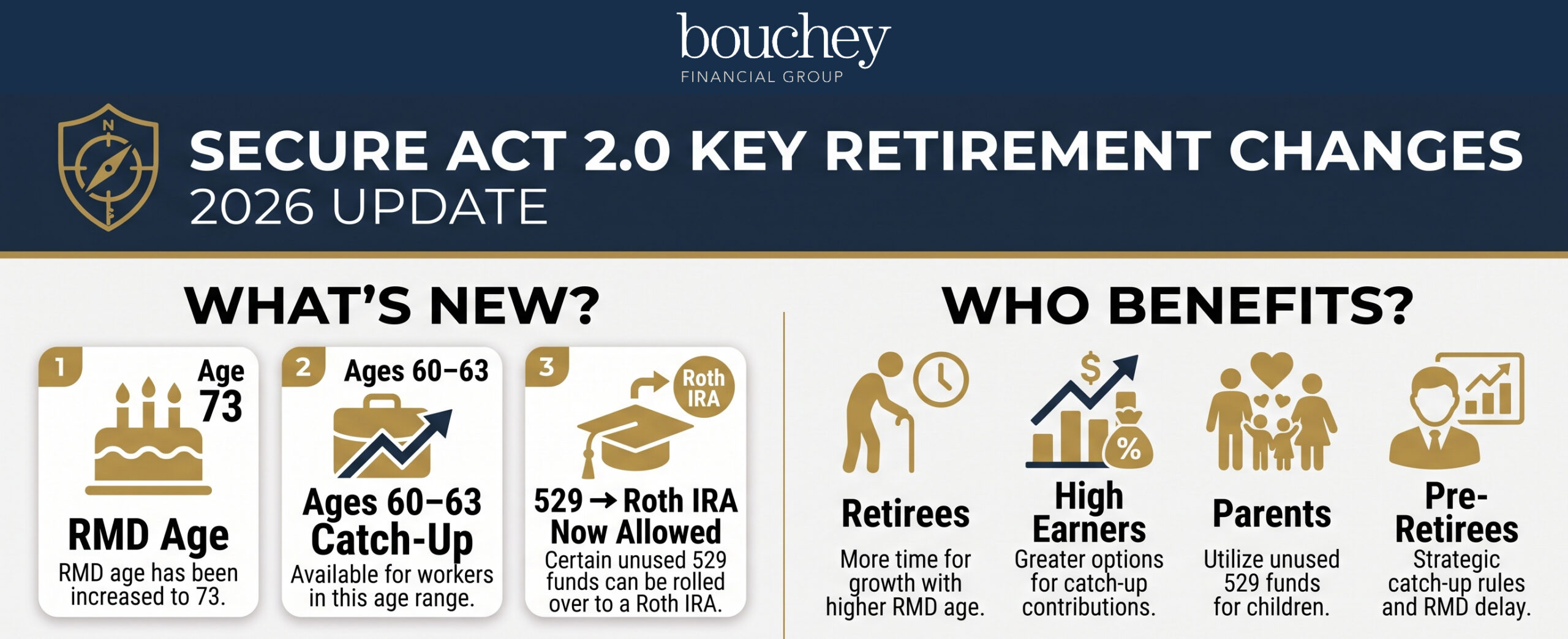
What Changed and When
| Provision | Effective Date |
| RMD age raised to 73 | January 1, 2023 |
| Roth 401(k) lifetime RMDs eliminated | January 1, 2024 |
| 529-to-Roth IRA rollovers permitted | Distributions after December 31, 2023 |
| Super catch-up contributions (ages 60–63) | January 1, 2025 |
| IRA catch-up indexed to inflation | January 1, 2024 |
| Mandatory Roth catch-up for high earners | IRS final regs apply after December 31, 2026 |
| RMD age raised to 75 | January 1, 2033 |
Source: SECURE 2.0 Act, Division T of the Consolidated Appropriations Act of 2023, IRS Retirement Plans
Required Minimum Distributions: The New Age and Rules
The RMD starting age increased from 72 to 73 for anyone who turned 72 after December 31, 2022. It will increase again to 75 for anyone turning 74 after December 31, 2032. The practical effect is a longer window for tax-deferred growth and Roth conversion planning before mandatory distributions begin.
The penalty for missing an RMD dropped from 50% to 25% — and to 10% if corrected within the two-year correction window. Missing a $20,000 RMD under the old rules generated a $10,000 penalty. Under SECURE 2.0, the corrected penalty is $2,000 if resolved promptly.
Roth 401(k) RMDs Eliminated
Starting January 1, 2024, Roth accounts in employer-sponsored plans are no longer subject to lifetime RMDs. Previously, Roth 401(k) holders had to take distributions even though they were tax-free — pushing many investors to roll into a Roth IRA simply to avoid the requirement. That workaround is no longer necessary, and balances can now compound without forced distributions during the owner's lifetime.
The Roth Conversion Window Gets More Valuable
Every additional year before RMDs begin is a year the traditional IRA or 401(k) balance can be converted to Roth at the account owner's discretion. Pushing the RMD start date from 72 to 73 — and eventually to 75 — extends the low-income window during which Roth conversions are most tax-efficient.
For a household with $1.5 million in a traditional IRA retiring at 65, the window between retirement and age 73 is now eight years of potential conversion opportunity. This window also intersects with Social Security timing: many retirees delay claiming to maximize benefits, per SSA guidance on retirement benefits, which keeps taxable income low in the early retirement years and creates additional room for Roth conversions before RMDs begin.
Catch-Up Contributions: Three Changes That Matter
Super Catch-Up for Ages 60–63
Starting January 1, 2025, workers who turn 60, 61, 62, or 63 during the calendar year can make enhanced catch-up contributions to workplace plans. The limit is the greater of $10,000 or 150% of the regular catch-up — in 2026, that equals $11,250.
Combined with the standard 401(k) limit of $24,500 and the regular catch-up of $8,000 for those 50+, a worker in this age range can contribute up to $34,750 to a 401(k) in 2026. That is a meaningful accumulation window for high earners in peak earning years with children out of college and mortgages paid down.
2026 Contribution Limits at a Glance
| Account | Standard Limit | Catch-Up (50+) | Super Catch-Up (60–63) |
| 401(k) / 403(b) | $24,500 | $8,000 | $11,250 |
| IRA (Traditional or Roth) | $7,500 | $1,100 | N/A |
| SIMPLE IRA | $16,500 | $3,500 | $5,250 |
Source: IRS 2026 Contribution Limits, IRS Catch-Up Contributions
IRA Catch-Up Now Indexed to Inflation
The IRA catch-up contribution, stuck at $1,000 for over a decade, is now indexed to inflation. In 2026, it increased to $1,100. This is a modest change but signals annual adjustments going forward rather than Congressional action to update it.
Mandatory Roth Catch-Up for High Earners
This is the most commonly misunderstood SECURE 2.0 provision. Employees aged 50 or older who earned more than $145,000 in FICA wages in the prior year must make catch-up contributions to workplace plans as Roth — not pre-tax. The IRS final regulations apply after December 31, 2026, though plans may implement earlier.
Two clarifications competitors often miss:
- The $145,000 threshold applies to FICA wages only — self-employment income is excluded. A consultant with only self-employment income is not subject to this rule regardless of earnings.
- If the employer plan does not offer a Roth contribution option, catch-up contributions may be disallowed entirely until the plan is amended.
529-to-Roth IRA Rollovers
SECURE 2.0 Section 126 allows unused 529 plan balances to roll into a Roth IRA in the beneficiary's name, effective for distributions after December 31, 2023. It turns trapped 529 funds into a retirement head start for beneficiaries who didn't use all their education savings.
The Five Rules That Must All Be Met
Per Saving for College's rollover guide and IRS guidance:
- The 529 account must have been open for at least 15 years. Changing the beneficiary likely resets this clock.
- Contributions and earnings from the last five years are ineligible.
- Annual rollovers are capped at $7,500 in 2026 ($8,600 if the beneficiary is 50+), subject to the Roth IRA contribution limit.
- The lifetime limit is $35,000 per beneficiary across all rollovers.
- The beneficiary must have earned income at least equal to the rollover amount that year.
The rollovers are not subject to Roth IRA income limits — a significant advantage for high-income beneficiaries who would otherwise be ineligible to contribute to a Roth directly. At current limits, reaching the $35,000 lifetime cap takes approximately five years.
Who Benefits Most
Retirees aged 70–72 gain an additional year of tax-deferred growth and Roth conversion planning before RMDs begin.
Workers aged 60–63 gain access to the largest catch-up window in U.S. retirement law — up to $34,750 in 401(k) contributions in 2026, particularly valuable when college tuition has ended and cash flow has freed up.
High earners subject to the mandatory Roth catch-up face a structural shift to after-tax contributions, accelerating Roth accumulation but requiring planning around the tax cost.
Parents with long-standing 529 accounts can begin rolling unused balances to a Roth IRA for their child, subject to the five conditions above.
Five Planning Moves to Discuss With Your Advisor
- Model the Roth conversion window. With RMDs now starting at 73, evaluate how much to convert annually between retirement and RMD age to reduce future required distributions.
- Confirm your catch-up category. Workers turning 60–63 in 2026 should verify they are using the super catch-up limit of $11,250, not the standard $8,000.
- Check your 529 account age. If you have a 529 account approaching 15 years, verify the opening date and begin planning the rollover sequence.
- Ask whether your plan allows Roth catch-up. High earners subject to the mandatory Roth rule should confirm their employer plan offers a Roth option before 2027.
- Reassess the Roth 401(k) vs. traditional decision. With Roth 401(k) lifetime RMDs eliminated, the calculus for Roth contributions in workplace plans has shifted for many households.
Bouchey Financial Group's advisory team helps clients evaluate these decisions within the context of their full financial plan — including tax strategy, investment management, and estate coordination. Contact the team to discuss which SECURE 2.0 provisions apply to your situation, or explore the firm's recent planning discussions through the Webinars & Videos library.
Frequently Asked Questions
What is the current RMD age under SECURE Act 2.0?
The RMD starting age is 73 for anyone who turned 72 after December 31, 2022. It will increase to 75 for anyone turning 74 after December 31, 2032. The first RMD can be delayed until April 1 of the year following the year you turn 73, though taking two distributions in one year may push you into a higher bracket.
Are Roth 401(k)s still subject to RMDs?
No. Starting January 1, 2024, Roth accounts in employer-sponsored plans are no longer subject to lifetime RMDs. This eliminated the main reason many investors rolled Roth 401(k) balances into Roth IRAs solely to avoid required distributions.
Who must make Roth catch-up contributions, and when does the rule take effect?
Employees aged 50 or older who earned more than $145,000 in FICA wages in the prior year must make catch-up contributions as Roth rather than pre-tax. IRS final regulations apply after December 31, 2026, though plans may implement the rule earlier. Self-employed income is excluded from the $145,000 threshold calculation.
How much can a 62-year-old contribute to a 401(k) in 2026?
A worker who turns 62 in 2026 can contribute the standard $24,500 plus the super catch-up of $11,250, for a total of $35,750. The super catch-up applies to workers who turn 60, 61, 62, or 63 during the calendar year and is the greater of $10,000 or 150% of the regular catch-up limit.
Can I roll over a 529 to a Roth IRA if I'm over the income limit for Roth contributions?
Yes. The 529-to-Roth rollover is not subject to the standard Roth IRA income limits. High earners who would otherwise be ineligible to contribute to a Roth IRA directly can still receive a 529 rollover, subject to the five conditions: 15-year account age, five-year contribution rule, annual limit of $7,500, $35,000 lifetime cap, and earned income requirement.
What happens if I change the beneficiary on a 529 account?
Changing the beneficiary likely resets the 15-year clock required before rollovers to a Roth IRA can begin. The new beneficiary must wait 15 years from the date they became the beneficiary. This is one of the most consequential planning decisions around the 529-to-Roth provision and should be evaluated before any beneficiary change is made.
How does the eliminated Roth 401(k) RMD affect estate planning?
Roth 401(k) balances can now compound without forced distributions during the account owner's lifetime, creating a potentially larger tax-free inheritance. Non-spouse beneficiaries still face a 10-year distribution window under current inherited account rules, but the growth that accumulates without forced distributions increases the tax-free amount passed to heirs.
IMPORTANT DISCLOSURE INFORMATION
Please remember that past performance is no guarantee of future results. Different types of investments involve varying degrees of risk, and there can be no assurance that the future performance of any specific investment, investment strategy, or product (including the investments and/or investment strategies recommended or undertaken by Bouchey Financial Group, Ltd. [“Bouchey Financial”]), or any non-investment related content, made reference to directly or indirectly in this blog will be profitable, equal any corresponding indicated historical performance level(s), be suitable for your portfolio or individual situation, or prove successful. Due to various factors, including changing market conditions and/or applicable laws, the content may no longer be reflective of current opinions or positions. Moreover, no portion of this discussion or information contained in this blog serves as the receipt of, or as a substitute for, personalized investment advice from Bouchey Financial. To the extent that a reader has any questions regarding the applicability of any specific issue discussed above to his/her individual situation, he/she is encouraged to consult with the professional advisor of his/her choosing. Neither Bouchey Financial’s investment adviser registration status, nor any amount of prior experience or success, should be construed that a certain level of results or satisfaction will be achieved if Bouchey Financial is engaged, or continues to be engaged, to provide investment advisory services. Bouchey Financial is neither a law firm nor a certified public accounting firm and no portion of the blog content should be construed as legal or accounting advice. A copy of the Bouchey Financial’s current written disclosure Brochure and Form CRS discussing our advisory services and fees is available for review upon request or at www.bouchey.com. Please Note: Bouchey Financial does not make any representations or warranties as to the accuracy, timeliness, suitability, completeness, or relevance of any information prepared by any unaffiliated third party, whether linked to Bouchey Financial’s web site or blog or incorporated herein, and takes no responsibility for any such content. All such information is provided solely for convenience purposes only and all users thereof should be guided accordingly. Please Remember: If you are a Bouchey Financial client, please contact Bouchey Financial, in writing, if there are any changes in your personal/financial situation or investment objectives for the purpose of reviewing/evaluating/revising our previous recommendations and/or services, or if you would like to impose, add, or to modify any reasonable restrictions to our investment advisory services. Unless, and until, you notify us, in writing, to the contrary, we shall continue to provide services as we do currently. Please Also Remember to advise us if you have not been receiving account statements (at least quarterly) from the account custodian.