
Financial Advisor in Jupiter FL | Fee-Only Fiduciary Wealth Management
Jupiter, Florida, has become one of the fastest-growing wealth markets in the country, and the planning needs of families here reflect that. Bouchey Financial Group is a fee-only fiduciary firm with a remote office in South Florida, serving Jupiter and Palm Beach County residents who want transparent, advisor-only wealth management with no commissions, no product sales, and no conflicts of interest.
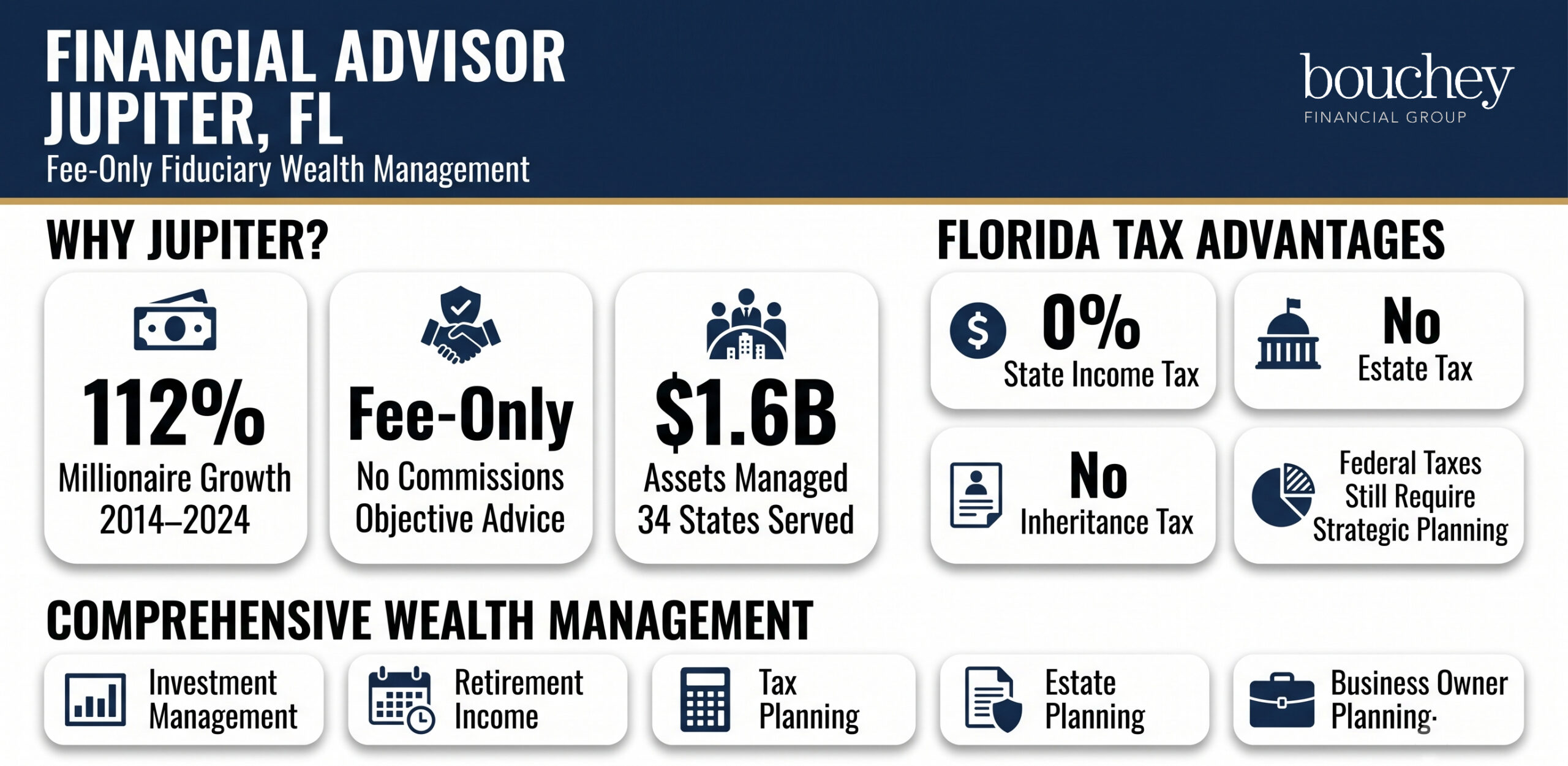
According to Henley & Partners' 2025 World's Wealthiest Cities Report, West Palm Beach and Palm Beach saw a 112% increase in millionaires between 2014 and 2024, ranking the area 4th globally for wealth growth. Jupiter sits at the center of this shift. That level of accumulated wealth demands planning that goes well beyond basic investment management.
Why Fee-Only Fiduciary Matters Here
Palm Beach County is home to countless professionals offering financial advice, but not all advisors operate under the same standards. Some earn commissions from the products they recommend, while others may receive compensation from both clients and third-party providers. A fee-only advisor is paid exclusively by clients, which helps reduce conflicts of interest and keeps the focus on providing objective advice.
A fiduciary advisor is legally obligated to act in your best interest at all times. When an advisor is both fee-only and fiduciary, their compensation structure and professional duty are aligned around helping you make the best financial decisions possible. For families navigating retirement, taxes, estate planning, and long-term wealth preservation, that alignment can provide an added level of confidence that recommendations are being made for your benefit—not someone else's.
The Florida Tax Advantage — and the Planning It Requires
Florida's tax structure is one of the primary reasons wealthy households have relocated here in significant numbers. There is no state income tax, no state estate tax, and no state inheritance tax. For a retiree converting a $1.5 million traditional IRA over five years, the absence of a state income tax layer changes the math considerably compared to planning done in New York or Massachusetts.
What Relocating Households Often Miss
The absence of state income tax does not eliminate federal tax exposure, and relocating families often underestimate how much planning is required to actually capture these savings. Social Security timing, Roth conversion windows, Required Minimum Distributions, and capital gains sequencing all still apply at the federal level.
A physician who relocated from New York to Jupiter with $3 million in deferred compensation and a concentrated stock position faces a very different planning picture than someone who built their wealth entirely in Florida. Coordination between investment management and tax planning — the kind that comes from having CPAs and CERTIFIED FINANCIAL PLANNER™ professionals on the same team — is what turns Florida's tax advantages into realized savings rather than theoretical ones.
What Fee-Only Wealth Management Covers
Comprehensive wealth management in Jupiter typically involves several overlapping disciplines, not a single investment account. The most consequential decisions for high-net-worth households tend to involve:
- Investment management: Strategic and tactical asset allocation across global asset classes, using index funds to minimize expense drag and maximize after-tax return
- Retirement income planning: Withdrawal sequencing, Social Security optimization, and RMD management to control taxable income across retirement years
- Tax-efficient investing: Coordination between portfolio decisions and annual tax exposure, particularly relevant for households with concentrated positions or significant capital gains
- Estate planning coordination: Ensuring investment and beneficiary structures align with estate documents; gifting strategy using the annual exclusion of $19,000 per recipient ($38,000 per couple) and the current federal estate tax exemption of $15M per individual
- Business owner planning: Exit strategy, liquidity event planning, and post-transaction wealth management for Jupiter-area entrepreneurs
Who This Firm Serves
Bouchey Financial Group works with individuals and families with $500,000 or more in investable assets. The firm currently manages approximately $1.6 billion for clients in 34 states. The team of 22 professionals includes 9 CFP® professionals, 3 CPAs, and 1 IRS Enrolled Agent — a combination that matters when tax efficiency is a central part of the planning strategy rather than an afterthought.
The CPA Differentiator
At many wealth management firms, tax planning happens separately from investment management. An advisor may make recommendations, then rely on an outside accountant to evaluate the tax implications later. When CPAs and advisors work together as part of the same team, those conversations happen at the same time, helping ensure that investment decisions are made with the tax impact already in mind.
That level of coordination can make a meaningful difference over the long run. For example, a retiree drawing income from multiple accounts while considering Roth conversions needs a strategy that balances both investment and tax considerations. Looking at the full picture can help reduce unnecessary taxes and keep more of a portfolio working toward long-term goals.
How Fiduciary Accountability Works in Practice
The SEC requires registered investment advisors to adhere to a fiduciary standard, which includes both a duty of care and a duty of loyalty. In practical terms, this means a fiduciary advisor must:
- Recommend strategies that serve the client's best interest, not the firm's revenue
- Disclose any conflicts of interest
- Use reasonable judgment in selecting investments
- Provide accurate and complete information
Consumers can verify an advisor's registration and disciplinary history through the SEC's Investment Adviser Public Disclosure database or through FINRA BrokerCheck. Any advisor who hesitates to confirm their fiduciary status in writing is worth scrutinizing.
Wealth Planning for Jupiter Retirees and Pre-Retirees
Many Jupiter residents are at or near retirement age, making the transition from building wealth to living off it one of the most important financial milestones they'll face. At this stage, the focus often shifts to creating reliable retirement income, deciding when to claim Social Security, managing taxes on withdrawals, and ensuring assets are positioned to support both current lifestyle goals and future family needs.
Social Security Optimization
The Social Security Administration estimates that delayed claiming from age 62 to 70 increases monthly benefits by approximately 77%. For a married couple where both spouses have significant earnings histories, the claiming decision alone can affect lifetime benefits by hundreds of thousands of dollars. It is also one of the most commonly deferred planning conversations — and one of the most consequential.
Making the Most of the Move to Jupiter
Jupiter's growth has attracted a wide range of financial professionals, from fee-only fiduciary advisors to commission-based brokers and hybrid firms. While titles can sound similar, the way an advisor is compensated and the standards they operate under can have a meaningful impact on the advice you receive. That's why it's worth asking a few key questions: Are they a fiduciary at all times? How are they paid? And do they have tax expertise available as part of the planning process? The answers can help you determine whether an advisor is truly positioned to support your long-term financial goals.
For families who have relocated to Jupiter from high-tax states, the planning opportunity is real — but only if executed deliberately. Bouchey Financial Group's team of CFP® professionals, CPAs, and IRS Enrolled Agent brings the combined expertise that complex planning at this level requires. To schedule a consultation, contact the team directly or tune in to Let's Talk Money on WGY Saturdays at 10:00am and Sundays at 8:00am to hear how the firm approaches these conversations each week.
Frequently Asked Questions
What is the difference between a fee-only and fee-based financial advisor?
A fee-only advisor is compensated exclusively by the client — through a flat fee, hourly rate, or percentage of assets under management — and earns no commissions on any product. A fee-based advisor may charge client fees and also receive compensation from third parties for recommending certain products. The distinction matters because compensation structure shapes incentives, and fee-only advisors have fewer conflicts of interest by design.
Does Florida's lack of a state income tax eliminate the need for tax planning?
No. Federal income tax still applies to ordinary income, capital gains, Roth conversions, and Required Minimum Distributions regardless of where you live. Florida's tax advantages create meaningful planning opportunities, but those opportunities require active management — particularly around withdrawal sequencing, RMD timing, and estate structure — to be fully realized.
How do I verify that a financial advisor in Jupiter, FL is a true fiduciary?
Ask the advisor to confirm their fiduciary status in writing and check their registration through the SEC's Investment Adviser Public Disclosure database at adviserinfo.sec.gov. Registered investment advisors are held to a fiduciary standard by law; broker-dealers are not. Advisors who are dually registered may switch between standards depending on the transaction.
What is a reasonable minimum investment to work with a fee-only fiduciary firm?
Minimums vary significantly by firm. Bouchey Financial Group requires a minimum of $500,000 in investable assets. Firms with lower minimums may offer limited planning services rather than comprehensive wealth management, while some boutique practices in Palm Beach County require $2 million or more.
What planning challenges are specific to households that relocated to Florida from high-tax states?
Relocation often triggers a multi-year planning window that includes establishing Florida domicile for tax purposes, reviewing beneficiary and estate documents under Florida law, evaluating deferred compensation or stock options that may have been taxed in the prior state, and reassessing asset allocation for a retirement income environment rather than an accumulation phase.
How does having in-house CPAs differ from coordinating with an outside accountant?
When CPAs and financial planners work within the same firm, investment decisions and tax consequences are evaluated simultaneously rather than sequentially. This integration is most valuable for retirees managing Roth conversions, business owners timing a liquidity event, or households with multiple income sources across different tax treatment categories.
What Social Security timing strategies are most relevant for affluent retirees in Jupiter?
High-net-worth retirees with sufficient portfolio assets to defer claiming often benefit from delayed Social Security — particularly the higher-earning spouse waiting until age 70, when benefits reach their maximum. In households with significant other income, provisional income calculations also affect how much of Social Security benefits are subject to federal tax, making the claiming decision one that should be analyzed alongside the overall withdrawal strategy.
IMPORTANT DISCLOSURE INFORMATION
Please remember that past performance is no guarantee of future results. Different types of investments involve varying degrees of risk, and there can be no assurance that the future performance of any specific investment, investment strategy, or product (including the investments and/or investment strategies recommended or undertaken by Bouchey Financial Group, Ltd. [“Bouchey Financial”]), or any non-investment related content, made reference to directly or indirectly in this blog will be profitable, equal any corresponding indicated historical performance level(s), be suitable for your portfolio or individual situation, or prove successful. Due to various factors, including changing market conditions and/or applicable laws, the content may no longer be reflective of current opinions or positions. Moreover, no portion of this discussion or information contained in this blog serves as the receipt of, or as a substitute for, personalized investment advice from Bouchey Financial. To the extent that a reader has any questions regarding the applicability of any specific issue discussed above to his/her individual situation, he/she is encouraged to consult with the professional advisor of his/her choosing. Neither Bouchey Financial’s investment adviser registration status, nor any amount of prior experience or success, should be construed that a certain level of results or satisfaction will be achieved if Bouchey Financial is engaged, or continues to be engaged, to provide investment advisory services. Bouchey Financial is neither a law firm nor a certified public accounting firm and no portion of the blog content should be construed as legal or accounting advice. A copy of the Bouchey Financial’s current written disclosure Brochure and Form CRS discussing our advisory services and fees is available for review upon request or at www.bouchey.com. Please Note: Bouchey Financial does not make any representations or warranties as to the accuracy, timeliness, suitability, completeness, or relevance of any information prepared by any unaffiliated third party, whether linked to Bouchey Financial’s web site or blog or incorporated herein, and takes no responsibility for any such content. All such information is provided solely for convenience purposes only and all users thereof should be guided accordingly. Please Remember: If you are a Bouchey Financial client, please contact Bouchey Financial, in writing, if there are any changes in your personal/financial situation or investment objectives for the purpose of reviewing/evaluating/revising our previous recommendations and/or services, or if you would like to impose, add, or to modify any reasonable restrictions to our investment advisory services. Unless, and until, you notify us, in writing, to the contrary, we shall continue to provide services as we do currently. Please Also Remember to advise us if you have not been receiving account statements (at least quarterly) from the account custodian.