
Q1 2026 Market Update: Momentum Between the Headlines
Written by: Paolo LaPietra, Director of Portfolio Strategy
The Masters has always felt like the unofficial start of spring to me. Something about that weekend, the course, the tradition, it just creates a sense of optimism that warmer days are right around the corner. After a long winter here in New York, I think we’re all ready for that. If only the market headlines felt the same way.
When we kicked off 2026, the theme was clear. This wasn’t a reset, it was momentum. After a strong 2025, the foundation for markets was built on earnings, capital investment, and a resilient economy. Over the last few months, that narrative has been tested, not broken, and most of that pressure has come from outside the economy itself.
The recent conflict in the Middle East has introduced a level of uncertainty that markets never handle particularly well, and the most immediate impact has come through energy. Roughly 20 to 25 percent of the world’s oil flows through the Strait of Hormuz, so any disruption there matters. We’ve all felt that firsthand, with gas prices now pushing above $4 here in New York.
Higher gas prices create pressure in a couple of important ways. First, they act as a direct hit to the consumer. The U.S. consumer makes up more than 70 percent of GDP, and when more money is going toward filling up the tank, it’s not being spent elsewhere. That doesn’t mean spending stops, it just shifts, and that shift tends to weigh on broader economic activity. At the same time, higher oil prices feed directly into inflation, which complicates the path forward for the Federal Reserve.
At the start of the year, markets were expecting two rate cuts in 2026. Today, expectations have shifted toward no cuts at all. That’s a meaningful change, and it’s largely tied to the stickiness of inflation and the recent move in energy prices.
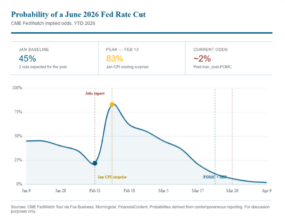
The good news is that energy-driven shocks like this are often temporary. We saw a glimpse of that just this week when a two-week ceasefire was announced and oil prices dropped roughly 15 percent in a single day. Whether that becomes something more lasting is still unclear. There’s been a lot of ambiguity around what has actually been agreed to, and while we’re seeing some normalization in shipping through the Strait of Hormuz, it remains well below pre-conflict levels. What matters more, in our view, is where the economy stood before all of this.
One of the charts we’ve been watching closely is the U.S. Economic Surprise Index, which measures how economic data is coming in relative to expectations. When it’s positive, it means the economy is outperforming forecasts. When it’s negative, it means the opposite. Right now, that index is sitting at its highest level in nearly three years.
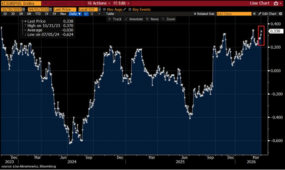
That’s important, because it tells a very different story than the headlines. Beneath the surface, the economy has remained resilient. We saw that reinforced again in the latest jobs report last week, which showed 178,000 jobs added and unemployment at 4.3 percent, both coming in better than expected. So where do we go from here?
In many ways, this becomes a question of timing. If the current ceasefire evolves into something more permanent, lower oil prices combined with a resilient economy and continued investment in AI should allow that original momentum story to reassert itself as we move through the year. If tensions persist and energy prices remain elevated, that pressure on the consumer and on inflation could create a more challenging backdrop for both the Federal Reserve and the markets. Either way, this is exactly the type of environment our portfolios are built for.
We’ve positioned our portfolios with the flexibility to respond to both scenarios, whether that means taking advantage of opportunities created by volatility or leaning into areas where long-term trends remain firmly intact. The goal is not to predict every headline, but to stay aligned with the underlying drivers that have historically mattered most over time. In environments like this, where headlines can shift quickly and volatility feels elevated, it’s important to stay grounded in what actually drives long-term results. While the path forward may not be perfectly smooth, the underlying trends we’ve been focused on remain intact.
During periods like this, it’s helpful to stay grounded in a simple principle: volatility doesn’t last, but long-term investors do. That mindset continues to guide how our portfolios are positioned, staying thoughtful, opportunistic, and focused on what matters most over time.
This letter was intentionally lighter on charts, as we covered the broader economic landscape in detail during last month’s State of the Economy.
If you haven’t had a chance to watch it, I’d encourage you to do so at the link below:
https://bouchey.com/2026/webinars-videos/2026-state-of-the-economy
Paolo

IMPORTANT DISCLOSURE INFORMATION
Please remember that past performance is no guarantee of future results. Different types of investments involve varying degrees of risk, and there can be no assurance that the future performance of any specific investment, investment strategy, or product (including the investments and/or investment strategies recommended or undertaken by Bouchey Financial Group, Ltd. [“Bouchey Financial”]), or any non-investment related content, made reference to directly or indirectly in this blog will be profitable, equal any corresponding indicated historical performance level(s), be suitable for your portfolio or individual situation, or prove successful. Due to various factors, including changing market conditions and/or applicable laws, the content may no longer be reflective of current opinions or positions. Moreover, no portion of this discussion or information contained in this blog serves as the receipt of, or as a substitute for, personalized investment advice from Bouchey Financial. To the extent that a reader has any questions regarding the applicability of any specific issue discussed above to his/her individual situation, he/she is encouraged to consult with the professional advisor of his/her choosing. Neither Bouchey Financial’s investment adviser registration status, nor any amount of prior experience or success, should be construed that a certain level of results or satisfaction will be achieved if Bouchey Financial is engaged, or continues to be engaged, to provide investment advisory services. Bouchey Financial is neither a law firm nor a certified public accounting firm and no portion of the blog content should be construed as legal or accounting advice. A copy of the Bouchey Financial’s current written disclosure Brochure and Form CRS discussing our advisory services and fees is available for review upon request or at www.bouchey.com. Please Note: Bouchey Financial does not make any representations or warranties as to the accuracy, timeliness, suitability, completeness, or relevance of any information prepared by any unaffiliated third party, whether linked to Bouchey Financial’s web site or blog or incorporated herein, and takes no responsibility for any such content. All such information is provided solely for convenience purposes only and all users thereof should be guided accordingly. Please Remember: If you are a Bouchey Financial client, please contact Bouchey Financial, in writing, if there are any changes in your personal/financial situation or investment objectives for the purpose of reviewing/evaluating/revising our previous recommendations and/or services, or if you would like to impose, add, or to modify any reasonable restrictions to our investment advisory services. Unless, and until, you notify us, in writing, to the contrary, we shall continue to provide services as we do currently. Please Also Remember to advise us if you have not been receiving account statements (at least quarterly) from the account custodian.