
The Big Beautiful Breakdown: What’s In the New Tax Bill?

Written by: Vincenzo G. Testa, CPA, CFP®, ECA
On July 4th, 2025, the “One Big Beautiful Bill” was signed into law, bringing with it the biggest changes to the U.S. tax code in nearly a decade. While the news coverage has focused on the politics, our priority is helping you understand what this means for you - whether you're a high-earning professional, investor, business owner, or retiree.
This blog breaks down the key tax changes we think you should know about - some create new planning opportunities, while others may require adjustments to your current strategy. Our goal is to help you stay informed and make smart, proactive decisions moving forward.
Lower Tax Rates Are Here to Stay
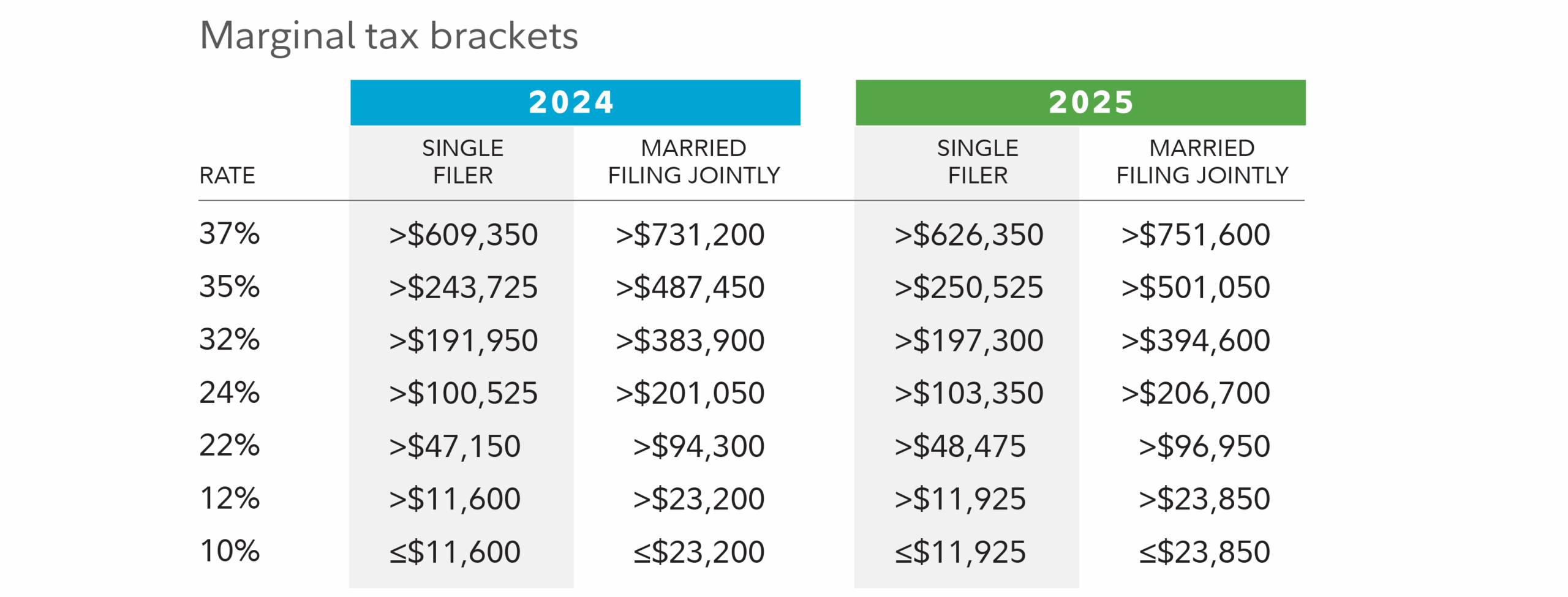
The 2017 Trump-era tax cuts for individuals have been made permanent. That means lower income tax brackets and a higher standard deduction will no longer expire after 2025.
Child Tax Credit Increased
The Child Tax Credit is now $2,200 per child (increased from $2,000), with income thresholds remaining the same. The credit is now partially refundable and indexed to inflation.
Expanded SALT Deduction (Temporarily)
The State and Local Tax (SALT) deduction cap has been raised to $40,000 starting in 2025, with a 1% yearly increase for households with a modified adjusted gross income (MAGI) under $500,000. Above $500,000, the SALT cap starts to phase out and drops to $10,000 once MAGI reaches $600,000.This expanded limit is temporary and revert back to $10,000 in 2030. The increase in the SALT Deduction will result in tax savings for many taxpayers.
New “Senior Deduction”
Taxpayers ages 65 and up can now claim an additional $6,000 deduction ($12,000 for married couples), which is aimed at reducing or eliminating tax on Social Security income. This deduction phases out for higher earners and expires after 2028.
Deductions Auto Loans (Temporarily)
Auto loan interest on U.S. made vehicles is deductible up to $10,000/year through 2028. This is an “above-the-line” deduction, which means that you do not have to itemize your deductions to claim this deduction. With auto loan rates at historic highs, this provision aims to increase demand on U.S. manufactured vehicles.
Estate & Gift Tax Exemption Increased
The estate, gift, and generation-skipping transfer tax exemption has been raised to $15 million per person ($30 million per couple), with inflation indexing going forward. This means – an estate will only owe Federal estate tax if the worth of the estate is above those thresholds. State Estate Tax Laws may differ.
New Investment Account for Dependents (“Trump Accounts”)
Trump Accounts” are tax-advantaged savings accounts seeded with $1,000 at birth for every U.S. child born from Dec 2025 to Dec 2028. Families can contribute up to $5,000 annually, with tax-deferred growth and favorable tax treatment on withdrawals used for education, first-time home purchases, or small business investments. Funds must be invested in low-cost U.S. equity index funds, and early or non-qualified withdrawals are penalized.
Charitable Deduction Rules for Non-Itemizers
The new legislation brings back an above-the-line charitable deduction and this time, it’s permanent. Starting in 2026, taxpayers taking the standard deduction can write off up to $1,000 (single) or $2,000 (joint) in cash donations to qualified charities. This allows non-itemizers to reduce their AGI and receive a tax benefit for giving without having to itemize their deductions.
As always, the right strategies depend on your individual goals, income, and long-term financial picture. If you have questions about how these changes impact your tax planning or investment strategy, we are here to help you navigate the changes with clarity and confidence. For other items included in the bill not listed in this blog, please reach out to an advisor to discuss in greater detail.
IMPORTANT DISCLOSURE INFORMATION
Please remember that past performance is no guarantee of future results. Different types of investments involve varying degrees of risk, and there can be no assurance that the future performance of any specific investment, investment strategy, or product (including the investments and/or investment strategies recommended or undertaken by Bouchey Financial Group, Ltd. [“Bouchey Financial”]), or any non-investment related content, made reference to directly or indirectly in this blog will be profitable, equal any corresponding indicated historical performance level(s), be suitable for your portfolio or individual situation, or prove successful. Due to various factors, including changing market conditions and/or applicable laws, the content may no longer be reflective of current opinions or positions. Moreover, no portion of this discussion or information contained in this blog serves as the receipt of, or as a substitute for, personalized investment advice from Bouchey Financial. To the extent that a reader has any questions regarding the applicability of any specific issue discussed above to his/her individual situation, he/she is encouraged to consult with the professional advisor of his/her choosing. Neither Bouchey Financial’s investment adviser registration status, nor any amount of prior experience or success, should be construed that a certain level of results or satisfaction will be achieved if Bouchey Financial is engaged, or continues to be engaged, to provide investment advisory services. Bouchey Financial is neither a law firm nor a certified public accounting firm and no portion of the blog content should be construed as legal or accounting advice. A copy of the Bouchey Financial’s current written disclosure Brochure and Form CRS discussing our advisory services and fees is available for review upon request or at www.bouchey.com. Please Note: Bouchey Financial does not make any representations or warranties as to the accuracy, timeliness, suitability, completeness, or relevance of any information prepared by any unaffiliated third party, whether linked to Bouchey Financial’s web site or blog or incorporated herein, and takes no responsibility for any such content. All such information is provided solely for convenience purposes only and all users thereof should be guided accordingly. Please Remember: If you are a Bouchey Financial client, please contact Bouchey Financial, in writing, if there are any changes in your personal/financial situation or investment objectives for the purpose of reviewing/evaluating/revising our previous recommendations and/or services, or if you would like to impose, add, or to modify any reasonable restrictions to our investment advisory services. Unless, and until, you notify us, in writing, to the contrary, we shall continue to provide services as we do currently. Please Also Remember to advise us if you have not been receiving account statements (at least quarterly) from the account custodian.