
Estate Planning Services in West Palm Beach | Tax-Efficient Wealth Transfer
The most common estate planning mistake isn't failing to write a will. It's assuming estate planning only becomes relevant once your net worth approaches the federal estate tax threshold. At $15 million per individual in 2026, most West Palm Beach families aren't there. But that doesn't mean their assets transfer efficiently, avoid probate, reach the right people, or receive favorable tax treatment without a plan.
Bouchey Financial Group coordinates the financial planning and tax strategy components of estate planning for West Palm Beach clients, working alongside estate attorneys and CPAs. The firm's CERTIFIED FINANCIAL PLANNER™ professionals and CPAs ensure investment decisions, account titling, beneficiary designations, and gifting strategies are aligned with clients' legal documents rather than working against them.
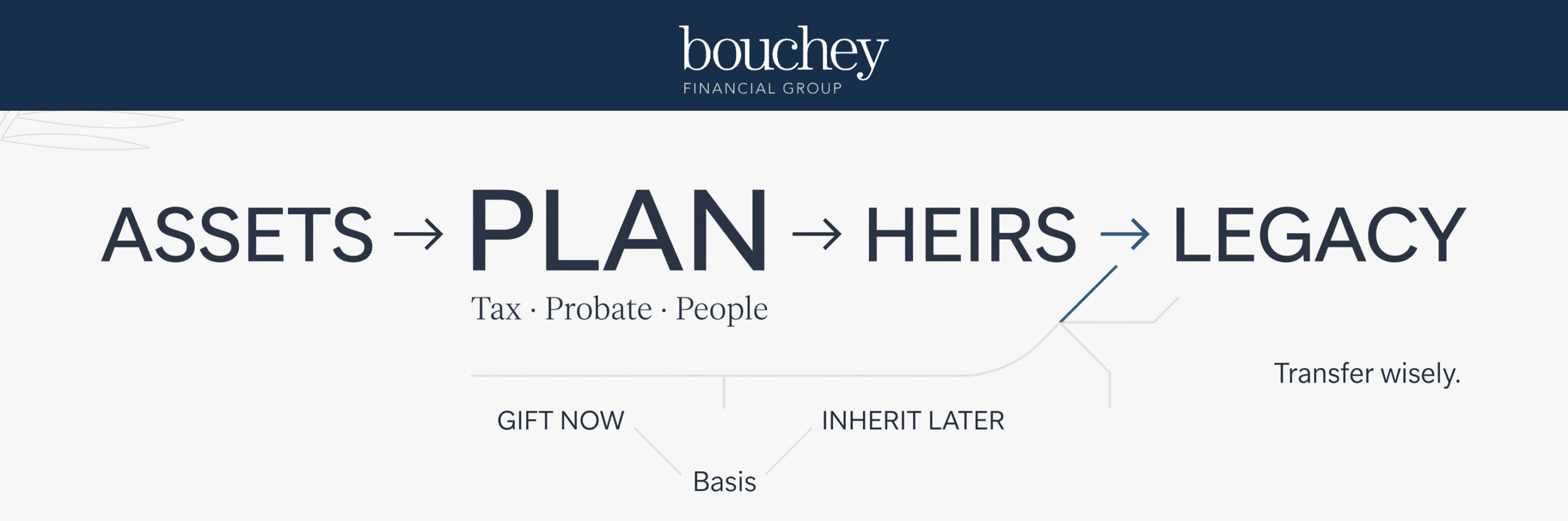
A $15 Million Exemption Doesn't Mean Planning Starts at $15 Million
For someone dying in 2026, federal estate tax generally applies when the gross estate plus adjusted taxable gifts exceeds $15 million, per the IRS estate tax FAQ. Most households don't come close.
But estate planning also determines who receives assets, when, what passes through probate, whether inherited assets receive favorable basis treatment, and how a surviving spouse is protected. A family with a $3 million estate and no plan can leave behind the same administrative chaos as a family that ignored a $20 million estate.
Estate Tax vs. Capital Gains Tax: They Pull in Different Directions
This is the planning tension most families never hear about until they've already made a costly decision.
Consider a couple holding an investment purchased for $500,000, now worth $4 million. The instinct is often to transfer it out of the estate early. But that instinct doesn't account for basis. According to IRS Publication 551, inherited property's basis is generally adjusted to fair market value at the date of death. A lifetime gift generally carries the donor's original basis to the recipient.
Give the asset during life: the recipient inherits a $500,000 basis on a $4 million asset. Leave it in the estate: the heir inherits a $4 million basis. The capital gains exposure on $3.5 million of appreciation doesn't disappear through gifting. For estates well below the federal exclusion, removing highly appreciated assets to reduce estate size can cost heirs far more in capital gains than it saves in estate taxes. The analysis requires modeling both.
Avoiding Probate and Avoiding Estate Tax Are Two Different Things
The Florida Bar's revocable trust guide is direct: revocable trusts are often credited with saving estate taxes, but that's not accurate. A revocable living trust can streamline administration and avoid probate for assets held within it. But those assets remain part of the gross estate for federal estate tax purposes. Probate planning and estate tax planning are separate exercises.
Irrevocable Trusts Can Create Tax Consequences of Their Own
An irrevocable trust can serve purposes related to wealth transfer, asset protection, or specialized tax objectives depending on its structure. But as the Florida Bar's irrevocable trust pamphlet warns, the tax consequences can be "incredibly nuanced and complex." Depending on structure and administration, income tax can fall on the trust, the donor, or beneficiaries. A trust isn't automatically a tax-saving device.
Your West Palm Beach Home Has Special Rules
Florida homestead law affects estate planning in ways that catch families off guard, particularly those with second marriages, blended families, or minor children.
Florida Statute §732.4015 restricts the devise of homestead when the owner is survived by a spouse or minor child. A West Palm Beach homeowner can't simply leave their primary residence to whoever they choose in those circumstances — the law imposes specific protections. Attempting to structure around these restrictions through a trust doesn't automatically succeed either. Under Florida Trust Code §736.1109, a trust disposition that violates constitutional homestead restrictions doesn't simply override them.
Can You Completely Disinherit a Spouse in Florida?
The short answer is no. Florida law gives a surviving spouse a right to an elective share of the deceased spouse's elective estate under the state's Probate Code provisions. For blended families, second marriages, or couples with children from prior relationships, this has meaningful implications for how estates are structured and how assets are titled.
A Florida estate attorney needs to be involved in these decisions. The financial planner's role is ensuring account titling, beneficiary designations, and investment structures are consistent with what the legal documents intend.
Portability: A Tax Filing That Has Nothing to Do with Tax Owed
When a spouse dies with unused federal exclusion, the surviving spouse can claim that unused amount through the portability election. But the election requires filing Form 706 within nine months of death, with extension available, regardless of whether the estate owes any estate tax.
The IRS is clear: the filing is to make the election, not to pay the tax. Miss that nine-month deadline and the unused exclusion is forfeited permanently. For a married West Palm Beach household well below the $15 million threshold today, that forfeiture might be irrelevant. For one that approaches the threshold through future appreciation or inheritance, it becomes a very expensive omission. This is a coordination item between the estate attorney and the CPA, and the financial advisor should be making sure it's on the list.
Which Assets Should You Spend, Gift, or Leave?
Not every asset transfers the same way or produces the same outcomes.
| Asset | Key Transfer Consideration |
| Highly appreciated stock | Estate exposure vs. basis consequences for heirs |
| Traditional IRA | Ordinary income to beneficiary; 10-year distribution window for non-spouse heirs |
| Roth IRA | Tax-free to heirs; still subject to 10-year window for non-spouses |
| Florida homestead | State devise restrictions; spousal and minor-child rights apply |
| Business interest | Valuation, succession, liquidity, and GST considerations |
| Life insurance | Ownership structure and beneficiary designation drive estate and income tax treatment |
| Charitable assets | QCDs, DAFs, CRTs, and direct bequests each carry different tax profiles |
The goal of tax-efficient wealth transfer isn't picking a strategy. It's knowing which strategy applies to which asset and why.
Leaving Assets to Grandchildren Adds Another Layer
Transfers that skip a generation can trigger generation-skipping transfer tax, per IRS Publication 559. The 2026 GST exemption is $15 million per individual. For West Palm Beach families who want wealth to benefit multiple future generations, structuring how those transfers occur and how GST exemption is allocated belongs in the planning conversation from the beginning.
Tax Records Have to Outlive the Wealth Owner
Original cost basis records, appraisals, valuations, Form 706, Form 709, and Schedule A/Form 8971 for applicable estates all need to survive the wealth owner and reach the estate administrator and beneficiaries.
A 20-year gifting program means two decades of Form 709 filings and GST exemption allocations. Families who gift systematically without maintaining the paper trail create disputes during administration. The financial advisor, CPA, and estate attorney each carry part of this responsibility.
Coordinating the Financial and Legal Plan
Bouchey Financial Group's role in estate planning isn't drafting legal documents. It's ensuring the financial plan and the legal plan say the same thing: that account titles match trust ownership, beneficiary designations reflect the estate plan, investment and gifting strategies are tax-coordinated, and the CPAs and estate attorney are working from the same picture.
The firm's 23-person advisory team includes CFP® professionals, 3 CPAs, and 1 IRS Enrolled Agent who coordinate these decisions for clients throughout West Palm Beach and Palm Beach County. For households with $1,000,000 or more in investable assets who want to review how their financial plan aligns with their estate plan, the Contact Us page is the place to start. Recent estate and tax planning discussions are also available through the Webinars and Videos library.
Frequently Asked Questions
Does estate planning only matter if my estate exceeds $15 million?
No. Estate planning determines who receives assets, when, through what legal mechanism, and with what tax consequences. Probate exposure, beneficiary designations, incapacity documents, and basis planning all apply well below the federal estate tax threshold. The $15 million number is relevant only to federal estate tax exposure.
What is the portability election and why does the filing deadline matter?
Portability allows a surviving spouse to claim the deceased spouse's unused federal exclusion. Claiming it requires filing Form 706 within nine months of death, even when the estate owes no tax. Missing the deadline forfeits the election permanently. For estates that could approach the threshold through future appreciation, this filing can be highly consequential.
Does a revocable living trust reduce estate taxes?
No. Assets in a revocable trust remain part of the gross estate for federal estate tax purposes. A revocable trust can avoid probate and simplify estate administration, but it doesn't remove assets from the taxable estate. Those are two separate planning objectives that require different tools.
Why might gifting an appreciated asset during life produce a worse tax outcome than inheriting it?
Gifted assets generally carry the donor's original cost basis to the recipient. Inherited assets generally receive a basis adjustment to fair market value at death. For assets with large unrealized gains, the capital gains tax exposure on the original basis can far exceed any estate tax saved by removing the asset from the estate, particularly for families well below the federal exclusion.
What are Florida's homestead devise restrictions?
Florida law restricts how homestead property can be transferred when the owner is survived by a spouse or minor child. Attempts to leave the property to someone outside those protections, including through a trust, don't automatically override the restrictions. Any West Palm Beach household with a primary residence and a spouse or minor children needs to have their estate documents reviewed by a Florida estate attorney.
What is generation-skipping transfer tax and when does it apply?
GST tax applies to transfers that skip a generation, such as direct transfers to grandchildren. The 2026 GST exemption is $15 million per individual. Proper allocation of that exemption at the time of transfer requires coordination with an estate attorney, and the GST system operates alongside the estate and gift tax system rather than replacing it.
Which assets are generally better to gift during life and which are better to leave at death?
Assets with low appreciation relative to their estate exposure may benefit from lifetime gifting. Highly appreciated assets with large embedded gains are often better candidates for inheritance, where heirs receive a basis adjustment at death. IRAs present a different calculus entirely, since they carry ordinary income tax regardless of how they transfer. Each asset type requires its own analysis within the overall transfer strategy.

IMPORTANT DISCLOSURE INFORMATION
Please remember that past performance is no guarantee of future results. Different types of investments involve varying degrees of risk, and there can be no assurance that the future performance of any specific investment, investment strategy, or product (including the investments and/or investment strategies recommended or undertaken by Bouchey Financial Group, Ltd. [“Bouchey Financial”]), or any non-investment related content, made reference to directly or indirectly in this blog will be profitable, equal any corresponding indicated historical performance level(s), be suitable for your portfolio or individual situation, or prove successful. Due to various factors, including changing market conditions and/or applicable laws, the content may no longer be reflective of current opinions or positions. Moreover, no portion of this discussion or information contained in this blog serves as the receipt of, or as a substitute for, personalized investment advice from Bouchey Financial. To the extent that a reader has any questions regarding the applicability of any specific issue discussed above to his/her individual situation, he/she is encouraged to consult with the professional advisor of his/her choosing. Neither Bouchey Financial’s investment adviser registration status, nor any amount of prior experience or success, should be construed that a certain level of results or satisfaction will be achieved if Bouchey Financial is engaged, or continues to be engaged, to provide investment advisory services. Bouchey Financial is neither a law firm nor a certified public accounting firm and no portion of the blog content should be construed as legal or accounting advice. A copy of the Bouchey Financial’s current written disclosure Brochure and Form CRS discussing our advisory services and fees is available for review upon request or at www.bouchey.com. Please Note: Bouchey Financial does not make any representations or warranties as to the accuracy, timeliness, suitability, completeness, or relevance of any information prepared by any unaffiliated third party, whether linked to Bouchey Financial’s web site or blog or incorporated herein, and takes no responsibility for any such content. All such information is provided solely for convenience purposes only and all users thereof should be guided accordingly. Please Remember: If you are a Bouchey Financial client, please contact Bouchey Financial, in writing, if there are any changes in your personal/financial situation or investment objectives for the purpose of reviewing/evaluating/revising our previous recommendations and/or services, or if you would like to impose, add, or to modify any reasonable restrictions to our investment advisory services. Unless, and until, you notify us, in writing, to the contrary, we shall continue to provide services as we do currently. Please Also Remember to advise us if you have not been receiving account statements (at least quarterly) from the account custodian.