
Wealth Advisor in West Palm Beach | Fiduciary Wealth Management
"Wealth advisor" isn't a regulated title. Anyone can use it. That's not a cynical observation, it's a fact documented by FINRA, and it's the first thing a West Palm Beach household with substantial assets should understand before hiring someone to steward them.
Bouchey Financial Group is an SEC-registered investment adviser serving West Palm Beach and Palm Beach County. The firm's CERTIFIED FINANCIAL PLANNER™ professionals, CPAs, and IRS Enrolled Agent work together on client accounts. Both are verifiable through public records, which is exactly how it should work.
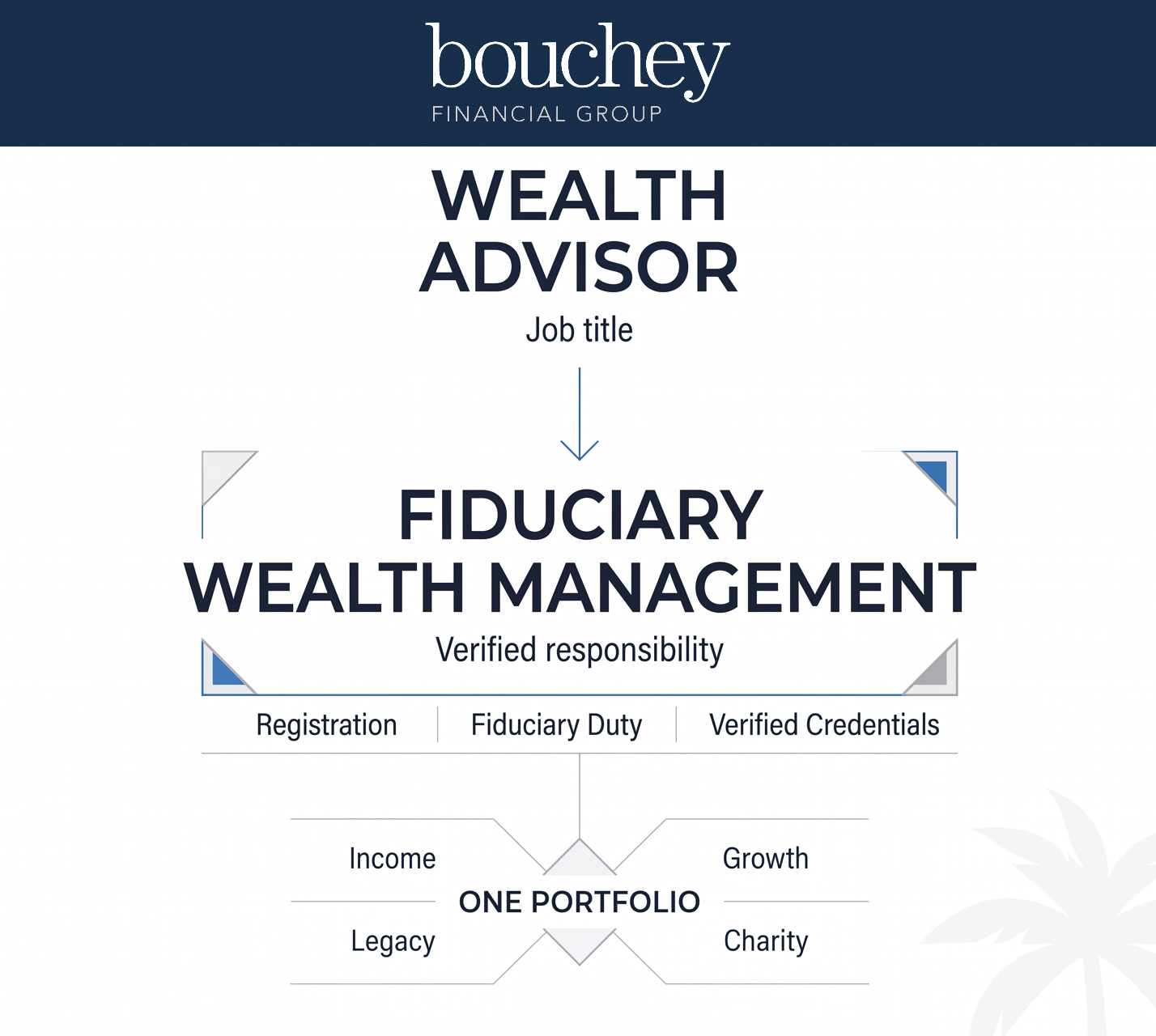
"Wealth Advisor" Is a Job Title, Not a Credential
This matters more than most people realize. According to FINRA's professional designations guidance, terms including financial advisor, financial consultant, financial planner, investment consultant, and wealth manager are generic job titles. They don't indicate that the person holds a specific credential, license, or registration.
Someone can print "wealth advisor" on a business card tomorrow. What you're actually looking for is SEC or state registration as an investment adviser, a fiduciary standard, specific professional credentials with verifiable requirements, and a disclosed fee structure. None of that appears automatically from a job title.
How to Verify What You're Being Told
The process isn't complicated. Check the firm and individual's registration through Investor.gov. Review Form ADV Part 2A for fee disclosures and conflicts. Use FINRA's professional designations database to look up what any listed credentials actually required — training, exams, continuing education, and whether the granting organization takes complaints.
The joint SEC/FINRA/NASAA bulletin on designations is direct: some designations require rigorous training, exams, and ongoing education, while others have substantially different requirements. Don't hire someone because of letters after their name. Find out what those letters required first.
What a Fiduciary Wealth Advisor Actually Owes You
As Investor.gov explains, investment advisers are required to act in your best interest and not put their own interests ahead of yours. That includes recommendations on buying, selling, and holding investments, ongoing monitoring against your stated objectives, asset allocation based on your circumstances, and identifying and disclosing conflicts of interest.
In practice, this means the advisor's job isn't just selecting securities. It includes reviewing whether the portfolio still matches its intended purpose as your life changes, flagging when changes in tax law or your financial situation warrant revisiting the strategy, and coordinating investment decisions with the tax and estate planning work happening elsewhere in your financial life.
What Fiduciary Doesn't Automatically Mean
Fiduciary is a legal obligation, not a skill set. An advisor can be required to act in your best interest and still lack the expertise to execute that obligation well. That's why verifying registration and the fiduciary standard is necessary but not sufficient. The credentials, experience, and team structure behind the obligation are what determine whether the standard is actually met.
Your Portfolio Doesn't Have One Time Horizon
This is one of the most important and underappreciated concepts in wealth management. A $7 million portfolio doesn't have a single purpose or a single time horizon. Different portions serve different roles.
| Purpose | Potential Horizon | Planning Priority |
| Near-term spending | 1–3 years | Capital preservation, liquidity |
| Retirement income | 10–20 years | Growth with managed risk |
| Long-term growth | 20+ years | Appropriate market participation |
| Heirs / legacy | Multi-generational | Different risk tolerance entirely |
| Charitable intent | Varies | Tax-efficient transfer |
A 75-year-old with $3 million earmarked for adult children doesn't necessarily have a 10-year investment horizon on that portion of the portfolio. The children might be 45. Managing all assets identically because the account owner is 75 isn't fiduciary management. It's age-based default.
Did Your Wealth Advisor Actually Do a Good Job Last Year?
Most people answer this by comparing their portfolio return to the S&P 500. That's almost never the right benchmark. The SEC cautions that investment performance should be evaluated alongside the investor's objectives, risk tolerance, time horizon, and fee impact — not against a single equity index that may bear no resemblance to the portfolio's actual purpose.
A retiree whose portfolio is 50% bonds and cash because their income needs require stability shouldn't compare their return to a 100% equity index. Success for that portfolio means funding withdrawals without excessive drawdown risk. Not outperforming the market. The benchmark should match the objective.
What Total Portfolio Cost Actually Means
Advisory fees get the most attention, but they're rarely the whole number. The SEC's fee guidance at Investor.gov illustrates how fee differences compound over time: a $100,000 portfolio growing at 4% annually reaches roughly $208,000 after 20 years at a 0.25% annual fee, $198,000 at 0.50%, and $179,000 at 1.00%.
The full cost picture includes advisory fees plus fund expense ratios, transaction costs, and any costs embedded in investment products the advisor recommends. Ask for the total, not just the advisory rate. Advisors who have trouble answering that question clearly are telling you something.
Asset Allocation Comes From Your Plan, Not Your Age
The brief's strongest planning concept deserves a direct statement: two 65-year-old West Palm Beach investors with the same net worth should not necessarily have the same portfolio. One may rely heavily on investments for income, prioritize stability, and have limited outside assets. The other has substantial pension income, a 25-year horizon, and intends most assets for heirs who are decades younger.
As the SEC's 2026 investor guidance explains, appropriate asset allocation depends on the investor's risk tolerance and investing timeframe — not a formula based on age alone. A fiduciary advisor builds the allocation from the plan. An advisor without a plan builds the plan from the allocation. That's the wrong order.
The Estate Planning Intersection
The IRS notes that the federal estate tax exclusion for 2026 is $15 million per individual. For most West Palm Beach families, that's not an immediate exposure concern.
Estate planning still belongs in the portfolio conversation. Concentrated positions, asset location, gifting strategy, and beneficiary designations all affect both the investment portfolio and the estate outcome. A fiduciary advisor coordinates those decisions with the client's CPA and estate attorney rather than treating the portfolio in isolation.
The IRS confirms that a surviving spouse can claim the deceased spouse's unused exclusion through the portability election. An estate return may need to be filed to make that election even when the estate is well below the $15 million threshold. Miss the deadline and the election is forfeited permanently. That's exactly the kind of detail that falls through the cracks when the advisor and attorney aren't talking.
Who Calls If Something Seems Wrong?
Naming a trusted contact on brokerage accounts is a practical protective step that doesn't require a power of attorney. Per FINRA's guidance on trusted contacts, a trusted contact is someone the firm may reach in limited circumstances: if they can't reach the account holder, or if there's concern about potential financial exploitation. That person has no authority to transact or direct the account. It's a protective mechanism, not a delegation of control.
For affluent West Palm Beach households, the full protective picture includes the trusted contact alongside a financial power of attorney, successor trustee if trusts are involved, and a designated person who knows where accounts, documents, and professional relationships are located. Fiduciary wealth management extends to that continuity planning, not just portfolio construction.
Working With Bouchey Financial Group
The firm's 23-person advisory team includes 9 CFP® professionals, 3 CPAs, and 1 IRS Enrolled Agent, all working together on the same client accounts rather than in separate silos. The firm manages approximately $1.8 billion for clients across 34 states, with a minimum of $1,000,000 in investable assets.
For West Palm Beach households who want to understand how the firm approaches portfolio stewardship before reaching out, recent planning discussions are available through the Webinars and Videos library. To schedule a conversation directly, use the Contact Us page.
Frequently Asked Questions
Is "wealth advisor" a regulated title?
No. FINRA explicitly states that terms including financial advisor, financial consultant, financial planner, investment consultant, and wealth manager are generic job titles that don't indicate a specific credential, license, or registration. What matters is whether the person is registered as an investment adviser, holds verified credentials, and operates under a fiduciary standard.
How do I verify a wealth advisor's credentials in West Palm Beach?
Check registration through Investor.gov, review Form ADV Part 2A for fees and conflicts, and use FINRA's professional designations database to look up what any cited credentials actually required. The database shows training prerequisites, exam requirements, continuing education obligations, and whether the granting organization accepts complaints. Don't skip this step.
What benchmark should my portfolio be compared against?
The right benchmark depends on what the portfolio is designed to do. A retirement income portfolio with 40% bonds shouldn't be compared to a 100% equity index. The SEC advises evaluating performance against the investor's individual objectives, risk tolerance, and time horizon. A fiduciary advisor defines the appropriate benchmark before the year starts, not after.
Does having different parts of my portfolio serve different purposes matter for how it's managed?
Yes, significantly. Assets intended for near-term spending, long-term growth, heirs, and charitable giving have different time horizons and risk profiles even when they sit in the same account. A fiduciary advisor manages with those distinctions in mind rather than applying a uniform allocation to the entire balance.
What does portability mean for estate planning purposes?
When a spouse dies, the surviving spouse can potentially claim the deceased spouse's unused federal estate tax exclusion through a portability election. This requires filing an estate return, which may be appropriate even when the estate is well below the $15 million 2026 exclusion threshold. Missing this filing deadline forfeits the election permanently. It's one reason the advisor and estate attorney should coordinate early.
What is a trusted contact and how is it different from a power of attorney?
A trusted contact is someone a brokerage firm may call in limited circumstances — if they can't reach the account holder or suspect financial exploitation. That person has no trading authority. A financial power of attorney designates someone with actual authority to make financial decisions. Both serve protective purposes, but they're distinct tools that don't substitute for each other.
How often should a portfolio's asset allocation be reviewed?
At minimum annually, and after any significant change in financial circumstances, life stage, or tax law. The allocation that made sense at 60 may not make sense at 75, particularly if the purpose of different portions of the portfolio has shifted. A fiduciary advisor proactively reviews rather than waiting for the client to initiate the conversation.

IMPORTANT DISCLOSURE INFORMATION
Please remember that past performance is no guarantee of future results. Different types of investments involve varying degrees of risk, and there can be no assurance that the future performance of any specific investment, investment strategy, or product (including the investments and/or investment strategies recommended or undertaken by Bouchey Financial Group, Ltd. [“Bouchey Financial”]), or any non-investment related content, made reference to directly or indirectly in this blog will be profitable, equal any corresponding indicated historical performance level(s), be suitable for your portfolio or individual situation, or prove successful. Due to various factors, including changing market conditions and/or applicable laws, the content may no longer be reflective of current opinions or positions. Moreover, no portion of this discussion or information contained in this blog serves as the receipt of, or as a substitute for, personalized investment advice from Bouchey Financial. To the extent that a reader has any questions regarding the applicability of any specific issue discussed above to his/her individual situation, he/she is encouraged to consult with the professional advisor of his/her choosing. Neither Bouchey Financial’s investment adviser registration status, nor any amount of prior experience or success, should be construed that a certain level of results or satisfaction will be achieved if Bouchey Financial is engaged, or continues to be engaged, to provide investment advisory services. Bouchey Financial is neither a law firm nor a certified public accounting firm and no portion of the blog content should be construed as legal or accounting advice. A copy of the Bouchey Financial’s current written disclosure Brochure and Form CRS discussing our advisory services and fees is available for review upon request or at www.bouchey.com. Please Note: Bouchey Financial does not make any representations or warranties as to the accuracy, timeliness, suitability, completeness, or relevance of any information prepared by any unaffiliated third party, whether linked to Bouchey Financial’s web site or blog or incorporated herein, and takes no responsibility for any such content. All such information is provided solely for convenience purposes only and all users thereof should be guided accordingly. Please Remember: If you are a Bouchey Financial client, please contact Bouchey Financial, in writing, if there are any changes in your personal/financial situation or investment objectives for the purpose of reviewing/evaluating/revising our previous recommendations and/or services, or if you would like to impose, add, or to modify any reasonable restrictions to our investment advisory services. Unless, and until, you notify us, in writing, to the contrary, we shall continue to provide services as we do currently. Please Also Remember to advise us if you have not been receiving account statements (at least quarterly) from the account custodian.