
Wealth Management Stillwater NY | Fee-Only Advisory & Tax Strategy
There's a version of "wealth management" that's mostly portfolio management with a quarterly statement attached. Then there's a version where investment decisions are evaluated against their tax consequences before they're executed, retirement income is planned across every account simultaneously, and the plan gets revisited every year as tax law and circumstances evolve. Those are different services.
Bouchey Financial Group serves Stillwater and Saratoga County from its Saratoga Springs, NY office as a fee-only fiduciary firm. The firm's CERTIFIED FINANCIAL PLANNER™ professionals, CPAs, and IRS Enrolled Agent work on the same client accounts, which means tax planning is part of every investment conversation, not a separate function that reports back in April.
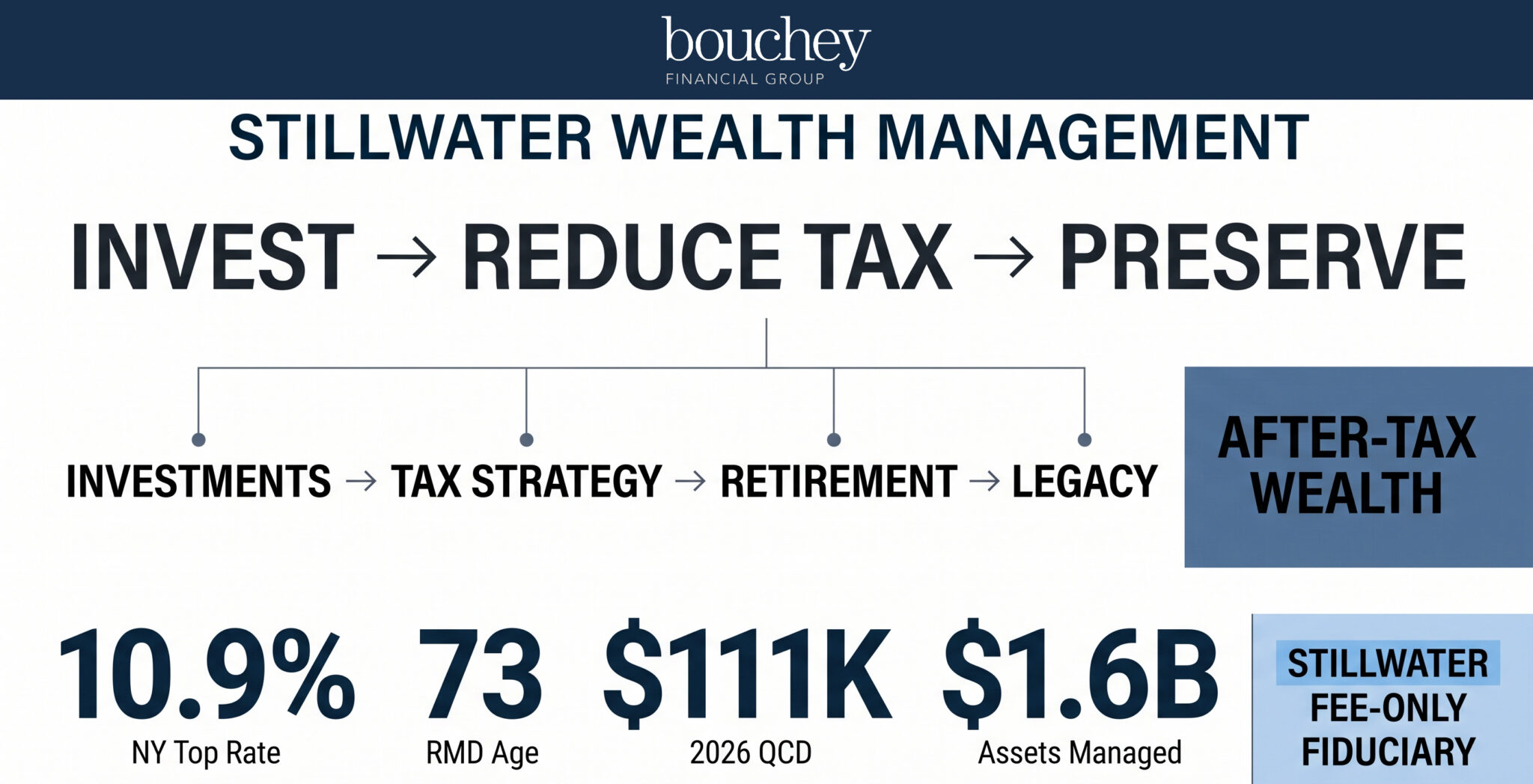
New York's Capital Gains Problem
Federal tax law gives preferential rates to long-term capital gains: 0%, 15%, or 20% depending on income, per IRS Topic 409. New York does not. The state taxes long-term capital gains at the same ordinary income rates as wages, ranging from 4% to 10.9%, per NYS Department of Taxation and Finance.
For a Stillwater household in the 6.85% New York bracket realizing a $150,000 long-term gain, the federal rate might be 15%. The state adds 6.85% on top. Combined with the 3.8% federal Net Investment Income Tax above certain MAGI thresholds, the effective combined rate can approach 26% or higher. Portfolio decisions made without accounting for that full picture often look less efficient than they appeared.
Tax-Loss Harvesting in a High-Tax State
Tax-loss harvesting realizes investment positions at a loss to offset gains, reducing combined state and federal tax on net realized gains. Per IRS Topic 409, losses offset same-type gains first, then other gains, with up to $3,000 of net loss offsetting ordinary income annually and the remainder carried forward indefinitely.
Because New York applies ordinary income rates to capital gains, each harvested dollar is worth more to a New York resident than to one in a preferential-rate state.
Asset Location: The Right Investment in the Right Account
Not all accounts are taxed the same way. A bond in a taxable brokerage account generates interest taxed annually at ordinary income rates — up to 10.9% in New York plus federal. The same bond in a traditional IRA defers that tax. In a Roth IRA, there's no tax at all on withdrawal.
Asset location places each investment type in the account where its tax treatment is most favorable. Per IRS guidance on retirement accounts, traditional IRA and 401(k) withdrawals are ordinary income; Roth distributions are generally tax-free. For Stillwater households with both taxable and tax-deferred accounts, getting location right reduces annual tax drag without changing the portfolio's overall risk profile.
RMD Planning: The Mandatory Withdrawal That Changes Everything
Required minimum distributions from traditional IRAs and most workplace accounts can begin at age 73 (age dependent upon birth year), per IRS RMD guidance. Roth IRAs have no lifetime RMD requirement for the original owner, and designated Roth workplace accounts eliminated their lifetime RMD requirement starting in 2024.
Once RMDs begin, every distribution is ordinary income at both the federal and New York state level. For households with large traditional IRA balances, RMDs in later years can push income into higher brackets than during working years.
The Planning Window Before RMD Age
The years between retirement and RMD Age, when income is lower and withdrawals are discretionary, are the most valuable planning window many retirees have. This is where Roth conversions, capital gains harvesting, and charitable distribution structuring all work best.
Roth Conversions Before RMD Age
Converting traditional IRA assets to Roth during lower-income years reduces the balance subject to future RMDs. Each converted dollar pays current income tax but exits the RMD calculation permanently. For a Stillwater household with $800,000 in a traditional IRA retiring at 66, converting $60,000 to $80,000 per year before RMDs begin can meaningfully reduce future distributions and create tax-free assets for heirs.
Charitable Giving and QCDs
A qualified charitable distribution allows IRA owners age 70½ or older to transfer up to $111,000 directly to a qualifying public charity in 2026, per IRS Publication 590-B. The distribution is excluded from taxable income entirely. It doesn't appear on the return as income, which is different from an itemized charitable deduction subject to the new 0.5% AGI floor under the One Big Beautiful Bill Act.
For a retiree with a $20,000 RMD who donates $20,000 via QCD, the entire RMD is satisfied without generating taxable income. Taking a distribution first and donating the proceeds requires the distribution to appear as income first. The QCD is almost always the more tax-efficient structure for regular charitable givers over 70½.
Donor-Advised Funds for Appreciated Assets
A donor-advised fund accepts appreciated securities, provides an immediate deduction for full fair market value, and allows grants over time. Donating appreciated stock directly avoids capital gains tax on the embedded appreciation — especially valuable in New York, where the state taxes that gain at ordinary income rates. Cash contributions to a DAF are deductible up to 60% of AGI; appreciated securities up to 30%, with a five-year carryforward, per IRS Publication 526, and may apply to your return assuming your itemized deductions are higher than the offered standard deduction.
Social Security Taxation: The Provisional Income Calculation
Up to 85% of Social Security benefits are subject to federal income tax depending on provisional income, per IRS Publication 915. Provisional income is AGI plus non-taxable interest plus half of Social Security benefits. New York does not tax Social Security, but the federal calculation still matters.
A large IRA withdrawal or Roth conversion in a year when Social Security is being received can push provisional income above the 85% inclusion threshold, increasing federal taxable income by more than the withdrawal amount alone.
Coordinating the Three Variables
The interaction between IRA distributions, Roth conversions, and Social Security taxation is one of the most consequential annual planning decisions for retirees. Getting it right requires modeling all three simultaneously.
Business Owner Tax Planning in Saratoga County
Pass-through income from S-corporations, partnerships, and sole proprietorships is taxed at individual rates, including New York's rates up to 10.9%. Business owners have more flexibility in structuring income, timing deductions, and selecting retirement plan types than W-2 employees.
Defined Benefit Plans for High-Income Owners
A defined benefit plan can allow contributions well above the standard defined contribution ceiling for high-income owners approaching retirement, generating large current-year deductions at combined marginal rates that make each deductible dollar more valuable.
Per the IRS small business retirement plans overview, plan type matters for both contribution ceiling and administrative requirements. Selecting the right structure benefits from a CFP® professional and CPA input working together.
Working With Bouchey Financial Group
Bouchey Financial Group's 22-person team includes 9 CFP® professionals, 3 CPAs, and 1 IRS Enrolled Agent serving Stillwater and Saratoga County from the Saratoga Springs, NY office. The firm manages approximately $1.7 billion for clients across 34 states, with a minimum of $1,000,000 in investable assets.
For Saratoga County households who want tax planning built into the investment process rather than added on afterward, schedule a conversation with the team. Recent planning discussions are available through the Webinars and Videos library.
Frequently Asked Questions
Does New York give preferential tax rates to long-term capital gains?
No. New York taxes long-term capital gains at ordinary income rates from 4% to 10.9%, unlike the federal 0%/15%/20% structure. A Stillwater household realizing a large long-term gain faces both the federal rate and New York's ordinary income rate on the same amount.
What is tax-loss harvesting and how often should it happen?
Tax-loss harvesting realizes investment positions at a loss to offset realized gains, reducing current-year tax liability. The IRS allows net capital losses to offset up to $3,000 of ordinary income annually, with the remainder carried forward. Year-round monitoring finds more opportunities than a December-only review.
How does a QCD differ from taking an IRA distribution and donating the proceeds?
A QCD excludes the distributed amount from taxable income entirely. Taking a distribution first results in it appearing as taxable income, with only a partial itemized deduction offset. The QCD is almost always more tax-efficient for IRA holders over 70½ who give to qualifying charities regularly.
How does Social Security get taxed alongside IRA withdrawals?
Federal tax on Social Security depends on provisional income: AGI plus non-taxable interest plus half of Social Security benefits. If provisional income exceeds $44,000 for married filers, up to 85% of Social Security is federally taxable. Large IRA withdrawals in the same year can push more of the benefit into taxable income. New York does not tax Social Security, but the federal coordination still matters.
What are the advantages of converting traditional IRA assets to Roth before RMDs begin?
Converting reduces the balance subject to future mandatory distributions, which can begin at age 73 and are taxed as ordinary income. Each converted dollar pays tax now but exits the RMD calculation permanently. If the current combined rate is lower than the expected rate when RMDs begin, the conversion produces a meaningful lifetime tax saving.
What retirement plan structures are available to self-employed Saratoga County business owners?
Options include SEP IRAs, solo 401(k)s, SIMPLE IRAs, and defined benefit plans. Defined benefit plans allow the highest contributions for high-income owners close to retirement, generating large deductions at combined marginal rates that make each dollar more valuable. The right structure depends on income, business type, and contribution goals.
Is asset location worth the complexity for a Stillwater household?
For households with both taxable and tax-deferred accounts, yes. Placing income-generating assets in tax-deferred accounts and growth equities in taxable or Roth accounts reduces annual tax drag without changing overall risk. In New York, where ordinary income rates apply to both interest and capital gains, the benefit is proportionally larger than in lower-tax states.

IMPORTANT DISCLOSURE INFORMATION
Please remember that past performance is no guarantee of future results. Different types of investments involve varying degrees of risk, and there can be no assurance that the future performance of any specific investment, investment strategy, or product (including the investments and/or investment strategies recommended or undertaken by Bouchey Financial Group, Ltd. [“Bouchey Financial”]), or any non-investment related content, made reference to directly or indirectly in this blog will be profitable, equal any corresponding indicated historical performance level(s), be suitable for your portfolio or individual situation, or prove successful. Due to various factors, including changing market conditions and/or applicable laws, the content may no longer be reflective of current opinions or positions. Moreover, no portion of this discussion or information contained in this blog serves as the receipt of, or as a substitute for, personalized investment advice from Bouchey Financial. To the extent that a reader has any questions regarding the applicability of any specific issue discussed above to his/her individual situation, he/she is encouraged to consult with the professional advisor of his/her choosing. Neither Bouchey Financial’s investment adviser registration status, nor any amount of prior experience or success, should be construed that a certain level of results or satisfaction will be achieved if Bouchey Financial is engaged, or continues to be engaged, to provide investment advisory services. Bouchey Financial is neither a law firm nor a certified public accounting firm and no portion of the blog content should be construed as legal or accounting advice. A copy of the Bouchey Financial’s current written disclosure Brochure and Form CRS discussing our advisory services and fees is available for review upon request or at www.bouchey.com. Please Note: Bouchey Financial does not make any representations or warranties as to the accuracy, timeliness, suitability, completeness, or relevance of any information prepared by any unaffiliated third party, whether linked to Bouchey Financial’s web site or blog or incorporated herein, and takes no responsibility for any such content. All such information is provided solely for convenience purposes only and all users thereof should be guided accordingly. Please Remember: If you are a Bouchey Financial client, please contact Bouchey Financial, in writing, if there are any changes in your personal/financial situation or investment objectives for the purpose of reviewing/evaluating/revising our previous recommendations and/or services, or if you would like to impose, add, or to modify any reasonable restrictions to our investment advisory services. Unless, and until, you notify us, in writing, to the contrary, we shall continue to provide services as we do currently. Please Also Remember to advise us if you have not been receiving account statements (at least quarterly) from the account custodian.