
Wealth Management Rochester NY | Fiduciary CFP® Professional & CPA Team
Wealth management means different things at different firms. At some, it means a managed portfolio with quarterly reports. At others, it means the investment account, the tax return, the retirement income plan, and the estate documents are all reviewed by the same team and updated when any one of them changes.
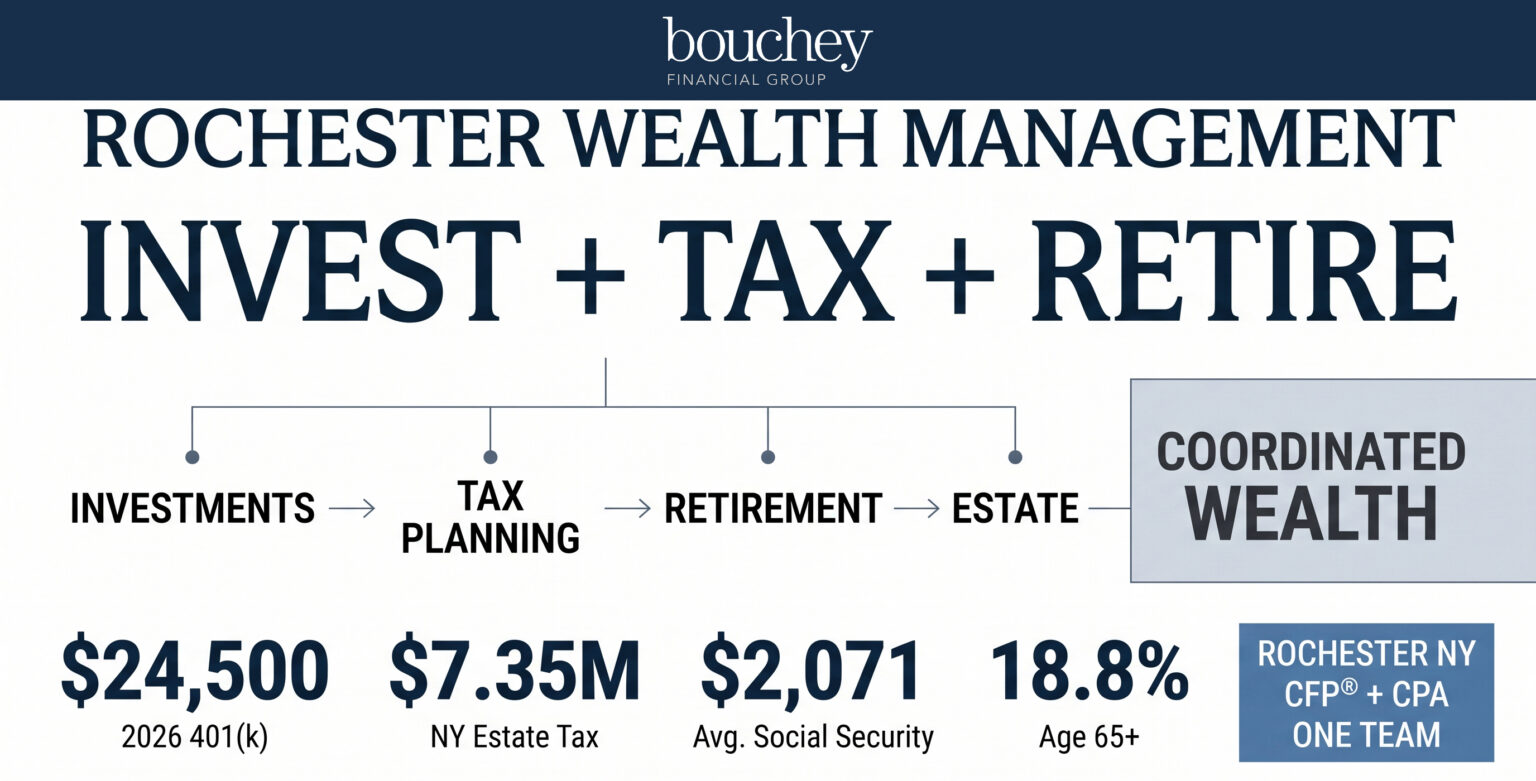
Bouchey Financial Group serves Rochester and Monroe County as a fee-only fiduciary firm. The firm's CERTIFIED FINANCIAL PLANNER™ professionals, CPAs, and IRS Enrolled Agent work on the same client accounts, which means a portfolio decision and its tax consequence are evaluated together before the trade, not separately after the return.
The Monroe County Planning Audience
Monroe County has a population of approximately 753,753 and a median household income of $76,520, per U.S. Census Bureau data. The average household income is $102,656. Households headed by someone between 45 and 64 earn a median of $96,241. That demographic, peak earners with retirement approaching, represents the core planning conversation in this market.
The Rochester metro's professional base spans healthcare, higher education, optics and photonics, financial services, and manufacturing. Many households hold long-tenured employer pension benefits alongside personal retirement accounts, equity compensation, and real estate. The planning challenge isn't accumulation. It's coordination.
What a CFP® Professional and CPA Working Together Produces
Most financial planning relationships separate investment management from tax planning. The portfolio manager handles one side, the CPA handles the other, and they coordinate occasionally around tax season. That structure works for simple situations. It produces gaps for complex ones.
A Roth conversion decision requires knowing the current-year income picture, the projected tax bracket, the Medicare IRMAA thresholds two years out, and how the conversion interacts with any pending capital gains or Social Security income. That's simultaneously an investment decision and a tax decision, and it needs to be made by someone who sees both.
The Difference in Practice
At Bouchey Financial Group, CFP® professionals and CPAs work on the same client accounts year-round. When the investment team models a Roth conversion, the CPA's current-year income projection is part of the analysis. The coordination happens before the decision, not after it.
Verifying a Fiduciary Wealth Manager in Rochester
"Fiduciary" and "fee-only" appear on many financial services websites. Verifying them before signing anything takes about ten minutes. The SEC's Investment Adviser Public Disclosure database lets anyone search an adviser's registration, Form ADV filings, and disciplinary history. FINRA BrokerCheck covers brokers: licenses, employment history, and regulatory actions. Both are free.
The SEC recommends asking specific questions before engaging a financial professional: How are you compensated, in dollars? Are you a fiduciary at all times? Who manages my account day to day? What conflicts exist? Do tax professionals work alongside financial planners at your firm? An advisor who hesitates on any of these is telling you something.
2026 Retirement Contribution Limits for Monroe County Savers
For households still in the accumulation phase, the 2026 limits set the ceiling on tax-advantaged savings each year. Per the IRS 2026 contribution limits:
| Account | 2026 Limit | Age 50+ Catch-Up | Age 60-63 Catch-Up |
| 401(k) / 403(b) / 457(b) | $24,500 | $8,000 | $11,250 |
| IRA (Traditional or Roth) | $7,500 | $1,100 | N/A |
| HSA (self-only / family) | $4,400 / $8,750 | N/A | N/A |
HSA limits are per IRS 2026 HSA guidance. The age 60-63 super catch-up, introduced by SECURE 2.0, is the largest workplace plan catch-up available in U.S. retirement law. A Rochester professional in that window who isn't using it is leaving meaningful tax-advantaged savings unused.
The 2026 Roth Catch-Up Rule
Workers who earned more than $150,000 from their employer in the prior year generally must make workplace plan catch-up contributions on a Roth basis in 2026, per IRS catch-up contribution guidance. Pre-tax catch-up contributions are no longer available for those earners in plans subject to the rule. This affects how after-tax retirement balances accumulate and changes the future tax treatment of those funds.
Retirement Income Planning for Rochester Households
Monroe County's 18.8% share of residents age 65 or older reflects a community navigating or approaching the retirement income transition. The planning question isn't how large the portfolio is. It's which accounts to draw from, in what order, and what the tax picture looks like across 20 or 30 years of distributions.
A Rochester couple with a pension, two traditional IRAs, a taxable brokerage account, and Social Security benefits not yet claimed has five distinct income sources with five different tax treatments. Drawing from the wrong account in the wrong year can push income past Medicare IRMAA thresholds, increase the taxable portion of Social Security, or accelerate RMD obligations in ways that compound tax exposure for years.
Social Security Timing in the Rochester Context
Per the SSA's 2026 COLA fact sheet, the average retired-worker benefit is $2,071 per month. The maximum for someone retiring at full retirement age is $4,152. Delaying to 70 increases benefits by roughly 8% per year between full retirement age and 70.
For a Rochester household where one or both spouses have earned substantial Social Security credits, the claiming decision directly affects the survivor benefit. The higher earner delaying to 70 maximizes the benefit that passes to a surviving spouse, which can matter for decades after the first death.
New York Estate Planning for Monroe County Families
New York's 2026 estate tax exclusion is $7,350,000, per the NY Department of Taxation and Finance. That's far below the $15 million federal exclusion. For Monroe County households with significant retirement accounts, real estate, and life insurance, total estate value can reach or approach that threshold without obvious signals in any single account balance.
New York's exclusion has a cliff: it phases out between 100% and 105% of the threshold, and above 105% the exclusion disappears entirely. An estate at $7.72 million owes significantly more in New York estate taxes than one at $7.35 million despite a difference of less than 5% in value. Annual gifting using the $19,000 per recipient exclusion ($38,000 per couple), per IRS gift tax guidance, reduces estate size incrementally without consuming lifetime exemption.
Rochester-Specific Planning: Employer Pension Holders
Rochester's legacy as an employer hub for Kodak, Xerox, Paychex, Wegmans, and the University of Rochester has produced a meaningful population of retirees and pre-retirees with defined benefit pension income. For these households, the pension represents a guaranteed income floor that changes the planning calculus on everything else.
A pension holder's portfolio doesn't have to serve as the primary income source. It can be invested with a longer time horizon because essential expenses are covered, Social Security can be deferred more comfortably, and the Roth conversion strategy in early retirement looks different when pension income fills most of the spending need.
Coordinating Pension Income With the Rest of the Plan
The planning questions for a Rochester pension holder include: How does the pension interact with Social Security timing? Which accounts are drawn first if spending exceeds pension income? What is the New York state tax treatment of pension distributions? New York exempts certain pension income from state income tax, per NY Tax Law guidance, which changes the after-tax value of pension income relative to IRA distributions.
Working With Bouchey Financial Group in Rochester
The firm's 22-person team includes 9 CFP® professionals, 3 CPAs, and 1 IRS Enrolled Agent. Bouchey Financial Group manages approximately $1.6 billion for clients across 34 states, with a minimum of $1,000,000 in investable assets.
For Rochester and Monroe County households who want investment management, tax planning, and retirement income strategy under one roof, the Contact Us page is the right place to begin. The Webinars and Videos library covers recent planning topics for those who want to explore the firm's thinking before reaching out.
Frequently Asked Questions
What is the difference between a CFP® Professional and a CPA in financial planning?
A CFP® covers comprehensive financial planning: retirement income, investment strategy, estate planning, and tax planning. A CPA specializes in tax law and compliance. For complex situations, having both on the same team produces better outcomes than coordinating between separate firms.
What makes a Rochester wealth management firm fee-only?
Fee-only means the firm is paid exclusively by the client, with no commissions on products sold. Fee-based advisors may charge client fees and also earn commissions. The structure shapes incentives over a long advisory relationship.
How does New York's pension income exclusion affect retirement planning?
New York exempts certain pension income from state income tax, including NYSLRS public pensions and qualifying private pensions. That makes pension income more tax-efficient at the state level than equivalent IRA distributions, which changes withdrawal sequencing for Rochester pension holders.
What should I do if my employer plan doesn't offer a Roth catch-up option?
Under the 2026 rule, employees earning over $150,000 must make workplace catch-up contributions as Roth. If the plan doesn't offer a Roth option, those contributions may be disallowed until the plan is amended. Confirm Roth availability with your plan administrator now.
How does the New York estate tax cliff work for Monroe County families?
The 2026 NY exclusion is $7,350,000. It phases out between 100% and 105% of that amount and disappears entirely above 105%. An estate just above the threshold can owe dramatically more than one just below it. Annual gifting and trust structures can reduce exposure with advance planning.
What is the SSA earnings test and when does it stop applying?
If you claim Social Security before full retirement age and keep working, benefits are reduced by $1 for every $2 earned above $24,480 in 2026. The test no longer applies after you reach full retirement age.
Does Bouchey Financial Group serve Rochester clients in person or remotely?
Both. The firm serves clients across 34 states, with a strong Upstate New York presence. Rochester-area clients can meet in person or work remotely depending on preference.

IMPORTANT DISCLOSURE INFORMATION
Please remember that past performance is no guarantee of future results. Different types of investments involve varying degrees of risk, and there can be no assurance that the future performance of any specific investment, investment strategy, or product (including the investments and/or investment strategies recommended or undertaken by Bouchey Financial Group, Ltd. [“Bouchey Financial”]), or any non-investment related content, made reference to directly or indirectly in this blog will be profitable, equal any corresponding indicated historical performance level(s), be suitable for your portfolio or individual situation, or prove successful. Due to various factors, including changing market conditions and/or applicable laws, the content may no longer be reflective of current opinions or positions. Moreover, no portion of this discussion or information contained in this blog serves as the receipt of, or as a substitute for, personalized investment advice from Bouchey Financial. To the extent that a reader has any questions regarding the applicability of any specific issue discussed above to his/her individual situation, he/she is encouraged to consult with the professional advisor of his/her choosing. Neither Bouchey Financial’s investment adviser registration status, nor any amount of prior experience or success, should be construed that a certain level of results or satisfaction will be achieved if Bouchey Financial is engaged, or continues to be engaged, to provide investment advisory services. Bouchey Financial is neither a law firm nor a certified public accounting firm and no portion of the blog content should be construed as legal or accounting advice. A copy of the Bouchey Financial’s current written disclosure Brochure and Form CRS discussing our advisory services and fees is available for review upon request or at www.bouchey.com. Please Note: Bouchey Financial does not make any representations or warranties as to the accuracy, timeliness, suitability, completeness, or relevance of any information prepared by any unaffiliated third party, whether linked to Bouchey Financial’s web site or blog or incorporated herein, and takes no responsibility for any such content. All such information is provided solely for convenience purposes only and all users thereof should be guided accordingly. Please Remember: If you are a Bouchey Financial client, please contact Bouchey Financial, in writing, if there are any changes in your personal/financial situation or investment objectives for the purpose of reviewing/evaluating/revising our previous recommendations and/or services, or if you would like to impose, add, or to modify any reasonable restrictions to our investment advisory services. Unless, and until, you notify us, in writing, to the contrary, we shall continue to provide services as we do currently. Please Also Remember to advise us if you have not been receiving account statements (at least quarterly) from the account custodian.