
Wealth Management Near Glens Falls NY | Adirondack Region Advisors
Glens Falls and the surrounding Adirondack region have a financial profile built on steady, multi-generational wealth accumulation — anchored by healthcare, tourism, and small business rather than rapid growth. Warren County's median household income reached $78,239 in 2023, according to U.S. Census Bureau data, with Glens Falls Hospital serving as the region's largest employer between Albany and Montreal. Bouchey Financial Group serves individuals and families throughout the Glens Falls area and the broader Adirondack corridor, with offices in Saratoga Springs and Troy.
The firm manages over $1.6 billion in assets for clients in 34 states and brings together 9 CERTIFIED FINANCIAL PLANNER™ professionals, 3 CPAs, 1 IRS Enrolled Agent, and a Certified Private Wealth Advisor® — all operating under a fee-only, fiduciary structure with no commissions and no proprietary products.
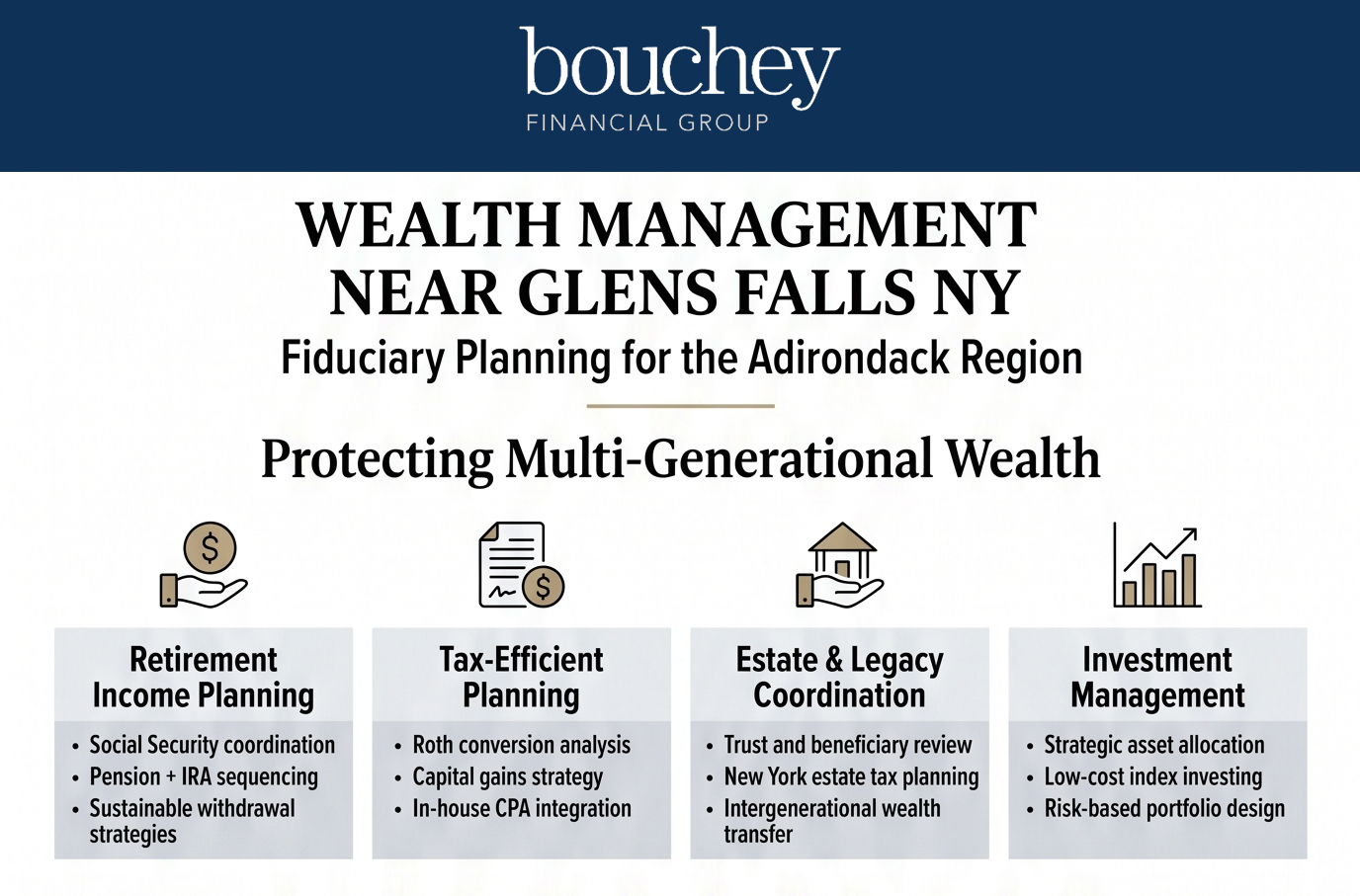
The Adirondack Region's Planning Landscape
The Greater Glens Falls area supports employment across approximately 65 diverse industries, with Glens Falls Hospital functioning as the largest healthcare system between Albany and Montreal. That concentration of healthcare employment — combined with a robust tourism economy, medical device manufacturing, and a long-established base of small and mid-sized businesses — creates a regional client profile centered on preservation-focused planning rather than wealth-building from scratch.
Many Glens Falls-area households arrive at a wealth management relationship with accumulated assets, a defined-benefit pension, significant home equity, and a retirement timeline within reach. The planning question is rarely "how do I grow this?" — it's "how do I protect it, distribute it efficiently, and pass it on intentionally?"
A Region Built on Stability
Tourism contributes a third of the Glens Falls MSA's economic output, drawn from outside the region — an unusual dynamic that has helped buffer the local economy against broader upstate New York contraction. That stability has supported business ownership across generations, with many Adirondack-region families holding meaningful assets across real estate, private business interests, and retirement accounts simultaneously.
Coordinating those assets into a coherent wealth plan — with tax efficiency, estate considerations, and retirement income sequencing built in — is the work of a firm equipped to handle financial complexity at every level.
Retirement Income Planning for Upstate New York Households
Retirement planning for Glens Falls-area households typically involves coordinating several income streams: Social Security, pension distributions, IRA and 401(k) withdrawals, and investment portfolio income. Getting the sequencing right has real consequences for lifetime tax liability, Medicare premium exposure, and the sustainability of the plan over a 25- to 30-year retirement horizon.
The Social Security Administration provides modeling tools for benefit estimates, but the timing decision itself — when to claim, how to coordinate spousal benefits, and how to integrate Social Security with portfolio withdrawals — requires the kind of integrated analysis that a fiduciary advisor provides as part of a full retirement income plan, not a standalone calculation.
Maximizing Tax-Advantaged Accounts Before Retirement
For pre-retirees still in accumulation mode, the IRS sets 401(k) contribution limits at $24,500 for 2026, with a $8,000 catch-up contribution for those 50 and older. The SECURE Act 2.0 established a higher catch-up contribution for those age 60 - 63 of $11,250 rather than the noted $8,000 allowing even greater contribution opportunity for those individuals. In New York State, contributions to traditional 401(k) and IRA accounts reduce taxable income at both the federal and state level — a meaningful advantage given New York's top marginal rate.
Bouchey Financial Group's in-house CPAs integrate these contribution decisions directly into each client's annual tax plan, rather than treating them as a separate conversation.
Tax-Efficient Wealth Management in New York State
New York imposes some of the highest state income tax rates in the country, according to the New York State Department of Taxation and Finance. For Adirondack-region households with multiple income sources — pension distributions, investment gains, rental income, or business proceeds — managing the interaction between those sources and New York's tax structure is an ongoing planning responsibility, not a once-a-year task at filing time.
Bouchey Financial Group's team includes 3 CPAs and 1 IRS Enrolled Agent, which means tax strategy is built into the advisory relationship rather than outsourced. Roth conversion planning, capital gains timing, and qualified charitable distribution strategies are evaluated annually as part of each client's broader wealth plan.
Why In-House CPA Expertise Matters
Most wealth management firms coordinate with a client's external accountant, creating a gap between investment decisions and their tax consequences. At Bouchey Financial Group, the tax implications of every portfolio decision — rebalancing, distributions, asset location — are evaluated within the firm. For individuals and families managing retirement assets in a high-tax state, that integration produces materially better outcomes than a siloed approach.
Estate Planning and Legacy Coordination
Warren County's median age of 46.8 years — among the higher in the Capital Region — reflects a population in or approaching the stage where estate planning transitions from "something to do eventually" to an active priority. New York State's estate tax exemption is significantly lower than the federal threshold, meaning estates that would pass tax-free federally may still carry meaningful state-level exposure.
Bouchey Financial Group coordinates with clients' estate attorneys to ensure that trust structures, beneficiary designations, and account titling align with the broader financial plan. The Why Bouchey Financial Group page outlines the firm's integrated, multi-discipline planning approach in detail.
Wealth Transfer and the Next Generation
The Glens Falls MSA has a median home price of $240,000 and a median household income of $72,600 — a combination that, for households with fully paid-off real estate and decades of retirement savings, can represent a significant transfer of wealth to the next generation. Coordinating that transfer across wills, trusts, gifting strategies, and tax planning requires the same integrated approach as retirement income planning — and benefits from the same in-house CPA and CFP® expertise.
Choosing a Fiduciary Advisor in the Adirondack Region
The SEC's investor education resources distinguish between registered investment advisers — who are held to a fiduciary standard — and broker-dealers, whose recommendations need only be "suitable," not necessarily in the client's best interest. For Glens Falls-area households evaluating advisory firms, that distinction is the most important question to ask first.
Below is a quick reference for evaluating advisory relationships:
| Question | What to Look For |
| Are you a fiduciary? | Yes — legally required to act in your interest |
| How are you compensated? | Fee-only (no commissions on products) |
| Do you have CPAs on staff? | In-house tax expertise, not outsourced |
| What credentials does your team hold? | CFP®, CPA, CPWA®, EA, AIF®, ECA, CEPA |
| What is your minimum? | Clarity on asset minimums upfront |
Bouchey Financial Group meets each of those criteria. The firm's fee-only structure eliminates commission-based conflicts, and its $500,000 minimum reflects the depth of the planning relationships it manages.
Planning That Reflects Where You Live
Glens Falls and the Adirondack region reward advisors who understand the local economy — the healthcare employment base, the seasonal business dynamics, the generational business ownership, and the retirement patterns of a region that skews older and holds its wealth quietly. Bouchey Financial Group's team of CERTIFIED FINANCIAL PLANNER™ professionals and in-house CPAs brings that combination of technical depth and regional context to every client relationship.
To explore whether the firm is a fit for your situation, contact the team to schedule a complimentary consultation at the Saratoga Springs office, a short drive from the Glens Falls area.
Frequently Asked Questions
What is the difference between wealth management and retirement planning?
Retirement planning focuses on accumulating assets and building a distribution strategy for retirement income. Wealth management is broader — incorporating retirement planning alongside investment management, tax strategy, estate coordination, and intergenerational transfer planning. For households with multiple asset types and income sources, the integrated framework addresses interactions between those components that retirement planning alone does not.
How does New York State's estate tax differ from the federal estate tax?
New York's estate tax exemption for 2026 is approximately $7.35 million — well below the federal exemption of $15 million. New York also uses a "cliff" structure: if an estate exceeds 105% of the state exemption, the entire estate becomes taxable, not just the excess. This makes coordinating trust structures and asset titling especially important for Adirondack-region households approaching that threshold.
What does a fee-only advisor charge, and how is it calculated?
Most fee-only advisors charge a percentage of assets under management — typically between 0.5% and 1.25% annually — or a flat retainer fee. There are no commissions or product markups, and the advisor's compensation grows only when the client's portfolio grows, directly aligning both parties' interests.
At what point should someone in the Glens Falls area consider working with a wealth manager?
The most common triggers are life transitions: approaching retirement, receiving an inheritance, or selling a business. Bouchey Financial Group's $500,000 investable asset minimum reflects the level at which a comprehensive, integrated planning relationship produces the most value.
How often should a retirement plan be reviewed?
A retirement plan should be reviewed formally at least once per year and revisited after any significant life event. According to the Federal Reserve's Survey of Household Economics and Decisionmaking, many households report retirement uncertainty even at higher income levels — often because their plan hasn't kept pace with changing circumstances.
Can a wealth management firm help with business succession planning?
Yes — succession planning is a core component for business-owning clients, especially in a region where many businesses have been family-held across generations. The process typically involves business valuation, ownership transfer structures, estate document coordination, and ensuring retirement income isn't entirely dependent on a single illiquid asset.
What is a Certified Private Wealth Advisor®, and why does it matter?
The CPWA® designation is an advanced credential for advisors working with high-net-worth clients, covering tax minimization, estate planning, concentrated stock positions, and alternative investments — areas beyond the standard CFP® curriculum. At Bouchey Financial Group, Harmony Wagner holds both the CFP® and CPWA® designations, bringing high-net-worth planning depth to the firm's existing advisory relationships.
IMPORTANT DISCLOSURE INFORMATION
Please remember that past performance is no guarantee of future results. Different types of investments involve varying degrees of risk, and there can be no assurance that the future performance of any specific investment, investment strategy, or product (including the investments and/or investment strategies recommended or undertaken by Bouchey Financial Group, Ltd. [“Bouchey Financial”]), or any non-investment related content, made reference to directly or indirectly in this blog will be profitable, equal any corresponding indicated historical performance level(s), be suitable for your portfolio or individual situation, or prove successful. Due to various factors, including changing market conditions and/or applicable laws, the content may no longer be reflective of current opinions or positions. Moreover, no portion of this discussion or information contained in this blog serves as the receipt of, or as a substitute for, personalized investment advice from Bouchey Financial. To the extent that a reader has any questions regarding the applicability of any specific issue discussed above to his/her individual situation, he/she is encouraged to consult with the professional advisor of his/her choosing. Neither Bouchey Financial’s investment adviser registration status, nor any amount of prior experience or success, should be construed that a certain level of results or satisfaction will be achieved if Bouchey Financial is engaged, or continues to be engaged, to provide investment advisory services. Bouchey Financial is neither a law firm nor a certified public accounting firm and no portion of the blog content should be construed as legal or accounting advice. A copy of the Bouchey Financial’s current written disclosure Brochure and Form CRS discussing our advisory services and fees is available for review upon request or at www.bouchey.com. Please Note: Bouchey Financial does not make any representations or warranties as to the accuracy, timeliness, suitability, completeness, or relevance of any information prepared by any unaffiliated third party, whether linked to Bouchey Financial’s web site or blog or incorporated herein, and takes no responsibility for any such content. All such information is provided solely for convenience purposes only and all users thereof should be guided accordingly. Please Remember: If you are a Bouchey Financial client, please contact Bouchey Financial, in writing, if there are any changes in your personal/financial situation or investment objectives for the purpose of reviewing/evaluating/revising our previous recommendations and/or services, or if you would like to impose, add, or to modify any reasonable restrictions to our investment advisory services. Unless, and until, you notify us, in writing, to the contrary, we shall continue to provide services as we do currently. Please Also Remember to advise us if you have not been receiving account statements (at least quarterly) from the account custodian.