
Wealth Management in Wellesley MA | Serving Greater Boston and MetroWest
As wealth grows, the decisions around it tend to multiply faster than the balance does. A tax decision affects the investment portfolio. An equity compensation event affects the estate plan. A business transition affects retirement income, tax exposure, and legacy planning simultaneously.
Most financial firms handle one of those pieces well. Fewer handle them together. Bouchey Financial Group serves Wellesley, Greater Boston, and MetroWest as a fee-only fiduciary firm whose team of CERTIFIED FINANCIAL PLANNER™ professionals, CPAs, and an IRS Enrolled Agent work on the same client accounts — so the tax and investment conversations happen in the same room.
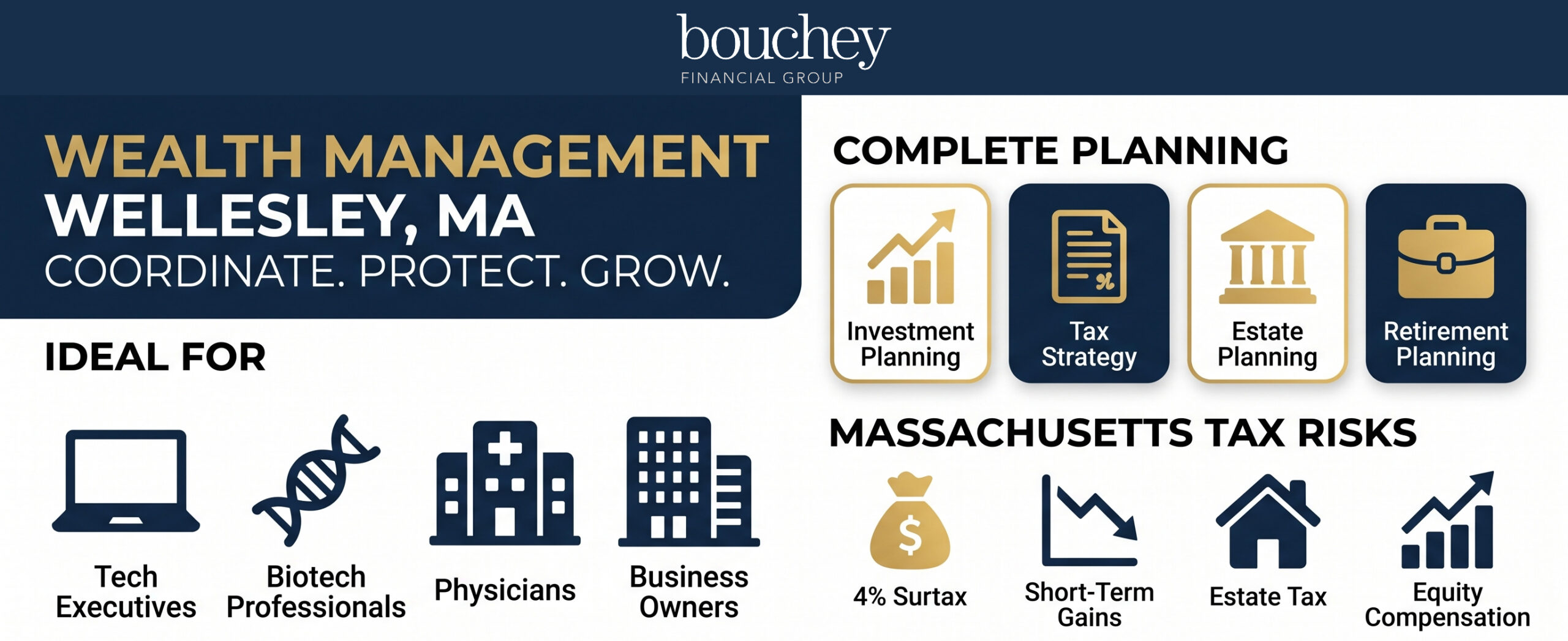
The Financial Landscape in Greater Boston Is Not Average
Massachusetts is the second-wealthiest state in the country by median household income. Middlesex County — home to Wellesley, Newton, Brookline, and much of MetroWest — has a median household income of $118,800, according to recent American Community Survey data.
The number of Massachusetts millionaires by net worth grew 38.6% between 2022 and 2024, reaching 612,109 individuals with a combined wealth of $2.2 trillion, according to a report by the Institute for Policy Studies.
The professionals driving this accumulation work primarily in technology, biotech, healthcare, financial services, and higher education. Many receive significant equity compensation on top of high base salaries. Their planning challenges are specific to that combination.
The Massachusetts Tax Stack
Massachusetts taxes most income at a flat 5%. That's the straightforward part.
The complexity comes from three layers stacked on top.
The 4% Surtax
Massachusetts imposes an additional 4% surtax on taxable income exceeding $1,107,750 in 2026, per mass.gov. Income above that threshold is taxed at a combined 9% state rate.
For an executive earning $900,000 in base salary who also vests $400,000 in RSUs in the same tax year, the combined income crosses the threshold. The surtax applies to the excess. Spreading vests across tax years, or coordinating the timing of other large income events, can reduce or eliminate the surtax exposure entirely.
Short-Term Capital Gains
Massachusetts taxes short-term capital gains — positions held less than a year — at 8.5%, compared to 5% for long-term gains. For portfolios with meaningful turnover, that differential compounds. Holding periods matter in Massachusetts in a way they don't in flat-tax states.
The Estate Tax Cliff
Massachusetts's estate tax deserves special attention because many families are closer to the threshold than they realize. The state imposes an estate tax on estates exceeding $2 million, with rates ranging from 0.8% to 16%. What makes the system particularly important from a planning perspective is that crossing the threshold can create a meaningful tax liability, making proactive estate planning essential for higher-net-worth households.
Unlike the federal system, Massachusetts does not allow spouses to combine estate tax exemptions through portability. At the same time, rising property values have pushed many families closer to the threshold.
According to the Harvard Joint Center for Housing Studies, the median single-family home price in Greater Boston reached $910,000 in 2023. When retirement accounts, investment portfolios, life insurance proceeds, and other assets are added to the equation, many Wellesley families may find their estate is larger than they expected, making regular estate plan reviews increasingly important.
Equity Compensation: The Planning Work That Doesn't Stop
A large share of Greater Boston's wealth is being built through equity compensation. RSUs, stock options, ESPPs, and deferred compensation plans each carry different tax treatment, different vesting mechanics, and different holding period implications.
RSUs vest as ordinary income in the year they become available, regardless of whether shares are sold. Incentive stock options can trigger the federal alternative minimum tax upon exercise. Holding concentrated employer stock creates a single-company risk that no other part of the portfolio carries.
The planning work here involves coordinating vest timing with other income, modeling the surtax threshold across multiple years, managing concentrated positions through diversification strategies that account for the embedded capital gain, and using charitable giving with appreciated shares to reduce both the position size and the tax cost simultaneously.
None of this is complicated in isolation. The difficulty is that it all interacts — and the interactions are what most advisors miss.
How Wealth Gets Lost Without Coordination
Many Greater Boston professionals have an investment advisor, a CPA, and an estate attorney operating independently. Each handles their piece. Nobody looks at the whole.
That structure works fine for households with simple finances. For a Wellesley executive with RSUs, a $1.8 million home, a $1.2 million IRA, two children approaching college, and an estate plan drafted in another state, it doesn't work. The CPA sees the tax return after the year closes. The investment advisor doesn't know the vest schedule. The estate attorney hasn't been called since the account was opened.
Bouchey Financial Group's team of 22 professionals includes 9 CFP® professionals, 3 CPAs, and 1 IRS Enrolled Agent working together on each account. The investment decision and its tax consequence are evaluated before the trade, not after the return.
College Planning in a High-Income Market
For many Wellesley families, college planning isn't primarily about qualifying for financial aid. Instead, the focus is often on building education savings in the most tax-efficient way possible while balancing other long-term financial goals.
Massachusetts offers tax benefits for 529 plan contributions, and funding these accounts early can provide years of tax-advantaged growth. Families may also use the annual gift tax exclusion of $19,000 per recipient to move assets into education savings accounts while gradually reducing the size of their taxable estate.
The planning becomes more complex when college expenses coincide with major financial events such as equity vesting, bonus income, or large investment gains. Coordinating these moving pieces in the same tax year can help families manage overall tax exposure while keeping education funding on track.
Who the Firm Serves
Bouchey Financial Group works with individuals and families with $500,000 or more in investable assets. The firm manages approximately $1.6 billion for clients across 34 states.
The Greater Boston and MetroWest client base includes technology and biotech executives managing equity compensation, physicians and healthcare professionals with variable income, business owners preparing for or navigating a sale, and multigenerational families working through estate planning and wealth transfer.
Start the Conversation Before the Decision
The Massachusetts surtax threshold, estate tax cliff, and equity compensation timing windows all create planning opportunities that close as events unfold. The conversations worth having are the ones that happen before the vest, before the business sale is under negotiation, before the estate plan becomes outdated.
Bouchey Financial Group offers a free initial consultation for prospective clients in Wellesley, Greater Boston, and MetroWest. Contact the team to schedule, or explore the firm's planning perspectives through recent Webinars & Videos before reaching out.
Frequently Asked Questions
How is wealth management different from investment management?
Investment management focuses on the portfolio. Wealth management coordinates the portfolio alongside tax planning, estate planning, equity compensation, business transitions, and family wealth transfer. The distinction matters most when decisions across those areas interact — which they do constantly for high-income households in Greater Boston.
How does the Massachusetts estate tax affect Wellesley families?
Massachusetts imposes an estate tax on estates exceeding $2 million, with a cliff effect: the entire estate is taxed, not just the excess above $2 million. There is no portability between spouses. Given Greater Boston's median home values and typical retirement account balances, many households are closer to this threshold than their financial plans account for. Credit shelter trusts and structured gifting strategies can address exposure without complex arrangements.
What makes equity compensation planning complicated in Massachusetts?
RSU vests are taxed as ordinary income in the year they vest, subject to both federal and Massachusetts taxes. If a vest pushes total income above the $1,107,750 surtax threshold in 2026, the combined state marginal rate reaches 9% on the excess. Short-term capital gains are taxed at 8.5% state — a meaningful premium if shares are sold quickly after vesting. Coordinating vest timing with other income, managing holding periods, and using charitable giving with appreciated shares all reduce the cumulative tax cost.
What college planning strategies apply to high-income families in Wellesley?
Households above federal financial aid thresholds benefit from treating 529 planning as a tax and estate efficiency tool. Massachusetts offers a 529 contribution deduction, and funding accounts early over multiple years reduces the taxable estate while building dedicated education assets. Coordinating 529 distributions with other income in the distribution year can also reduce the tax cost of the funds when they're deployed.
How does a fee-only fiduciary model differ from traditional wealth management?
A fee-only advisor is paid only by the client — no commissions, no product-based compensation. A fiduciary is legally required to act in the client's interest. Together, those standards eliminate the compensation-driven conflicts that can lead advisors to recommend products or strategies that benefit the firm rather than the client. Any advisor's compensation structure is publicly disclosed in Form ADV Part 2A, available through the SEC's IAPD database at adviserinfo.sec.gov.
Why does having in-house CPAs matter for Greater Boston clients?
Tax consequences of equity vesting, portfolio rebalancing, Roth conversions, and business transactions are evaluated simultaneously with investment decisions — not after the return is filed. For clients with multiple intersecting income events in a single tax year, that integration prevents the kind of surprises that show up in April when the planning window has already closed.
What services should a wealth management firm provide for a MetroWest business owner?
Business owners benefit most from a firm that can coordinate personal wealth planning with business succession, exit structuring, and the post-transaction investment plan. Key questions before engaging a firm: Do they handle tax planning in-house or refer out? Can they model the after-tax outcome of different sale structures before the deal is negotiated? Do they have experience managing concentrated liquidity events without disrupting the broader financial plan?
IMPORTANT DISCLOSURE INFORMATION
Please remember that past performance is no guarantee of future results. Different types of investments involve varying degrees of risk, and there can be no assurance that the future performance of any specific investment, investment strategy, or product (including the investments and/or investment strategies recommended or undertaken by Bouchey Financial Group, Ltd. [“Bouchey Financial”]), or any non-investment related content, made reference to directly or indirectly in this blog will be profitable, equal any corresponding indicated historical performance level(s), be suitable for your portfolio or individual situation, or prove successful. Due to various factors, including changing market conditions and/or applicable laws, the content may no longer be reflective of current opinions or positions. Moreover, no portion of this discussion or information contained in this blog serves as the receipt of, or as a substitute for, personalized investment advice from Bouchey Financial. To the extent that a reader has any questions regarding the applicability of any specific issue discussed above to his/her individual situation, he/she is encouraged to consult with the professional advisor of his/her choosing. Neither Bouchey Financial’s investment adviser registration status, nor any amount of prior experience or success, should be construed that a certain level of results or satisfaction will be achieved if Bouchey Financial is engaged, or continues to be engaged, to provide investment advisory services. Bouchey Financial is neither a law firm nor a certified public accounting firm and no portion of the blog content should be construed as legal or accounting advice. A copy of the Bouchey Financial’s current written disclosure Brochure and Form CRS discussing our advisory services and fees is available for review upon request or at www.bouchey.com. Please Note: Bouchey Financial does not make any representations or warranties as to the accuracy, timeliness, suitability, completeness, or relevance of any information prepared by any unaffiliated third party, whether linked to Bouchey Financial’s web site or blog or incorporated herein, and takes no responsibility for any such content. All such information is provided solely for convenience purposes only and all users thereof should be guided accordingly. Please Remember: If you are a Bouchey Financial client, please contact Bouchey Financial, in writing, if there are any changes in your personal/financial situation or investment objectives for the purpose of reviewing/evaluating/revising our previous recommendations and/or services, or if you would like to impose, add, or to modify any reasonable restrictions to our investment advisory services. Unless, and until, you notify us, in writing, to the contrary, we shall continue to provide services as we do currently. Please Also Remember to advise us if you have not been receiving account statements (at least quarterly) from the account custodian.