
How to Set Up a Donor-Advised Fund | A Step-by-Step Guide for High-Net-Worth Donors
Setting up a donor-advised fund is simpler than most donors expect. The account can be opened in days. The strategic decisions around timing, asset type, and contribution size are where the real planning work happens — and where most of the tax value either gets captured or missed.
Bouchey Financial Group integrates DAF planning into broader wealth management for clients with philanthropic goals. The firm's CERTIFIED FINANCIAL PLANNER™ professionals and CPAs coordinate DAF contributions alongside investment management, tax planning, and estate strategy rather than treating charitable giving as a separate conversation.
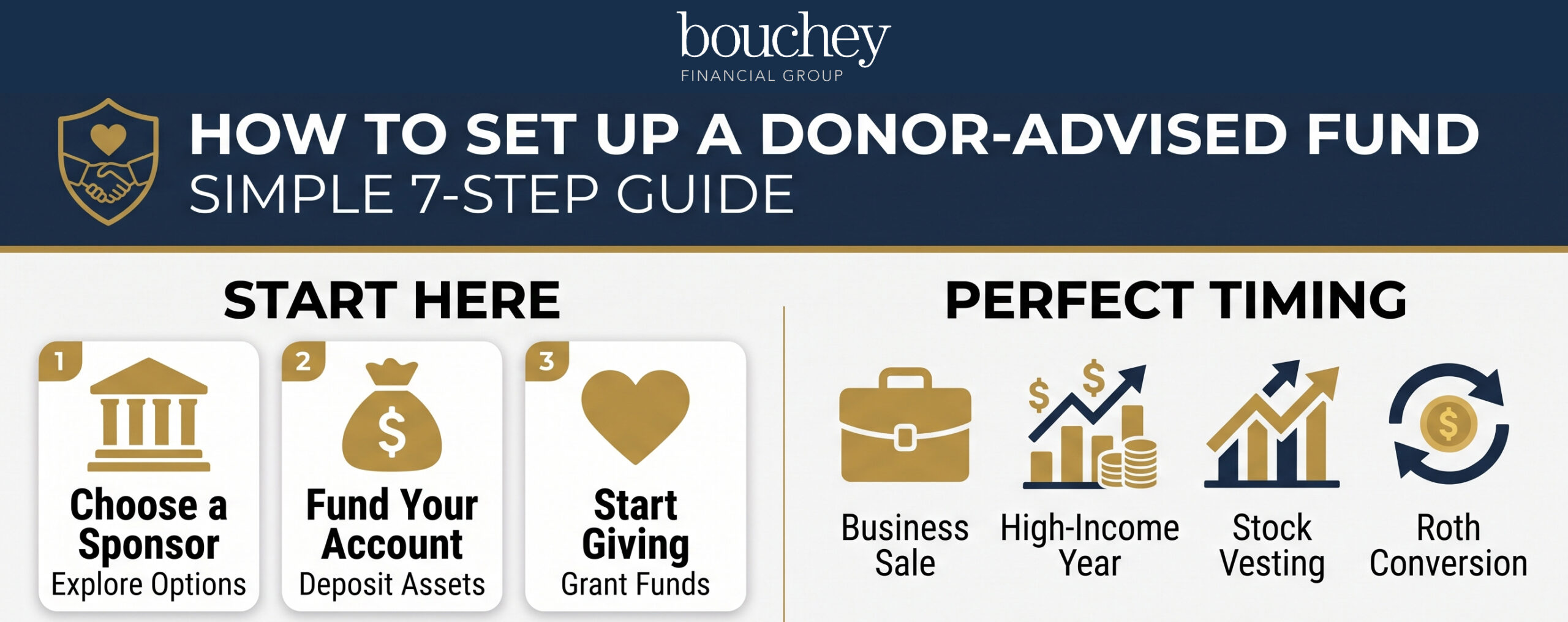
Step 1: Choose a Sponsoring Organization
A donor-advised fund must be held by a 501(c)(3) sponsoring organization. Three types of sponsors exist, and the right choice depends on your giving priorities.
National sponsors such as Fidelity Charitable, Schwab Charitable, and National Philanthropic Trust offer online account access, broad investment menus, and direct integration with brokerage accounts. They're the most practical choice for donors who want simplicity, wide grantmaking reach, and brokerage account transfers. Fidelity Charitable has no minimum initial contribution; NPT requires $10,000; some sponsors require up to $250,000.
Community foundations are locally focused organizations that offer DAF accounts alongside deep knowledge of regional nonprofits. They're a strong fit for donors with a primary giving focus in a specific geography.
Single-issue sponsors support specific missions, faith communities, or causes. If your giving is concentrated in one area, a single-issue sponsor can align the fund's culture with your philanthropic goals.
Questions to Ask Before Selecting a Sponsor
- What is the minimum initial contribution?
- What are the annual administrative fees? (Typically 0.15%–0.60% of assets)
- Can I contribute appreciated securities or complex assets directly?
- Does the platform support anonymous grantmaking?
- Can I nominate my financial advisor to manage the fund's investments?
- What is the minimum grant amount, and can I set up recurring grants?
Step 2: Gather Documents and Open the Account
Opening a DAF account is a low-friction administrative step. Most national sponsors allow you to open an account before making any contribution, which lets you evaluate the platform and set up preferences on a separate timeline from the funding decision.
Documents typically required include a government-issued ID, your Social Security number or EIN, and the name you want on the account (individual, family name, or anonymous fund name). If you plan to name successor advisors, gather their contact information as well.
One important distinction from the IRS guidance on donor-advised funds: the sponsoring organization assumes legal control of assets upon contribution. Advisory privileges — over investments and grant recommendations — remain yours, but the contribution is irrevocable. This is not a custodial account. It is a charitable gift.
Step 3: Select Your Contribution Asset
The choice of what to contribute has more impact on the tax outcome than almost any other decision in the process.
| Asset Type | Deduction Limit | Capital Gains Avoided | Notes |
| Cash | 60% of AGI | N/A | Simplest; lower tax efficiency |
| Publicly traded stock (held 1+ year) | 30% of AGI | Yes, in full | Most common high-value strategy |
| Mutual funds / ETFs (held 1+ year) | 30% of AGI | Yes, in full | Same treatment as stock |
| Closely held business interests | 30% of AGI | Yes, in full | Requires qualified appraisal; 3–6 weeks to process |
| Real estate | 30% of AGI | Yes, in full | Requires appraisal; varies by sponsor |
| Cryptocurrency | 30% of AGI | Yes, in full | Accepted by major national sponsors |
| Private company stock (pre-IPO) | 30% of AGI | Yes, potentially | Sponsor approval required; timing critical |
Source: IRS Publication 526
Contributing appreciated securities rather than cash is the most commonly underused strategy. A donor holding $200,000 in stock with a $40,000 cost basis avoids up to $24,000 in federal capital gains tax by donating the shares directly rather than selling first and donating proceeds. The deduction is still based on full fair market value.
Step 4: Time the Contribution Strategically
The deduction applies in the year the sponsoring organization receives the contribution, even if grants are made years later. Timing the contribution to coincide with a high-income year maximizes its value.
Three Situations Where DAF Timing Produces the Most Benefit
Business sale: Contributing appreciated business interests before the transaction closes can eliminate capital gains on the donated portion and generate a deduction against the same year's taxable income. The window between signing a letter of intent and closing is often the last opportunity to act.
Roth conversion year: A large Roth conversion increases taxable income. A same-year DAF contribution creates an offsetting deduction, reducing the net federal tax cost of the conversion.
Equity compensation vest: An executive vesting a large RSU grant can contribute appreciated shares to a DAF, offsetting income pushed into the top federal bracket or past the Massachusetts 4% surtax threshold.
Year-End Deadlines
Contributions must be received by December 31 to qualify for a current-year deduction. For publicly traded securities, initiate transfers by mid-December. For complex assets such as closely held stock or real estate, the timeline is three to six weeks minimum. Waiting until the final week of December for non-cash assets is a common and costly mistake.
Step 5: Select an Investment Allocation
Once assets are contributed, they can be invested inside the DAF to grow tax-free until distributed as grants. Most sponsors offer a menu of investment pools ranging from conservative fixed income to growth-oriented equity strategies.
The right allocation depends on your grant timeline. If you plan to distribute most assets within 12 months, a conservative or money market allocation is appropriate. If you are building a longer-term philanthropic endowment over five or more years, a growth-oriented allocation allows the fund to compound before distribution.
Many national sponsors allow donors to nominate a financial advisor to manage the investment allocation, which is particularly useful for donors whose advisor already manages their broader portfolio and can coordinate asset location across accounts.
Step 6: Designate Successor Advisors
Most sponsors allow you to name one or more successor advisors who take over grant recommendation authority when you die or become incapacitated. This is commonly used to involve children or other family members in the fund's continuation.
Designating successors transforms a DAF from a single-generation giving tool into a multigenerational philanthropic vehicle. Families who want to establish shared charitable values across generations often use the successor structure to create an ongoing giving program without the governance overhead of a private foundation.
DAF assets do not pass through probate and are not included in the taxable estate — they already belong to the sponsoring organization. This makes the successor designation a cleaner mechanism than a bequest for directing charitable assets after death.
Step 7: Recommend Grants
Grant recommendations are made through the sponsor's online platform, typically processed within one to two weeks. Grants must go to qualified 501(c)(3) public charities — verify eligibility through the IRS Tax Exempt Organization Search before recommending. Minimum grant amounts vary by sponsor, typically $50 to $250.
What DAF Grants Cannot Do
Three restrictions apply under IRC Section 4967:
- Grants cannot satisfy a legally binding pledge
- Grants cannot pay for fundraising event tickets or auction items with personal value
- Grants cannot benefit the donor or related parties
Grants can be made anonymously through most major sponsors, which is useful for donors who prefer privacy or are supporting sensitive causes.
Before You Contribute: Consult Your Advisor
A DAF contribution is irrevocable. The asset type, contribution amount, and timing all have tax consequences that interact with income, portfolio strategy, estate planning, and the 2026 OBBBA changes — including the new 0.5% AGI floor on itemized charitable deductions and the 35% cap for top-bracket donors.
The Bouchey Financial Group team works with clients to evaluate DAF contributions as part of the full financial plan — not as a standalone decision. The firm's CFP® professionals and CPAs coordinate charitable giving strategy alongside investment management, Roth conversion planning, and estate coordination.
Contact the team before a high-income event to make sure the contribution timing and asset selection capture the full available tax benefit. Explore recent planning topics through the firm's Webinars & Videos library before reaching out.
Frequently Asked Questions
When do I receive the tax deduction?
The deduction applies in the tax year the sponsoring organization receives the contribution, regardless of when grants are made to charities. Contributing to a DAF by December 31 locks in the current year's deduction even if you don't recommend any grants until the following year or later.
Can I contribute to a DAF after it's been opened?
Yes. Additional contributions can be made at any time and in any amount. Most sponsors have no cap on subsequent contributions, though each additional gift is subject to the same AGI deduction limits and documentation requirements as the initial contribution.
What documentation do I need to claim the deduction?
For contributions of $250 or more, you need a contemporaneous written acknowledgment from the sponsoring organization confirming the contribution amount and that no goods or services were received in exchange. For non-cash assets valued above $500, IRS Form 8283 is required. Contributions of non-cash assets above $5,000 require a qualified appraisal, per IRS Publication 526.
Can I remain anonymous when making grants?
Yes. Most major national sponsors support anonymous grantmaking. The sponsoring organization processes the grant without disclosing your identity to the recipient charity. Over 90% of grants through Fidelity Charitable include donor identification, but the option to give anonymously is available for those who want it.
What happens to my DAF when I die?
The fund continues under the management of the sponsoring organization. If you have designated successor advisors, they assume grant recommendation authority. If no successors are designated, most sponsors distribute the remaining balance to charitable organizations according to the account terms or the donor's stated preferences. The assets are not included in the taxable estate.
Can I contribute stock that hasn't vested yet?
No. You must have legal ownership of the asset before contributing it to a DAF. Unvested RSUs or unexercised stock options cannot be donated until they vest or are exercised. The timing strategy for equity compensation involves contributing shares after vesting but before selling, to avoid recognizing ordinary income or capital gains on the donated portion.
Can I use a DAF if I take the standard deduction?
A DAF contribution only produces a deduction if you itemize. Taxpayers taking the standard deduction receive no federal tax benefit from a DAF contribution itself. Starting in 2026, non-itemizers can deduct up to $1,000 ($2,000 for joint filers) for cash donations made directly to operating charities — but that deduction does not apply to DAF contributions.
IMPORTANT DISCLOSURE INFORMATION
Please remember that past performance is no guarantee of future results. Different types of investments involve varying degrees of risk, and there can be no assurance that the future performance of any specific investment, investment strategy, or product (including the investments and/or investment strategies recommended or undertaken by Bouchey Financial Group, Ltd. [“Bouchey Financial”]), or any non-investment related content, made reference to directly or indirectly in this blog will be profitable, equal any corresponding indicated historical performance level(s), be suitable for your portfolio or individual situation, or prove successful. Due to various factors, including changing market conditions and/or applicable laws, the content may no longer be reflective of current opinions or positions. Moreover, no portion of this discussion or information contained in this blog serves as the receipt of, or as a substitute for, personalized investment advice from Bouchey Financial. To the extent that a reader has any questions regarding the applicability of any specific issue discussed above to his/her individual situation, he/she is encouraged to consult with the professional advisor of his/her choosing. Neither Bouchey Financial’s investment adviser registration status, nor any amount of prior experience or success, should be construed that a certain level of results or satisfaction will be achieved if Bouchey Financial is engaged, or continues to be engaged, to provide investment advisory services. Bouchey Financial is neither a law firm nor a certified public accounting firm and no portion of the blog content should be construed as legal or accounting advice. A copy of the Bouchey Financial’s current written disclosure Brochure and Form CRS discussing our advisory services and fees is available for review upon request or at www.bouchey.com. Please Note: Bouchey Financial does not make any representations or warranties as to the accuracy, timeliness, suitability, completeness, or relevance of any information prepared by any unaffiliated third party, whether linked to Bouchey Financial’s web site or blog or incorporated herein, and takes no responsibility for any such content. All such information is provided solely for convenience purposes only and all users thereof should be guided accordingly. Please Remember: If you are a Bouchey Financial client, please contact Bouchey Financial, in writing, if there are any changes in your personal/financial situation or investment objectives for the purpose of reviewing/evaluating/revising our previous recommendations and/or services, or if you would like to impose, add, or to modify any reasonable restrictions to our investment advisory services. Unless, and until, you notify us, in writing, to the contrary, we shall continue to provide services as we do currently. Please Also Remember to advise us if you have not been receiving account statements (at least quarterly) from the account custodian.