
Retirement Planning in Boca Raton, FL | Securing Your Financial Future
Retirement isn't one decision. It's a sequence of decisions that interact with each other in ways most people don't fully map out until they're already in the middle of them. When do you stop working? When do you claim Social Security? Which account do you spend first? What happens when RMDs start? Miss the sequencing, and you pay for it in taxes and lost income for the rest of retirement.
Bouchey Financial Group serves Boca Raton and the surrounding South Florida area as a fee-only fiduciary firm. The firm's CERTIFIED FINANCIAL PLANNER™ professionals and CPAs work together on retirement income planning, tax strategy, and investment management as one coordinated process — not three separate conversations.
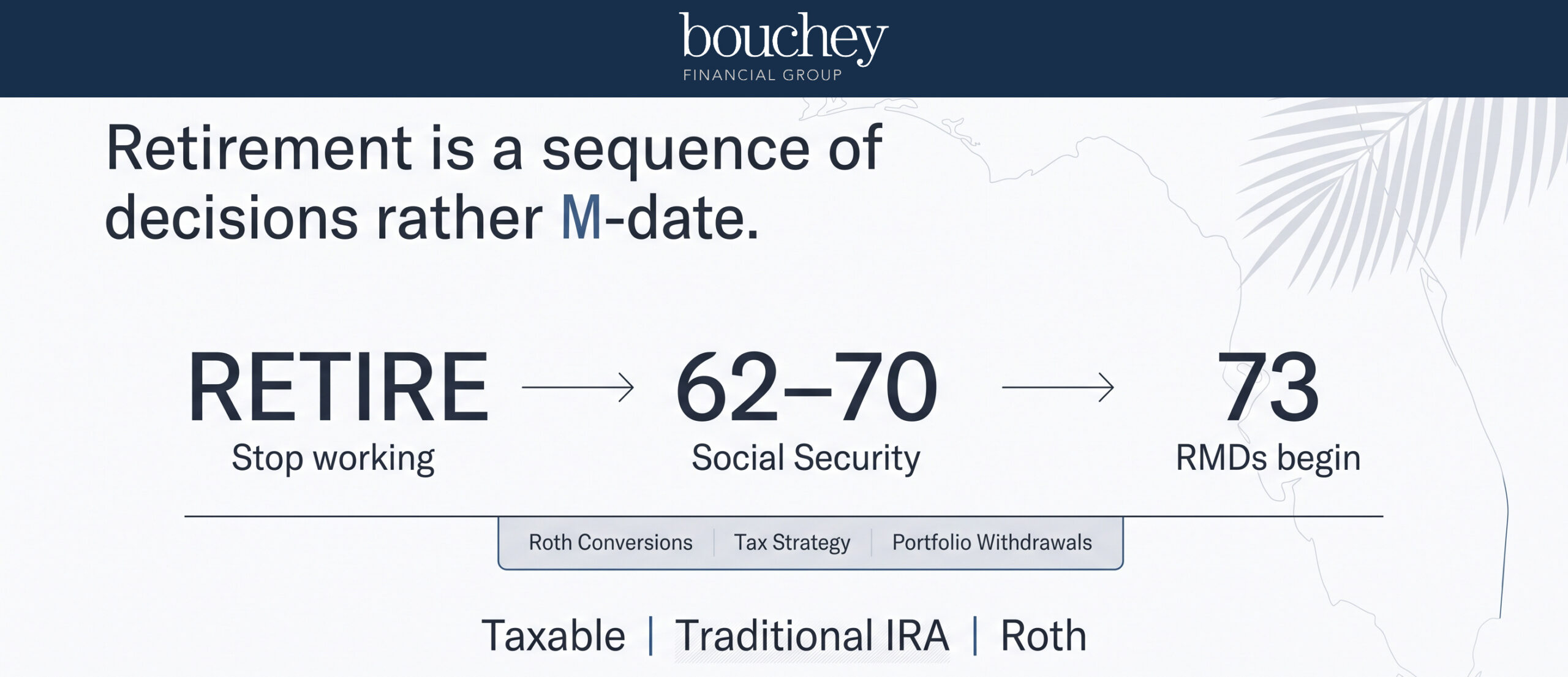
Retirement Has Three Dates, Not One
Most people think of retirement as a single event: the day you stop working. In practice, there are three distinct dates that shape the financial picture, and treating them as the same date is a costly mistake.
Date one is when you stop working.
Date two is when you claim Social Security, anywhere from 62 to 70.
Date three is when RMDs begin, currently age 73 under IRS guidance for most retirement accounts.
The gap between these dates is where the planning happens.
Retiring at 62 Doesn't Mean Claiming at 62
This is one of the most important distinctions in retirement planning, and surprisingly few people make it. According to the SSA's claiming guidance, you can start benefits as early as 62, but every month before full retirement age permanently reduces the amount. Waiting past full retirement age increases the benefit through delayed retirement credits, up to age 70 — after which there's no additional increase.
The 2026 maximum benefit for someone who earned the taxable maximum throughout their career illustrates the range: SSA's 2026 figures show $2,969 per month at 62, $4,152 at full retirement age, and $5,181 at 70. That's a $2,212 monthly difference between the two extremes. Over a 25-year retirement, the gap compounds into a substantial lifetime income difference.
For Married Couples, It's Not an Individual Decision
The SSA's When to Start Receiving Retirement Benefits publication specifically notes that claiming timing affects not just the retiree's lifetime income but also survivor benefit protection. For married couples in Boca Raton, the higher earner's decision to delay carries a second dimension: a surviving spouse inherits the higher earner's benefit.
That changes the analysis entirely. If one spouse has a significantly higher earnings record, their claiming decision is really a joint financial planning decision, not a personal one.
Don't Forget Medicare While You're Waiting
Here's a detail that catches people off guard. The SSA's delayed retirement guidance explicitly warns that delaying Social Security doesn't mean delaying Medicare. If you're waiting until 70 to claim, you still need to sign up for Medicare at 65. Missing that window can delay your coverage and increase your premiums. Two completely separate enrollment decisions.
Which Account Do You Spend First?
This is arguably the most consequential ongoing decision in retirement, and the answer changes year by year as income and tax law evolve. The three main account types behave very differently in retirement.
According to the IRS's comparison of traditional and Roth IRAs, traditional IRA withdrawals are generally taxable as ordinary income and subject to RMD rules beginning at 73. Roth IRA qualified distributions are generally tax-free, and Roth accounts have no lifetime RMD requirement for the original owner. A taxable brokerage account generates capital gains, dividends, and interest, each with their own treatment.
| Account Type | Retirement Tax Characteristic |
| Taxable brokerage | Capital gains, dividends, interest; rates depend on income |
| Traditional IRA / 401(k) | Generally taxable as ordinary income; RMD rules apply at 73 |
| Roth IRA | Qualified distributions generally tax-free; no lifetime RMD |
Having all three account types isn't an accident of planning. It's a deliberate strategy. Each year in retirement, you choose where spending comes from, which affects your taxable income, your Medicare premiums, your Social Security taxation, and your Roth conversion capacity simultaneously.
Should You Pay Tax on Your IRA Before the IRS Forces You To?
That's what a Roth conversion is. You take money from a traditional IRA, pay income tax on it now, and it grows tax-free from that point forward.
The IRS explains that previously untaxed amounts converted to a Roth generally become taxable income in the conversion year. Whether that's worth doing depends on your current bracket versus your expected future bracket, whether you have cash outside the IRA to pay the taxes, and what the additional income does to Medicare premiums that year.
The Window Before RMDs Is Critical
Roth conversions work best in the years between retirement and age 73, when income tends to be lower and bracket room is available. The logic: converting $80,000 per year during the low-income window, paying tax at 22%, is usually better than waiting for RMDs to force $120,000 per year out of a larger balance at a higher combined rate. Missing this window isn't catastrophic. But it narrows the options available for the rest of retirement.
Florida Is Tax-Friendly — With Important Limits
Florida has no individual income tax, which means no state tax on IRA distributions, Roth conversions, Social Security, or capital gains. That's real money.
But federal taxes don't disappear. IRS Publication 915 is specific: up to 85% of Social Security benefits may be included in taxable income for higher-income retirees. Florida removes one layer. It doesn't remove the federal picture.
What Boca Raton Retirees Still Need to Plan Around
Even with Florida's advantages, a household drawing from a traditional IRA, pension, Social Security, and a taxable portfolio still needs to manage federal bracket exposure, Medicare IRMAA surcharges on prior-year MAGI, and the provisional income thresholds that determine how much Social Security gets taxed.
Your Boca Raton Home Is Part of the Plan
For many retirees, the Florida residence is one of the largest assets on the balance sheet. It doesn't generate retirement income directly, but it affects the plan. Florida's Homestead Exemption and Save Our Homes cap reduce property tax exposure, and portability lets retirees moving within Florida carry accumulated assessment savings to a new homestead.
Housing costs, insurance, and maintenance also represent a significant fixed expense in retirement cash flow. Decisions about downsizing or relocating later in retirement carry both financial and estate planning implications that belong in the plan from the beginning.
If You're Already Giving to Charity
The IRS's guidance in Publication 590-B covers qualified charitable distributions: IRA owners age 70½ or older can transfer up to $111,000 directly to a qualifying charity in 2026, excluding that amount from taxable income. It can satisfy RMDs without adding to AGI.
For Boca Raton retirees who give regularly to charity, this matters. The source of the charitable gift changes its tax treatment in ways that can protect Medicare thresholds and Social Security provisional income simultaneously. The planning question isn't just how much to give. It's which asset funds the gift.
Building the Income Plan
Retirement income planning isn't about finding the "right" answer once and moving on. It's an annual process: reviewing income sources, updating Roth conversion sizing, confirming RMD calculations, evaluating charitable strategy, and adjusting portfolio withdrawals as tax law and life circumstances evolve.
Bouchey Financial Group works with Boca Raton households navigating exactly this kind of planning. The firm requires a minimum of $1,000,000 in investable assets and manages approximately $1.8 billion for clients across 34 states. To talk through your retirement timeline and income strategy, schedule a free consultation with the team. The firm's Webinars and Videos library covers these topics in plain language for anyone who wants to explore before reaching out.
Frequently Asked Questions
Can I retire at 62 and delay Social Security until 70?
Yes. These are two separate decisions. You can stop working at 62, fund spending from investment accounts, and claim Social Security at 70 to maximize the monthly benefit. Whether that's the right call depends on your portfolio size, health, spouse's benefit history, and what the delay does to your bracket management during the bridging years.
What is the actual dollar difference between claiming Social Security at 62 vs. 70?
For someone who earned the taxable maximum throughout their career, the 2026 SSA figures show $2,969 per month at 62 versus $5,181 at 70. That's a $2,212 monthly difference. Most people earn less than the maximum, so the absolute numbers will be lower, but the proportional gap applies to everyone.
Is Social Security income tax-free in Florida?
Florida imposes no state income tax, so there's no state-level tax on Social Security. But federal income tax still applies. IRS Publication 915 covers when Social Security becomes federally taxable: up to 85% of benefits can be included in taxable income depending on combined income. Florida helps — it doesn't eliminate the federal calculation.
Why do Roth conversions make sense before RMDs begin?
Traditional IRA and 401(k) balances grow tax-deferred but are eventually forced out as ordinary income through RMDs starting at 73. Converting portions of that balance to Roth during the lower-income years before RMDs begin reduces the future mandatory distribution amount and creates tax-free assets for retirement and heirs. The conversion is taxable now, but paying a lower rate today on smaller amounts often beats paying a higher rate later on a larger balance.
How does Social Security timing affect a surviving spouse in Florida?
The higher earner's claiming decision directly affects the survivor benefit. A surviving spouse generally receives the higher of their own benefit or their deceased spouse's benefit. If the higher earner delayed to 70 and built up the maximum benefit, the survivor inherits that larger amount. For married couples with a meaningful earnings gap, this makes the claiming decision a joint financial planning call, not an individual one.
What happens if I miss Medicare enrollment while waiting to claim Social Security?
Delaying Social Security doesn't automatically delay Medicare. You still need to enroll in Medicare at 65 regardless of when you plan to claim Social Security. The SSA explicitly warns that missing the Medicare enrollment window can delay coverage and increase premiums. These are separate enrollments with separate deadlines.
How does the Homestead Exemption affect retirement cash flow planning in Boca Raton?
The Florida Homestead Exemption reduces taxable property value and activates the Save Our Homes cap, which limits annual assessed value increases. Over time, that gap between assessed value and market value reduces property tax exposure meaningfully. Retirees who move within Florida can also port their accumulated assessment savings to a new homestead, which is worth calculating before selling a prior Florida property.

IMPORTANT DISCLOSURE INFORMATION
Please remember that past performance is no guarantee of future results. Different types of investments involve varying degrees of risk, and there can be no assurance that the future performance of any specific investment, investment strategy, or product (including the investments and/or investment strategies recommended or undertaken by Bouchey Financial Group, Ltd. [“Bouchey Financial”]), or any non-investment related content, made reference to directly or indirectly in this blog will be profitable, equal any corresponding indicated historical performance level(s), be suitable for your portfolio or individual situation, or prove successful. Due to various factors, including changing market conditions and/or applicable laws, the content may no longer be reflective of current opinions or positions. Moreover, no portion of this discussion or information contained in this blog serves as the receipt of, or as a substitute for, personalized investment advice from Bouchey Financial. To the extent that a reader has any questions regarding the applicability of any specific issue discussed above to his/her individual situation, he/she is encouraged to consult with the professional advisor of his/her choosing. Neither Bouchey Financial’s investment adviser registration status, nor any amount of prior experience or success, should be construed that a certain level of results or satisfaction will be achieved if Bouchey Financial is engaged, or continues to be engaged, to provide investment advisory services. Bouchey Financial is neither a law firm nor a certified public accounting firm and no portion of the blog content should be construed as legal or accounting advice. A copy of the Bouchey Financial’s current written disclosure Brochure and Form CRS discussing our advisory services and fees is available for review upon request or at www.bouchey.com. Please Note: Bouchey Financial does not make any representations or warranties as to the accuracy, timeliness, suitability, completeness, or relevance of any information prepared by any unaffiliated third party, whether linked to Bouchey Financial’s web site or blog or incorporated herein, and takes no responsibility for any such content. All such information is provided solely for convenience purposes only and all users thereof should be guided accordingly. Please Remember: If you are a Bouchey Financial client, please contact Bouchey Financial, in writing, if there are any changes in your personal/financial situation or investment objectives for the purpose of reviewing/evaluating/revising our previous recommendations and/or services, or if you would like to impose, add, or to modify any reasonable restrictions to our investment advisory services. Unless, and until, you notify us, in writing, to the contrary, we shall continue to provide services as we do currently. Please Also Remember to advise us if you have not been receiving account statements (at least quarterly) from the account custodian.