
Investment Management Rochester NY | Direct Indexing & Tax Strategy
Most Rochester-area investors with significant taxable portfolios own index funds and think of themselves as tax-efficient investors. They're partially right. Index ETFs are structurally efficient: low turnover, low dividends, no capital gains distributions. But they have one blind spot that costs money every year. When any position in the fund falls, the loss belongs to the fund, not to the investor. You can't harvest it.
Bouchey Financial Group serves Rochester and the Monroe County area as a fee-only fiduciary firm. The firm's CERTIFIED FINANCIAL PLANNER™ professionals and CPAs integrate direct indexing, tax-loss harvesting, and retirement income planning as one coordinated strategy for clients with significant taxable investment accounts.
What Direct Indexing Is and Why It Exists
Direct indexing means owning the individual securities that make up an index rather than a pooled fund. Instead of buying an S&P 500 ETF, the investor holds hundreds of individual stocks in approximately the same proportions, inside a separately managed account.
That ownership structure changes what's possible. When individual positions within the index fall below their cost basis, the investor can harvest those losses while maintaining exposure to the index's overall return. In any given year, even strong market years, a meaningful number of index components decline. According to Charles Schwab research, 433 stocks within the Schwab 1000 lost value during 2024, a year in which the index itself returned nearly 25%. Each of those declining positions is a potential harvesting opportunity unavailable to the ETF holder.
The After-Tax Return Advantage
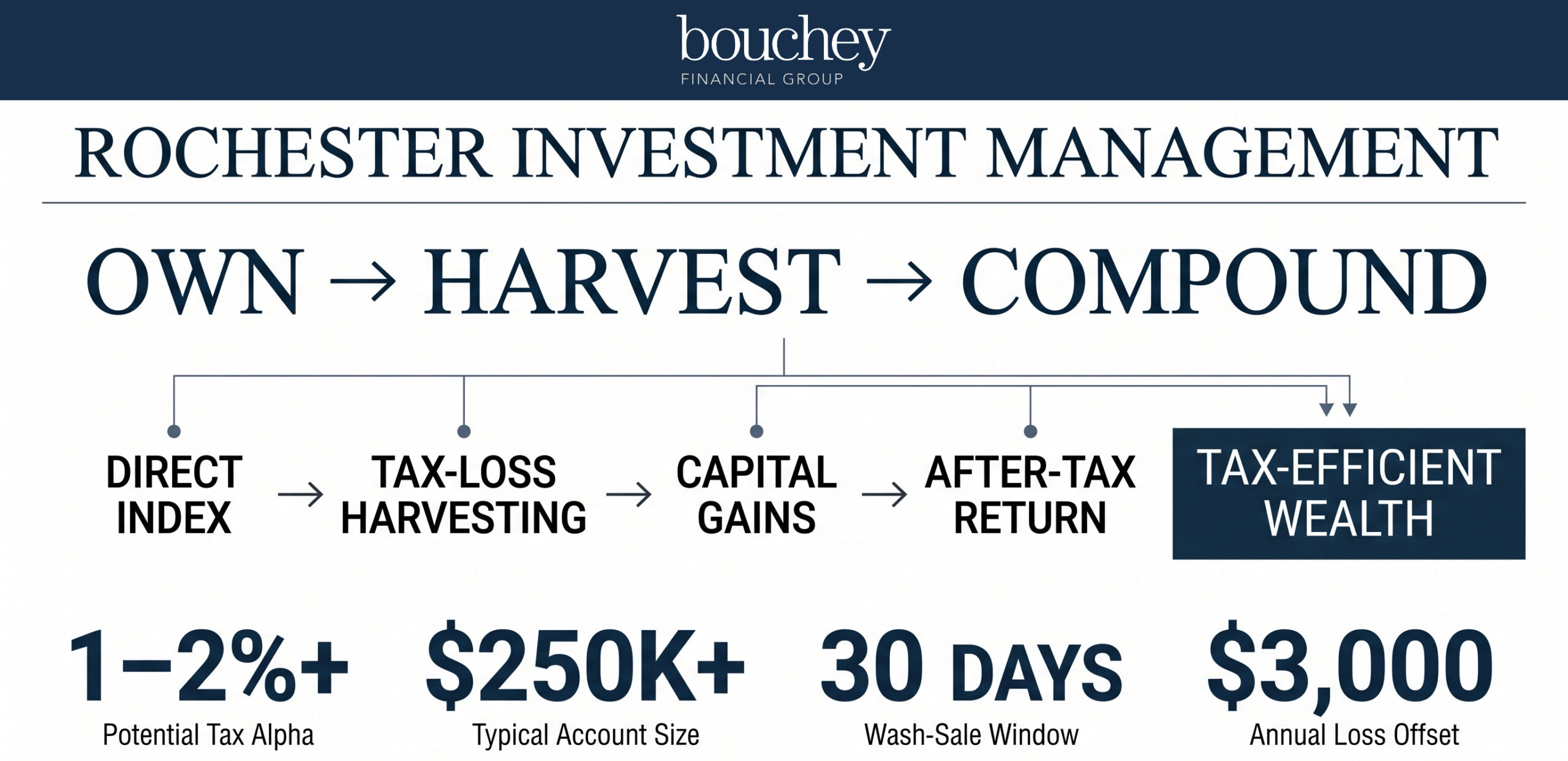
Tax-loss harvesting within a direct index produces measurable after-tax return improvement. Vanguard's research on personalized indexing found that daily monitoring for loss-harvesting opportunities can boost after-tax returns by 1% to 2% or more annually depending on portfolio size, market volatility, and tax bracket. Schwab's own modeling estimates that a disciplined harvesting strategy can add approximately 1.03 percentage points in annual after-tax returns over a passive ETF approach at the top federal tax rate.
For a Rochester-area investor in the 32% or 37% federal bracket plus New York's ordinary income rate on capital gains, the combined value of each harvested loss is proportionally higher than for investors in lower-tax states.
How Tax-Loss Harvesting Works Inside a Direct Index
When a position falls below its cost basis, the portfolio manager sells it and immediately purchases a correlated but not substantially identical replacement security. The loss is realized for tax purposes. Market exposure is maintained. Per IRC Section 1091, the wash-sale rule prohibits repurchasing the same or substantially identical security within 30 days before or after a sale. Replacement securities must be similar enough to maintain index-like exposure without triggering disallowance.
Harvested losses offset realized gains from other sources: portfolio rebalancing, real estate sales, business transactions, or concentrated stock dispositions. Per IRS Topic 409, net capital losses can offset up to $3,000 of ordinary income annually, with the remainder carried forward indefinitely.
Frequency Matters More Than Most Investors Realize
Year-end harvesting captures one window of opportunity. Daily or continuous monitoring captures losses as they arise throughout the year. Parametric's research estimates 1% to 2% tax alpha annually for equity direct indexing strategies, with the higher end associated with more frequent monitoring during volatile markets. Waiting until December to look for losses means missing most of them.
Direct Indexing vs. Index ETFs: The Key Differences
| Feature | Direct Indexing | Index ETF |
| Security ownership | Individual stocks | Fund shares |
| Tax-loss harvesting | Security-level, ongoing | Not available |
| Portfolio customization | Yes (exclude sectors, companies) | No |
| Wash-sale management | Required | N/A |
| Minimum account size | $100,000–$250,000 typical | No minimum |
| Management fee | (0.15%–0.40%+) | (0.03%–0.20%) |
| Tax efficiency in bull markets | High | High (ETF structure) |
For a Rochester-area investor at the 37% federal bracket with significant taxable assets and ongoing capital gain exposure, the after-tax benefit typically exceeds the fee differential at account sizes above $250,000. For investors in lower brackets or holding primarily in retirement accounts, the math often doesn't favor the additional cost.
Who Benefits Most in Rochester
Not every investor is a good candidate. Direct indexing produces the most value when several conditions are present:
- Taxable account size above $250,000, where the fee differential is offset by harvesting benefits
- Federal tax bracket of 32% or higher, where each harvested dollar saves more
- Ongoing capital gain exposure from rebalancing, real estate, business income, or concentrated stock
- Long investment horizon, allowing harvested losses and reset basis to compound over time
- Portfolio customization needs, such as excluding a former employer's stock or specific sectors
Rochester's professional population — physicians, executives, engineers, attorneys, and business owners — tends to fit several of these criteria simultaneously. Concentrated stock positions from employer equity, real estate gains from long-held property, and high combined state and federal marginal rates all amplify the value of systematic harvesting.
Portfolio Customization Beyond Tax Efficiency
Security-level ownership enables something else an ETF cannot: meaningful portfolio customization. A Rochester physician holding significant stock in a hospital system has already concentrated exposure to that sector. A direct index can exclude that company, or that sector entirely, while maintaining broad market exposure.
ESG preferences, faith-based screens, and sector tilts are implementable at the individual security level. The customization doesn't require active management of the overall portfolio. It simply builds around positions the investor already holds or wants to avoid.
New York's Capital Gains Context
New York taxes long-term capital gains at ordinary income rates, not the federal preferential structure, per NYS Department of Taxation and Finance guidance. Federal long-term gains are taxed at 0%, 15%, or 20% depending on income, per IRS Topic 409. The state adds 4% to 10.9% on the same gain.
For a Rochester-area investor in the 6.85% New York bracket realizing a $200,000 gain, the combined rate, federal plus state plus potential 3.8% Net Investment Income Tax, can reach 25% or higher. Each dollar of harvested loss saves proportionally more in New York than in states that mirror the federal preferential rate structure or have no income tax at all. That's one reason direct indexing is more valuable for New York residents than for investors in most other states.
Connecting Direct Indexing to the Retirement Income Plan
Direct indexing lives in the taxable account. But its value connects directly to the retirement income plan. Harvested losses generated in peak earning years carry forward to offset gains realized in retirement, when large portfolio withdrawals or concentrated stock sales might otherwise create significant tax events.
For a Rochester household with $800,000 in a taxable account, $500,000 in a traditional IRA, and a concentrated stock position approaching retirement, the interaction between direct indexing, Roth conversion planning, and retirement income sequencing can produce a materially better after-tax outcome than managing each piece separately. Per IRS Publication 550, capital loss carryforwards survive until they're used — they don't expire — making them a long-term tax asset worth building systematically.
Starting the Conversation
Bouchey Financial Group's 22-person team includes 9 CFP® professionals, 3 CPAs, and 1 IRS Enrolled Agent. The firm manages approximately $1.6 billion for clients across 34 states, with a minimum of $1,000,000 in investable assets.
For Rochester and Monroe County households with significant taxable portfolios who want to evaluate whether direct indexing makes sense for their situation, contact the team to start the conversation. Recent discussions on tax-efficient investing and portfolio strategy are available through the Webinars and Videos library.
Frequently Asked Questions
What is the minimum account size for direct indexing?
Most established direct indexing providers require $100,000 to $250,000 as a minimum. Some platforms accept accounts as small as $5,000 using fractional shares, but the tax benefit at smaller account sizes in lower tax brackets is generally insufficient to justify the additional management fee. For Rochester-area investors in higher tax brackets, $250,000 is a reasonable threshold where the economics consistently favor the strategy.
Does the wash-sale rule apply to direct indexing?
Yes. Selling a security at a loss and repurchasing the same or substantially identical security within 30 days disallows the loss under IRC Section 1091. Direct indexing managers navigate this by replacing harvested positions with correlated but distinct securities, maintaining index-like exposure without triggering disallowance. This requires active management — it's one reason direct indexing can't simply be replicated with a standard brokerage account.
Can I use direct indexing inside a retirement account?
The structure is available inside IRAs and retirement accounts, but the primary benefit, tax-loss harvesting, has no value in tax-deferred accounts where transactions don't generate taxable events. Placing a direct index in a retirement account means paying a higher management fee for a benefit that doesn't apply in that context.
How does New York's capital gains treatment affect the value of direct indexing?
New York taxes long-term capital gains at ordinary income rates rather than the federal preferential rates. For a Rochester-area investor in a higher New York bracket, each harvested loss saves more in combined state and federal tax than it would for an investor in a no-income-tax state. The higher the combined marginal rate, the more valuable systematic harvesting becomes.
What is a capital loss carryforward and how long does it last?
A capital loss carryforward is the amount of net capital loss that exceeds the $3,000 annual ordinary income offset limit. It carries forward to future tax years without expiration, where it offsets future capital gains first and then ordinary income up to $3,000 per year. Per IRS Publication 550, carryforwards survive until fully used, making them a long-term tax asset worth building systematically in high-earning years.
Can I exclude individual stocks or sectors in a direct index?
Yes. Direct indexing allows customization at the individual security level. An investor can exclude a former employer's stock, remove specific sectors, apply ESG or faith-based screens, or tilt the portfolio toward or away from particular characteristics. These customizations are one of the primary advantages over pooled funds, which don't allow individual position adjustments.
How does direct indexing connect to a broader retirement plan?
Capital losses harvested in a taxable direct index carry forward to retirement, where they can offset gains from concentrated stock sales, real estate transactions, or portfolio rebalancing. Coordinating the direct indexing strategy with Roth conversion timing and retirement income sequencing can produce materially better lifetime after-tax outcomes than managing each piece separately. This is why the tax planning and investment management functions benefit from working together on the same accounts.

IMPORTANT DISCLOSURE INFORMATION
Please remember that past performance is no guarantee of future results. Different types of investments involve varying degrees of risk, and there can be no assurance that the future performance of any specific investment, investment strategy, or product (including the investments and/or investment strategies recommended or undertaken by Bouchey Financial Group, Ltd. [“Bouchey Financial”]), or any non-investment related content, made reference to directly or indirectly in this blog will be profitable, equal any corresponding indicated historical performance level(s), be suitable for your portfolio or individual situation, or prove successful. Due to various factors, including changing market conditions and/or applicable laws, the content may no longer be reflective of current opinions or positions. Moreover, no portion of this discussion or information contained in this blog serves as the receipt of, or as a substitute for, personalized investment advice from Bouchey Financial. To the extent that a reader has any questions regarding the applicability of any specific issue discussed above to his/her individual situation, he/she is encouraged to consult with the professional advisor of his/her choosing. Neither Bouchey Financial’s investment adviser registration status, nor any amount of prior experience or success, should be construed that a certain level of results or satisfaction will be achieved if Bouchey Financial is engaged, or continues to be engaged, to provide investment advisory services. Bouchey Financial is neither a law firm nor a certified public accounting firm and no portion of the blog content should be construed as legal or accounting advice. A copy of the Bouchey Financial’s current written disclosure Brochure and Form CRS discussing our advisory services and fees is available for review upon request or at www.bouchey.com. Please Note: Bouchey Financial does not make any representations or warranties as to the accuracy, timeliness, suitability, completeness, or relevance of any information prepared by any unaffiliated third party, whether linked to Bouchey Financial’s web site or blog or incorporated herein, and takes no responsibility for any such content. All such information is provided solely for convenience purposes only and all users thereof should be guided accordingly. Please Remember: If you are a Bouchey Financial client, please contact Bouchey Financial, in writing, if there are any changes in your personal/financial situation or investment objectives for the purpose of reviewing/evaluating/revising our previous recommendations and/or services, or if you would like to impose, add, or to modify any reasonable restrictions to our investment advisory services. Unless, and until, you notify us, in writing, to the contrary, we shall continue to provide services as we do currently. Please Also Remember to advise us if you have not been receiving account statements (at least quarterly) from the account custodian.