
Financial Advisor in North Palm Beach | Comprehensive Wealth Planning
Most people who describe themselves as "already doing pretty well financially" are doing well at accumulating. The planning side is often a different story. They have investment accounts, an IRA, an estate plan drafted years ago, and a general sense that everything is on track. But nobody has sat down and shown how all of it fits together — or what happens when one decision changes the others.
That's what comprehensive planning actually is. Bouchey Financial Group serves North Palm Beach and the surrounding area as a fee-only fiduciary firm. The 23-person advisory team includes 9 CERTIFIED FINANCIAL PLANNER™ professionals, 3 CPAs, and 1 IRS Enrolled Agent who handle investment management, retirement income planning, tax strategy, and estate coordination as connected disciplines.
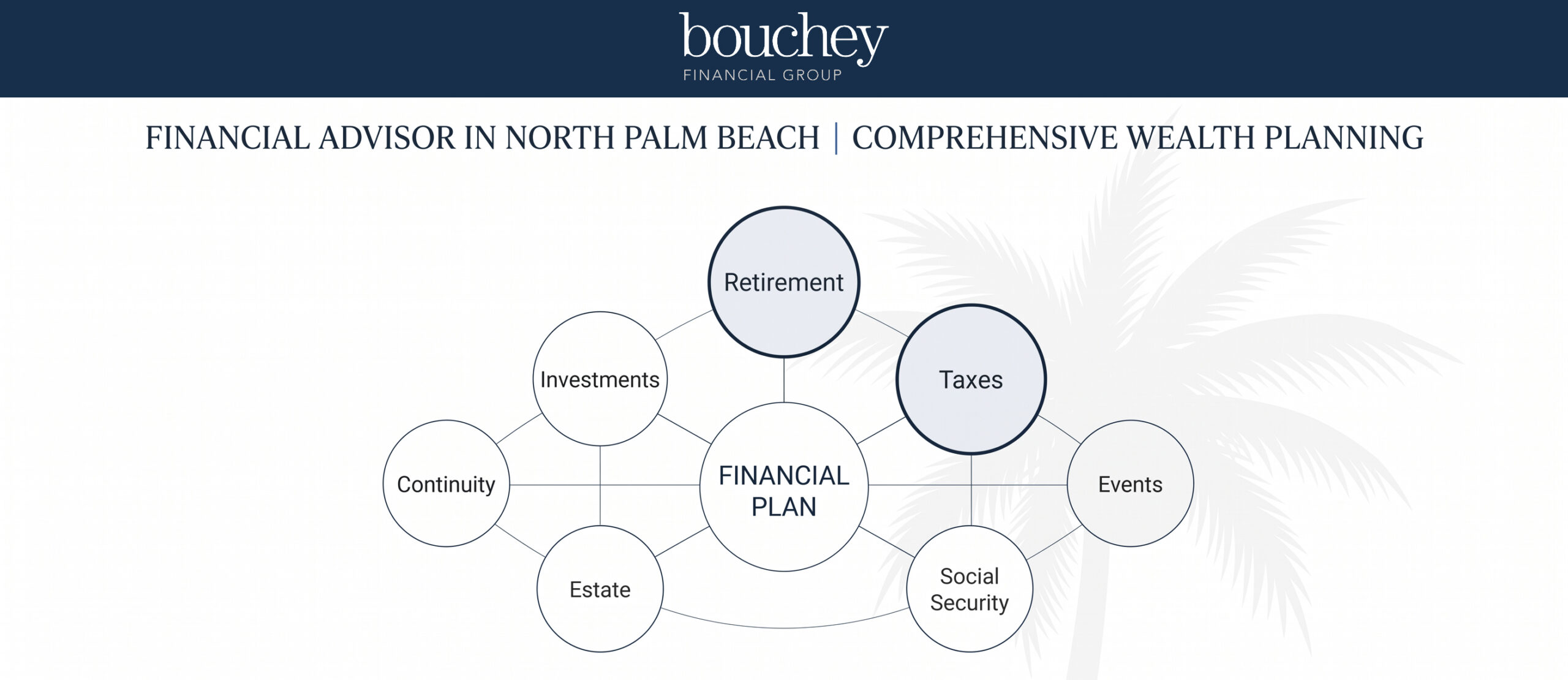
A Financial Plan Is More Than an Investment Portfolio
The Consumer Financial Protection Bureau frames retirement planning as balancing income, assets, and major decisions simultaneously. A complete financial plan connects investment strategy, retirement income projections, Social Security timing, tax planning, estate documents, beneficiary designations, and charitable goals.
Change one element and several others shift. That's not a problem with the plan. The goal is to model those decisions together, so an adjustment in one area doesn't create an unintended consequence somewhere else.
The Planning Decisions That Actually Interact
Take a couple approaching retirement in North Palm Beach. They have a taxable brokerage account, two traditional IRAs, a Roth, a pension, and Social Security benefits neither has claimed. Delaying Social Security means the portfolio funds spending now — which requires choosing which account to draw from.
Drawing from the traditional IRA in those years manages future RMD exposure. But IRA distributions raise taxable income, which affects Roth conversion capacity. Roth conversions affect Medicare IRMAA surcharges two years out. And the QCD strategy they want for charitable giving depends on when RMDs begin and how large they'll be. None of those decisions exist independently.
Social Security Timing
According to SSA's official claiming guidance, benefits can start as early as 62, but claiming before full retirement age permanently reduces the monthly amount. Delaying past full retirement age increases benefits through delayed retirement credits, up to age 70.
The real question isn't whether to delay. It's how delaying interacts with bracket management, Roth conversion opportunities, spousal and survivor benefits, and portfolio withdrawal sequencing. This is a planning question, not a rules question.
The Pre-RMD Window
IRS RMD guidance requires distributions from traditional IRAs and most retirement plan accounts beginning at age 73. Roth IRAs and designated Roth workplace accounts don't require lifetime distributions from the original owner.
The years between retirement and age 73 are often the best planning window in a retiree's financial life. Income is lower, bracket room is available, and withdrawals are discretionary. That's where Roth conversions, capital gains harvesting, and QCD planning can make a structural difference. Miss it and the planning leverage shrinks.
The Annual RMD Process
It's not just pulling a dollar amount from an account. The IRS provides different RMD worksheets depending on account type and beneficiary circumstances. For households with multiple retirement accounts, the annual process covers account inventory, per-account calculations, distribution sourcing, tax withholding, and rebalancing.
Per IRS IRA distribution guidance, a qualified charitable distribution can satisfy some or all of the RMD requirement without the amount counting as taxable income. For households who give regularly to charity, the source of the gift changes its tax treatment.
Florida Doesn't Tax Capital Gains — The Federal Government Does
The Florida Department of Revenue confirms that Florida imposes no individual capital gains tax, because Florida has no individual income tax. That's a genuine advantage.
Federal capital gains taxes still apply at 0%, 15%, or 20% depending on taxable income, with the 3.8% Net Investment Income Tax applying above certain thresholds. Selling appreciated securities or rebalancing a portfolio still carry federal consequences that need modeling against other retirement income. Florida removes one layer. It doesn't remove the planning requirement.
Tax Planning Doesn't Stop When the Paycheck Does
Retirement often makes tax management more complicated, not less. When you had a salary, an employer handled withholding. In retirement, income arrives from multiple sources — Social Security, IRA withdrawals, pension, dividends, interest, realized gains — and none of it comes with automatic tax coordination.
IRS Publication 505 covers estimated tax requirements for 2026. Taxpayers generally owe estimated payments when they expect to owe at least $1,000 after withholding and credits. The 2026 standard deduction is $32,200 for married couples filing jointly, with a new enhanced senior deduction of up to $6,000 per qualifying individual subject to MAGI limits.
Annual Review Matters
The optimal withdrawal strategy isn't set once at retirement and followed unchanged. Tax law changes, income shifts, and portfolio values fluctuate. The plan that made sense in year one won't automatically remain optimal in year ten. Annual review isn't optional for households trying to stay in front of the tax picture.
Who Manages Your Financial Life If You Can't?
The CFPB flagged this as a critical gap for older adults in its Managing Someone Else's Money resources. A financial power of attorney designates someone to handle financial decisions if you become unable to. Without one, family members who want to help may face court proceedings to establish authority.
The CFPB notes that failing to establish appropriate authority beforehand can require exactly that — an expensive, time-consuming process during an already difficult moment.
Estate Planning Isn't Only About Death
Most people have addressed some but not all of the key tools. A will governs what happens after death. Beneficiary designations transfer specific assets. Trust structures control ownership and distribution. A financial POA handles decision-making during incapacity. These are four different tools that need to work together.
Trusted Contact vs. Power of Attorney
Per FINRA's guidance on trusted contacts, a trusted contact is someone a brokerage firm may reach out to in limited circumstances — if they can't reach you or suspect potential financial exploitation. Critically, a trusted contact has no authority to transact or direct the account. That's the POA's role. Naming one does not substitute for the other.
Building a Financial Continuity Plan
The CFPB's resources for older adults cover exactly this gap: ensuring that a spouse, adult child, or trusted family member can step in if needed.
A financial continuity plan answers practical questions: Where are all investment accounts? Who are the beneficiaries? Who holds the financial POA? Is there a trusted contact on brokerage accounts? Does a spouse know the names of the CPA, attorney, and advisor? Without those answers documented, a family member dealing with an incapacity faces a scavenger hunt at the worst possible time.
Planning That Connects All the Pieces
Bouchey Financial Group's fee-only fiduciary model means the only compensation comes from clients — no commissions, no product incentives. In-house CPAs and an IRS Enrolled Agent work alongside CFP® professionals on the same accounts, so investment decisions, tax consequences, and estate planning implications are evaluated together.
For North Palm Beach households with $1,000,000 or more in investable assets, the firm offers a free initial consultation. Contact the team directly to start the conversation, or review planning topics through the Webinars and Videos library before reaching out.
Frequently Asked Questions
What does comprehensive wealth planning include beyond investment management?
It covers retirement income planning, Social Security timing, tax-efficient withdrawals, RMD management, estate document review, beneficiary coordination, charitable giving strategy, and incapacity planning. The value comes from coordinating those elements so a decision in one area doesn't create unintended consequences in another.
When is the right time to claim Social Security?
It depends on health, spousal benefit history, other income sources, and portfolio withdrawal plans. Delaying past full retirement age increases benefits up to age 70. For households with sufficient assets to bridge the gap, delay usually pays off — but the timing should be modeled against bracket management, Roth conversion capacity, and RMD projections.
What is the pre-RMD planning window and why does it matter?
The years between retirement and age 73 often represent the most flexible tax planning period in a retiree's financial life. Income is lower, bracket room is available, and withdrawals are discretionary. Roth conversions, capital gains harvesting, and QCD structuring during this window can reduce lifetime tax exposure meaningfully.
Does Florida's lack of a capital gains tax eliminate the need for investment tax planning?
No. Federal capital gains tax still applies at 0%, 15%, or 20%, plus the 3.8% Net Investment Income Tax above certain thresholds. Florida removes the state layer, which is a real advantage, but the federal calculation remains unchanged.
What is the difference between a trusted contact and a power of attorney?
A trusted contact is someone a brokerage firm may contact in limited circumstances — they have no authority to manage the account. A financial power of attorney designates someone with actual authority to make financial decisions on your behalf. Both are useful, and neither substitutes for the other.
How often should a financial plan be reviewed?
At minimum once a year, and after any significant life or financial event. Tax law changes, income shifts, and portfolio values fluctuate. The withdrawal strategy that made sense in year one of retirement won't automatically remain optimal in year ten.
What happens if I become incapacitated without a financial POA?
Family members who want to manage your finances may need to go through court to obtain legal authority. That process is time-consuming and expensive during an already difficult period. A financial power of attorney, established while you're healthy, designates someone to act on your behalf without court involvement.

IMPORTANT DISCLOSURE INFORMATION
Please remember that past performance is no guarantee of future results. Different types of investments involve varying degrees of risk, and there can be no assurance that the future performance of any specific investment, investment strategy, or product (including the investments and/or investment strategies recommended or undertaken by Bouchey Financial Group, Ltd. [“Bouchey Financial”]), or any non-investment related content, made reference to directly or indirectly in this blog will be profitable, equal any corresponding indicated historical performance level(s), be suitable for your portfolio or individual situation, or prove successful. Due to various factors, including changing market conditions and/or applicable laws, the content may no longer be reflective of current opinions or positions. Moreover, no portion of this discussion or information contained in this blog serves as the receipt of, or as a substitute for, personalized investment advice from Bouchey Financial. To the extent that a reader has any questions regarding the applicability of any specific issue discussed above to his/her individual situation, he/she is encouraged to consult with the professional advisor of his/her choosing. Neither Bouchey Financial’s investment adviser registration status, nor any amount of prior experience or success, should be construed that a certain level of results or satisfaction will be achieved if Bouchey Financial is engaged, or continues to be engaged, to provide investment advisory services. Bouchey Financial is neither a law firm nor a certified public accounting firm and no portion of the blog content should be construed as legal or accounting advice. A copy of the Bouchey Financial’s current written disclosure Brochure and Form CRS discussing our advisory services and fees is available for review upon request or at www.bouchey.com. Please Note: Bouchey Financial does not make any representations or warranties as to the accuracy, timeliness, suitability, completeness, or relevance of any information prepared by any unaffiliated third party, whether linked to Bouchey Financial’s web site or blog or incorporated herein, and takes no responsibility for any such content. All such information is provided solely for convenience purposes only and all users thereof should be guided accordingly. Please Remember: If you are a Bouchey Financial client, please contact Bouchey Financial, in writing, if there are any changes in your personal/financial situation or investment objectives for the purpose of reviewing/evaluating/revising our previous recommendations and/or services, or if you would like to impose, add, or to modify any reasonable restrictions to our investment advisory services. Unless, and until, you notify us, in writing, to the contrary, we shall continue to provide services as we do currently. Please Also Remember to advise us if you have not been receiving account statements (at least quarterly) from the account custodian.