
Financial Advisor in Stuart FL | Serving Martin and Palm Beach Counties
Many of the families who call us from the Treasure Coast arrive at the conversation the same way: they've done well, they're close to or already in retirement, and they want someone to look at the full picture — not just the investment account. Bouchey Financial Group serves Stuart, Martin County, and the Palm Beach County corridor through a fee-only fiduciary model that covers retirement income planning, tax strategy, investment management, and estate coordination under one roof.
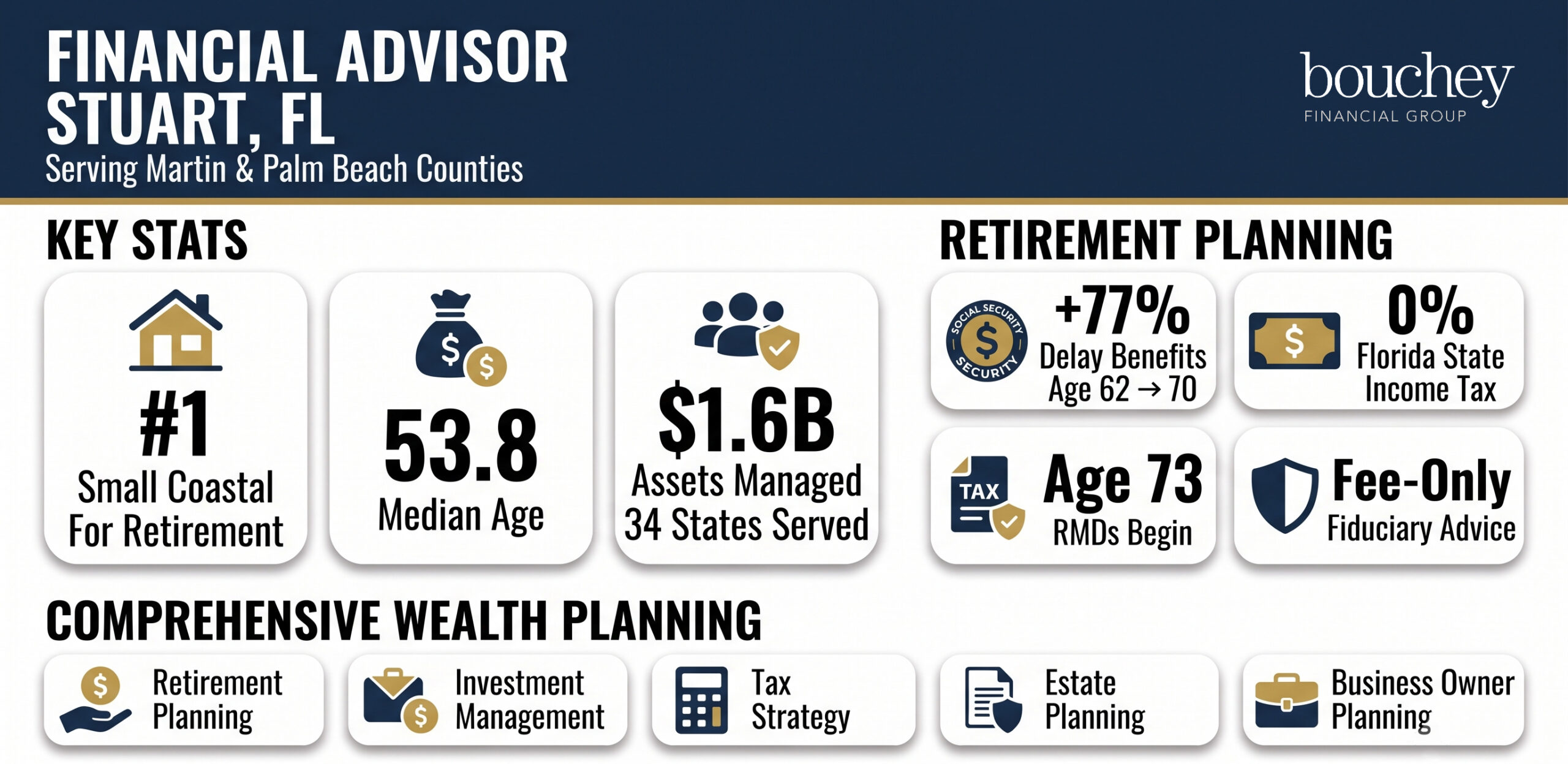
Stuart was ranked the number one small coastal town for retirement in the United States in 2024 by Bankrate — a recognition that reflects what's been visible on the ground for years. Martin County's median age is 53.8, and more than 28% of residents are 65 or older. This is not a community where people are building careers. It's a community where people are managing what they've built, and protecting it.
Am I Actually Ready to Retire?
It's one of the most common questions people ask as retirement approaches, and the answer is rarely as straightforward as a single account balance. Retirement readiness isn't just about how much you've saved. It's about understanding where your income will come from, how withdrawals will be taxed, and whether your assets can support the lifestyle you want for the next 20 or 30 years.
For example, a Palm City household with $1.5 million spread across a pension, a 401(k), and a brokerage account faces a very different planning situation than a household with the same amount held primarily in a traditional IRA. Social Security timing, required minimum distributions beginning at age 73, Medicare IRMAA thresholds, and withdrawal strategies can all influence long-term outcomes. Each decision may seem manageable on its own, but together they create a level of complexity that often benefits from a coordinated retirement plan.
Social Security Timing on the Treasure Coast
The Social Security Administration shows that delaying benefits from age 62 to 70 increases monthly payments by approximately 77%. For retirees in Stuart with sufficient assets to bridge the gap, that figure deserves more attention than it typically gets. The decision also affects survivor benefits — for married couples, the higher earner delaying to 70 can meaningfully increase the income available to a surviving spouse for the rest of their life.
Claiming early because it "feels like the right time" is one of the most common and least recoverable financial decisions retirees make. It's worth modeling the breakeven points before committing.
Is My Portfolio Taking More Risk Than It Should?
The portfolio that helped build wealth during your working years isn't always the same portfolio that's best suited for retirement. Many retirees discover they're still invested for growth long after their priorities have shifted toward generating income, preserving assets, and reducing unnecessary volatility. As retirement approaches, it's worth taking a fresh look at whether your investment strategy still aligns with your goals.
Risk is also more personal than many people realize. A market decline can feel very different when you're no longer earning a paycheck and relying on your portfolio to support your lifestyle. That's why it's important to look beyond risk tolerance alone and consider risk capacity — how much volatility your portfolio can realistically withstand based on your income needs, retirement timeline, and other financial resources. In retirement, managing risk is often just as important as pursuing returns.
Florida's Tax Environment Changes the Calculation
One of the biggest financial advantages of retiring in Florida is the absence of state income tax. Withdrawals from IRAs, pension income, Social Security benefits, and capital gains are not subject to state tax, which can create meaningful savings for retirees relocating from states such as New York or New Jersey. That said, federal taxes still apply, and decisions involving tax brackets, Social Security taxation, and Roth conversions remain an important part of the planning process.
For many retirees, the years between retirement and age 73, when required minimum distributions begin, present a valuable planning opportunity. During this period, taxable income is often lower, creating room for strategies such as Roth conversions that may reduce future tax liabilities. Taking advantage of this window can help lower future RMDs, increase tax-free retirement assets, and provide greater flexibility for both retirees and their heirs.
What Business Owners in Martin County Actually Need
About 16% of Martin County's working population runs their own business, according to Data USA. For this group, the planning conversation is different from the start. Personal wealth and business value are often intertwined, and separating them — let alone transferring one or the other — requires coordination that most investment-only advisors aren't set up to provide.
A business owner preparing for a sale needs to think about how the transaction is structured well before the deal closes. Capital gains treatment, installment sale arrangements, the timing of the transaction relative to other income, and what happens to the proceeds afterward all affect the after-tax outcome more than the sale price itself. A business owner who waits until the purchase agreement is drafted to think about these questions has already lost most of the planning leverage.
What Fiduciary Actually Means — and Why It's Worth Asking About
The word "fiduciary" appears on a lot of financial services websites. It doesn't mean the same thing at every firm. A registered investment advisor is legally required to act in the client's best interest at all times. A broker-dealer operates under a suitability standard, which is a lower bar — recommendations need to be appropriate, not optimal.
Some advisors are dually registered, meaning they can shift between the two standards depending on the transaction. Asking "are you a fiduciary at all times?" is a more useful question than asking "are you a fiduciary?" Anyone can say yes to the second question without it meaning much. The first one requires a more specific answer. Compensation disclosures in Form ADV Part 2A — available publicly through the SEC — show exactly how a firm is paid and whether any conflicts of interest exist.
Who the Firm Serves
Bouchey Financial Group works with individuals and families with $500,000 or more in investable assets. The firm currently manages approximately $1.6 billion for clients across 34 states. The 22-person team includes 9 CFP® professionals, 3 CPAs, and 1 IRS Enrolled Agent — a combination that means tax planning is part of the investment conversation rather than a separate referral.
The Stuart and Treasure Coast client base includes retirees managing income across multiple account types, pre-retirees building the transition plan, business owners working through a sale or succession, and families coordinating estate planning after a Florida relocation.
Starting the Conversation
The families who get the most out of planning are the ones who start it before a decision is already made — before the retirement date is set, before the business deal is on the table, before the RMDs begin. Bouchey Financial Group offers a free initial consultation for prospective clients in Stuart, Martin County, and Palm Beach County. Contact the team directly to schedule, or tune in to Let's Talk Money on WGY Saturdays at 10:00am and Sundays at 8:00am to hear how the firm approaches these conversations each week.
Frequently Asked Questions
How do I know if a financial advisor in Stuart is truly fee-only?
Check Item 5.E of the advisor's Form ADV Part 2A through the SEC's IAPD database. This section discloses all sources of compensation. Also search the advisor through FINRA BrokerCheck to confirm they are not dually registered as a broker, which would allow commission-based compensation on certain products.
What is the biggest financial mistake retirees in Stuart make?
Claiming Social Security too early ranks near the top. Delaying from age 62 to 70 increases monthly benefits by approximately 77%, and for married couples, the survivor benefit implications compound that decision further. Poor withdrawal sequencing — drawing from the wrong accounts in the wrong order — runs a close second, because the tax consequences aren't visible until they're already locked in.
Does a financial advisor in Stuart help with Medicare planning?
A good one should, at minimum, flag the interaction between income decisions and Medicare IRMAA surcharges. Medicare Part B and Part D premiums increase at certain income thresholds, and those thresholds are calculated using tax returns from two years prior. A large Roth conversion or capital gain in a single year can raise Medicare costs for the following two years — a consequence that retirement income planning needs to account for.
What should Martin County business owners look for in a financial advisor?
Business owners need advisors who can coordinate personal financial planning with the business — not just manage the personal portfolio in isolation. Specific capabilities to ask about include exit planning, transaction structuring, liquidity event tax management, and integration of business sale proceeds into a broader wealth and retirement plan. These require cross-discipline coordination between financial planners and tax professionals.
Is it better to work with a local advisor in Stuart or a national firm?
Local and national aren't inherently better or worse — the relevant factors are the advisory team's depth across financial planning, tax, and estate disciplines, their fiduciary status, and their compensation structure. What local advisors sometimes provide is familiarity with Florida-specific planning considerations: domicile establishment, homestead exemptions, and the planning needs common among Treasure Coast retirees who relocated from high-tax states.
How does the Roth conversion window work for Treasure Coast retirees?
The years between retirement and age 73 — when RMDs begin — often represent the best opportunity for Roth conversions. Income is typically lower during this gap, placing retirees in favorable federal brackets. In Florida, conversions are taxed only at the federal level, with no state income tax layer. Converting strategically during this window reduces future RMD obligations and creates tax-free assets for heirs.
How does working with a firm that has in-house CPAs differ from referral-based tax planning?
When CPAs work alongside financial planners within the same firm, investment decisions and tax consequences are evaluated simultaneously. A portfolio rebalancing decision, a Roth conversion, and an estate planning adjustment all have tax implications that benefit from real-time coordination rather than a phone call to a separate accountant after the fact. For retirees managing multiple income sources across different account types, that integration often produces better after-tax outcomes than sequential planning does.
IMPORTANT DISCLOSURE INFORMATION
Please remember that past performance is no guarantee of future results. Different types of investments involve varying degrees of risk, and there can be no assurance that the future performance of any specific investment, investment strategy, or product (including the investments and/or investment strategies recommended or undertaken by Bouchey Financial Group, Ltd. [“Bouchey Financial”]), or any non-investment related content, made reference to directly or indirectly in this blog will be profitable, equal any corresponding indicated historical performance level(s), be suitable for your portfolio or individual situation, or prove successful. Due to various factors, including changing market conditions and/or applicable laws, the content may no longer be reflective of current opinions or positions. Moreover, no portion of this discussion or information contained in this blog serves as the receipt of, or as a substitute for, personalized investment advice from Bouchey Financial. To the extent that a reader has any questions regarding the applicability of any specific issue discussed above to his/her individual situation, he/she is encouraged to consult with the professional advisor of his/her choosing. Neither Bouchey Financial’s investment adviser registration status, nor any amount of prior experience or success, should be construed that a certain level of results or satisfaction will be achieved if Bouchey Financial is engaged, or continues to be engaged, to provide investment advisory services. Bouchey Financial is neither a law firm nor a certified public accounting firm and no portion of the blog content should be construed as legal or accounting advice. A copy of the Bouchey Financial’s current written disclosure Brochure and Form CRS discussing our advisory services and fees is available for review upon request or at www.bouchey.com. Please Note: Bouchey Financial does not make any representations or warranties as to the accuracy, timeliness, suitability, completeness, or relevance of any information prepared by any unaffiliated third party, whether linked to Bouchey Financial’s web site or blog or incorporated herein, and takes no responsibility for any such content. All such information is provided solely for convenience purposes only and all users thereof should be guided accordingly. Please Remember: If you are a Bouchey Financial client, please contact Bouchey Financial, in writing, if there are any changes in your personal/financial situation or investment objectives for the purpose of reviewing/evaluating/revising our previous recommendations and/or services, or if you would like to impose, add, or to modify any reasonable restrictions to our investment advisory services. Unless, and until, you notify us, in writing, to the contrary, we shall continue to provide services as we do currently. Please Also Remember to advise us if you have not been receiving account statements (at least quarterly) from the account custodian.