
Financial Advisor in North Andover MA | Serving the Merrimack Valley
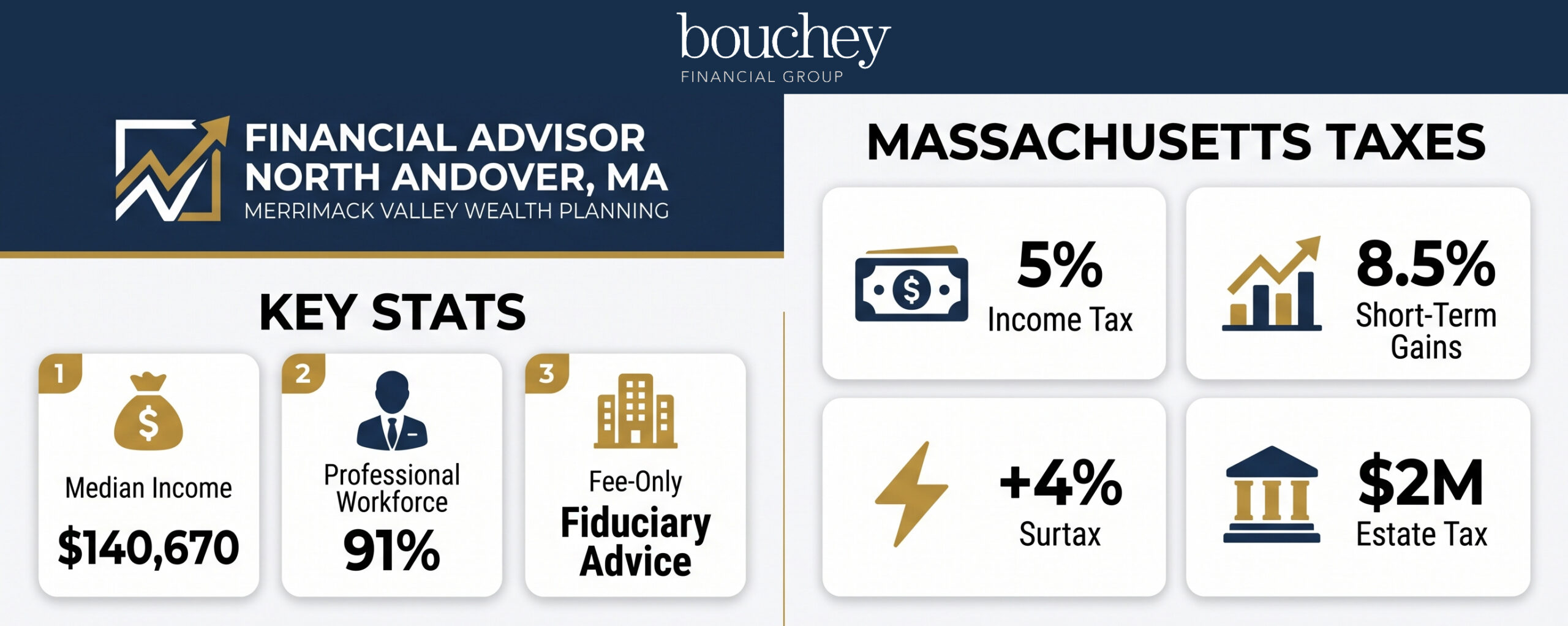
North Andover sits in an unusual position for a Massachusetts suburb. It has the income profile of a wealthy community — median household income of $140,670, more than 1.5 times the national figure, with an average household income of $180,254 — but it doesn't always get treated that way by the financial services industry. Most of the fee-only fiduciary firms that serve this income level concentrate in Boston or MetroWest.
Bouchey Financial Group serves North Andover and the broader Merrimack Valley through a fee-only fiduciary model, with offices in Medfield, Massachusetts, and New York. The firm's 22-person team includes 9 CERTIFIED FINANCIAL PLANNER™ professionals, 3 CPAs, and 1 IRS Enrolled Agent who work on the same client accounts, so investment decisions, tax consequences, and estate planning considerations are evaluated together.
Who Lives in North Andover and What They Actually Need
North Andover's working population skews heavily professional. According to recent Census data analyzed by Census Reporter, 91% of residents work in professional or administrative roles. About 9.3% run their own businesses. The largest income bracket for households headed by someone between 45 and 64 — the prime planning demographic — earns a family median of $172,973.
This is a community of engineers, healthcare executives, technology professionals, and business owners commuting to Boston or Lawrence. Many have accumulated meaningful assets through high salaries, equity compensation, and retirement plan contributions over long careers. Their planning challenges aren't investment-selection problems. They're coordination problems: taxes, estate exposure, equity compensation timing, and retirement income all intersecting in ways that don't resolve themselves.
The Massachusetts Tax Challenges Merrimack Valley Families Face
Massachusetts taxes most income at a flat 5%. That's the number most people know. There are three layers underneath it that matter more for high-income households.
| Tax Layer | Rate | Threshold |
| Base income tax | 5% | All taxable income |
| Short-term capital gains | 8.5% | Positions held under 1 year |
| High-earner surtax | +4% (9% combined) | Income above $1,107,750 in 2026 |
| State estate tax | 0.8%–16% | Estates exceeding $2 million |
The 4% Surtax
Massachusetts imposes an additional 4% surtax on taxable income exceeding $1,107,750 in 2026, per mass.gov. Income above that threshold faces a combined 9% state marginal rate. A North Andover executive with a $250,000 salary who also vests $900,000 in RSUs crosses the threshold on the combined amount. Timing equity events across tax years can reduce or eliminate the surtax exposure — but only if the planning happens before the vest, not after.
Short-Term Capital Gains
Massachusetts taxes short-term gains at 8.5% versus 5% for long-term gains. That 3.5-point spread compounds meaningfully for portfolios generating consistent turnover. Holding period discipline, asset location, and tax-loss harvesting each reduce the effective rate — but they require active management, not passive observation.
The Massachusetts Estate Tax Cliff
Massachusetts imposes an estate tax on estates exceeding $2 million, with rates from 0.8% to 16%. A $99,600 credit effectively shelters the first $2 million, and only the amount above that threshold is taxed — the old 'cliff' was eliminated in 2023. There is no portability between spouses.
For an Andover household with a $900,000 home, a $700,000 IRA, and $600,000 in a taxable brokerage account, the estate already sits above $2 million. The federal estate tax exemption is $15 million per individual in 2026, per IRS estate and gift tax guidance, so federal exposure is rarely the concern. Massachusetts is.
Equity Compensation Planning in the Merrimack Valley
The Merrimack Valley has a meaningful concentration of pharmaceutical, defense, and technology employers. Raytheon Technologies, Pfizer, and Hasbro all maintain facilities in the region. Many North Andover and Andover residents receive RSUs, stock options, or ESPPs as part of their compensation.
Each of these carries different tax treatment:
- RSUs vest as ordinary income in the year they become available, regardless of whether shares are sold
- Incentive stock options (ISOs) can trigger the AMT upon exercise
- ESPPs generate ordinary income on the discount at purchase, then capital gain treatment on subsequent appreciation, with holding period requirements affecting the tax character of each
Concentrated employer stock is the planning problem that follows. Holding a large position in a single company creates risk that no amount of portfolio diversification elsewhere eliminates. Systematic diversification — coordinated with the surtax threshold, tax-loss harvesting opportunities in the broader portfolio, and charitable giving with appreciated shares — reduces both the tax cost and the concentration risk simultaneously.
Planning for Business Owners in North Andover
About 9.3% of North Andover's working population is self-employed. For this group, a business sale creates concentrated liquidity, a large taxable event, and a need to rebuild a financial plan around a fundamentally different asset base.
Transaction structure, installment payment arrangements, contribution of appreciated interests to a donor-advised fund, and estate plan coordination all affect the after-tax outcome more than the sale price in many cases. Bouchey Financial Group's in-house CPAs work alongside CFP® professionals on these accounts, so tax consequences are modeled before the deal is negotiated rather than discovered after it closes.
What Fee-Only Fiduciary Means — and Why It's Worth Verifying
Fee-only means the firm is paid exclusively by the client. No commissions. No revenue from product recommendations. A fee-based advisor — a different category despite the similar name — may charge client fees and also collect commissions depending on the service.
Fiduciary is a legal standard, not a marketing claim. Registered investment advisors are legally required to act in the client's best interest and disclose conflicts of interest. A broker-dealer operates under a suitability standard, which requires only that recommendations be appropriate.
Prospective clients can verify any advisor's registration, compensation structure, and disciplinary history through FINRA's BrokerCheck and the SEC's Investment Adviser Public Disclosure database. Both are free. Form ADV Part 2A shows exactly how the firm is compensated and what conflicts of interest exist.
Common Financial Mistakes Merrimack Valley Families Make Before Retirement
A few that come up consistently in planning conversations with North Andover and Andover households:
Holding Too Much Employer Stock
It's easy to accumulate a concentrated position over years of RSU vests without actively managing the size. By the time the concentration becomes visible, significant unrealized gains have often built up, making the tax cost of diversification feel prohibitive. Starting the diversification process earlier — before the position becomes a dominant holding — reduces both the risk and the eventual tax burden.
Outdated Estate Documents
Beneficiary designations override wills. An outdated beneficiary form on a 401(k) or IRA distributes those assets to whoever is named, regardless of what the estate plan says. This is worth reviewing after any major life event — marriage, divorce, birth of a child, death of a prior beneficiary — and after any significant change in Massachusetts law.
Ignoring the Roth Conversion Window
The years between leaving full-time employment and age 73, when IRS retirement plan rules require minimum distributions to begin, often represent the most favorable window for Roth conversions. Income is lower. Massachusetts taxes the conversion at 5%, with no state capital gains premium. Converting during this window reduces future RMD obligations and creates tax-free assets for heirs.
Who the Firm Serves
Bouchey Financial Group works with individuals and families with $500,000 or more in investable assets. The firm manages approximately $1.6 billion for clients across 34 states. The team of 22 professionals serves clients throughout North Andover, Andover, Boxford, Newburyport, Haverhill, and the broader Merrimack Valley.
Plan Before the Moment Arrives
The surtax threshold, the estate tax cliff, and equity compensation timing windows all create planning leverage that shrinks as events unfold. The business sale that could have been structured differently. The RSU vest that pushed income over the surtax threshold because nobody modeled it in advance. The estate plan that was never updated after a Massachusetts law change.
Bouchey Financial Group offers a free initial consultation for prospective clients throughout the Merrimack Valley. Contact the team directly to schedule, or explore the firm's planning perspectives through the Webinars & Videos library before reaching out.
Frequently Asked Questions
How do I choose a fiduciary financial advisor in North Andover?
Verify the advisor's compensation structure through Form ADV Part 2A at adviserinfo.sec.gov and their disciplinary history through FINRA BrokerCheck. Ask whether they are fee-only at all times, whether tax planning is handled in-house, and who specifically will work on your account. An advisor who hesitates on any of these is giving you useful information.
What taxes affect Massachusetts residents with significant investment accounts?
Massachusetts taxes most income at 5%, short-term capital gains at 8.5%, and imposes a 4% surtax on income above $1,107,750 in 2026.
When does a trust make sense for a North Andover family?
A credit shelter trust is the most commonly used tool to address Massachusetts estate tax exposure for married couples, since there is no spousal portability at the state level. For households with combined assets exceeding $2 million, that conversation is worth having before assets appreciate further.
How often should a financial plan be updated?
At minimum, annually and after any major financial event: a business sale, large equity vest, marriage, divorce, or change in tax law. Massachusetts's estate tax and surtax thresholds both require periodic reassessment as income and asset values shift. An advisor who reviews only the portfolio is missing most of what changes year to year.
Is a CFP® designation enough, or should my advisor coordinate with my CPA?
For households with equity compensation, business ownership, or estate complexity, having CPAs on the same team produces better outcomes than coordinating with an outside accountant. When tax professionals and financial planners work on the same account, decisions are evaluated for tax consequences before they're executed, not after.
What happens to a traditional IRA when it passes to heirs?
Non-spouse beneficiaries must withdraw inherited IRA funds within 10 years of the original owner's death. For heirs in their peak earning years, this creates compressed taxable income. Roth conversions during the account owner's lifetime reduce that burden, since inherited Roth accounts follow the same 10-year rule but withdrawals are generally tax-free.
What should Merrimack Valley business owners know about planning for a sale?
Transaction structure, installment payment arrangements, contribution of appreciated interests to a donor-advised fund before closing, and coordination with an existing estate plan all affect the after-tax outcome substantially. The earlier the planning starts relative to the transaction, the more of those options remain available.
IMPORTANT DISCLOSURE INFORMATION
Please remember that past performance is no guarantee of future results. Different types of investments involve varying degrees of risk, and there can be no assurance that the future performance of any specific investment, investment strategy, or product (including the investments and/or investment strategies recommended or undertaken by Bouchey Financial Group, Ltd. [“Bouchey Financial”]), or any non-investment related content, made reference to directly or indirectly in this blog will be profitable, equal any corresponding indicated historical performance level(s), be suitable for your portfolio or individual situation, or prove successful. Due to various factors, including changing market conditions and/or applicable laws, the content may no longer be reflective of current opinions or positions. Moreover, no portion of this discussion or information contained in this blog serves as the receipt of, or as a substitute for, personalized investment advice from Bouchey Financial. To the extent that a reader has any questions regarding the applicability of any specific issue discussed above to his/her individual situation, he/she is encouraged to consult with the professional advisor of his/her choosing. Neither Bouchey Financial’s investment adviser registration status, nor any amount of prior experience or success, should be construed that a certain level of results or satisfaction will be achieved if Bouchey Financial is engaged, or continues to be engaged, to provide investment advisory services. Bouchey Financial is neither a law firm nor a certified public accounting firm and no portion of the blog content should be construed as legal or accounting advice. A copy of the Bouchey Financial’s current written disclosure Brochure and Form CRS discussing our advisory services and fees is available for review upon request or at www.bouchey.com. Please Note: Bouchey Financial does not make any representations or warranties as to the accuracy, timeliness, suitability, completeness, or relevance of any information prepared by any unaffiliated third party, whether linked to Bouchey Financial’s web site or blog or incorporated herein, and takes no responsibility for any such content. All such information is provided solely for convenience purposes only and all users thereof should be guided accordingly. Please Remember: If you are a Bouchey Financial client, please contact Bouchey Financial, in writing, if there are any changes in your personal/financial situation or investment objectives for the purpose of reviewing/evaluating/revising our previous recommendations and/or services, or if you would like to impose, add, or to modify any reasonable restrictions to our investment advisory services. Unless, and until, you notify us, in writing, to the contrary, we shall continue to provide services as we do currently. Please Also Remember to advise us if you have not been receiving account statements (at least quarterly) from the account custodian.