
Donor-Advised Fund vs Private Foundation | Cost, Control, and Tax Trade-Offs
The choice between a donor-advised fund and a private foundation is rarely as simple as picking the cheaper option. Both are legitimate charitable giving vehicles. They serve different donors with different philanthropic goals, and the right answer depends on how much control you want, how much administrative complexity you're willing to manage, and what you're trying to accomplish over the long term.
Bouchey Financial Group works with clients who are making exactly this decision — often in the context of a business sale, a large equity event, or a multigenerational wealth transfer. The firm's CERTIFIED FINANCIAL PLANNER™ professionals and CPAs integrate charitable giving strategy into broader financial and estate planning rather than treating it as a separate conversation.
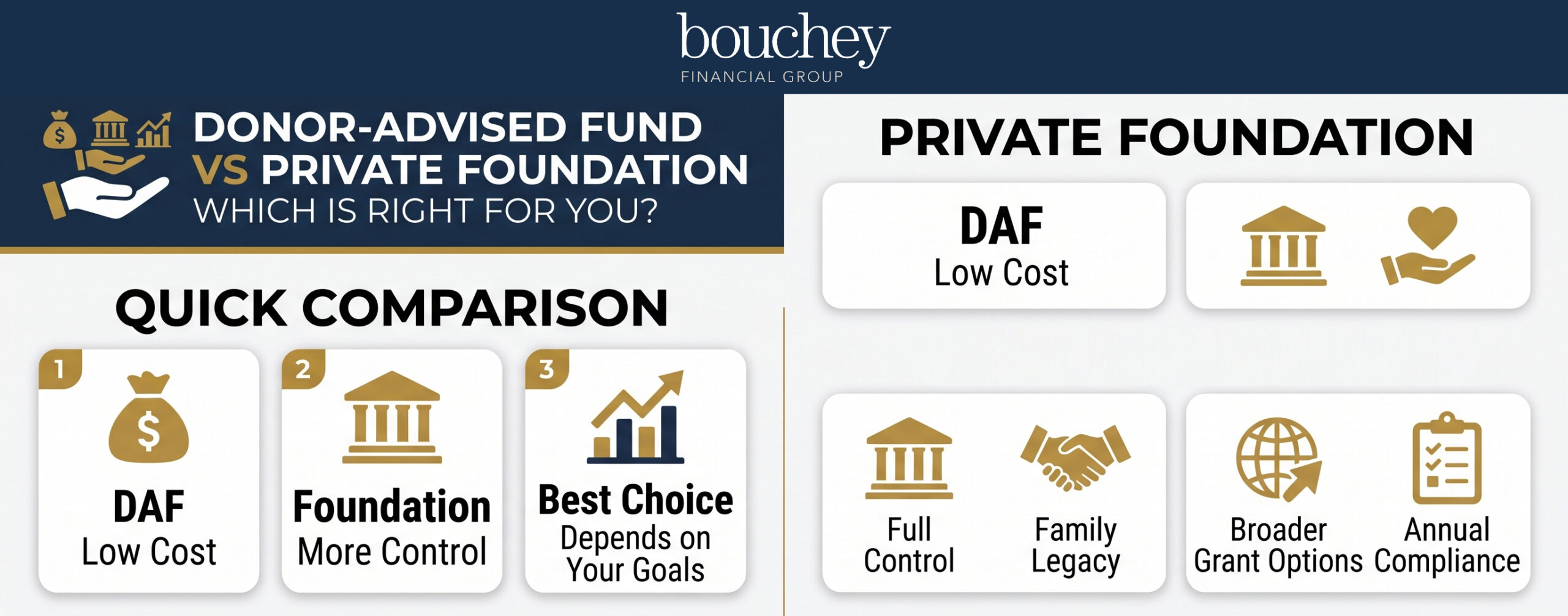
Side-by-Side Comparison
| Feature | Donor-Advised Fund | Private Foundation |
| Minimum to establish | As low as $5,000 | $1M+ practical minimum; $2M+ recommended |
| Setup cost | Minimal (open online) | $5,000–$20,000+ in legal and filing fees |
| Annual admin cost | Near zero (sponsor handles compliance) | $10,000–$50,000+ in legal, accounting, filing |
| Cash deduction limit | 60% of AGI | 30% of AGI |
| Appreciated securities deduction limit | 30% of AGI | 20% of AGI |
| Annual distribution requirement | None federally (sponsor policies vary) | 5% of assets annually under IRC §4942 |
| Excise tax on investment income | None | 1.39% on net investment income |
| Annual IRS filing | None required of donor | Form 990-PF (public record) |
| Privacy | Grants can be anonymous | Grants and financials are public record |
| Investment control | Advisory only | Full discretion |
| Grantmaking to individuals | Not permitted | Permitted with IRS approval |
| International grantmaking | Limited (sponsor must approve) | Permitted with expenditure responsibility |
| Employ staff | Not applicable | Permitted |
| Successor control | Successor advisor designation | Board succession |
Sources: IRS Publication 526, IRS Donor-Advised Funds, IRC §4942
The Tax Deduction Difference
The DAF's higher deduction limits are the most immediate financial advantage. Cash contributions to a DAF are deductible up to 60% of adjusted gross income. A private foundation caps cash gifts at 30%. Appreciated securities are deductible at 30% for a DAF versus 20% for a private foundation.
For a donor making a $2 million contribution in a high-income year, that gap is meaningful. Both vehicles allow a five-year carryforward for deductions that exceed the annual AGI limit, per IRS Publication 526.
The 2026 OBBBA changes also apply to both vehicles equally: itemizers face a new 0.5% AGI floor on charitable deductions, and top-bracket donors are capped at 35 cents per dollar of benefit rather than 37 cents. Neither vehicle escapes these new limits, but the DAF's higher base ceilings remain a structural advantage.
The 5% Distribution Requirement
Private foundations must distribute at least 5% of their average net investment assets annually under IRC §4942. Qualifying distributions include grants, reasonable administrative expenses, and directly operated charitable programs. A $5 million foundation must distribute roughly $250,000 per year; failure to meet the requirement triggers excise taxes.
DAFs have no federally mandated distribution requirement. Individual sponsoring organizations may require at least one grant per year, but there is no statutory minimum tied to asset size. For donors who want to build a philanthropic endowment without committing to a specific annual payout, this is a significant structural difference.
Cost and Administrative Burden
Opening a DAF costs nothing beyond the initial contribution. The sponsoring organization handles compliance, tax reporting, and investment administration — no IRS filings, no board meetings, no legal overhead for the donor.
A private foundation is a separate legal entity. Setup typically requires $5,000 to $20,000 or more in legal and filing fees. Annual costs including accounting, legal counsel, Form 990-PF preparation, and investment management commonly run $10,000 to $50,000 or more. Most advisors suggest a practical minimum of $1 million in assets to justify those ongoing costs, with $2 million or more providing greater sustainability.
Control and Flexibility
A private foundation gives donors full legal control. The foundation is its own legal entity with a board that can include family members, the ability to employ staff, make grants to individuals with IRS approval, and operate direct charitable programs. A DAF account holder retains only advisory privileges — the sponsoring organization holds legal title and must approve all grants.
For families who want a formal philanthropic institution with direct program capability, a private foundation provides what a DAF structurally cannot. For donors whose grantmaking focuses on established public charities, the DAF's simplicity rarely costs anything meaningful in practice.
Public Disclosure vs. Privacy
Private foundations file Form 990-PF annually with the IRS, and that filing is a public document. Grant recipients, asset values, investment returns, compensation paid to family members serving as officers, and board member names are all publicly accessible through databases like Candid.
DAF grants can be made anonymously through most major sponsors. Donors who wish to support controversial causes or prefer that their philanthropy not be publicly tracked have a structural privacy advantage with a DAF.
When Each Vehicle Makes Sense
Use a DAF When:
- Charitable assets are under $1 million
- Simplicity and low administrative cost are priorities
- Grantmaking will focus on established public charities
- Privacy is important
- You want to front-load a multi-year giving strategy without ongoing compliance obligations
- You need to act quickly before year-end or a liquidity event
Consider a Private Foundation When:
- Charitable assets are $2 million or more and growing
- Family wants direct governance and investment control
- You intend to operate direct charitable programs
- International grantmaking with expenditure responsibility is part of the strategy
- Employing staff for philanthropic work is part of the model
- Multi-generational family governance and public identity matter
- Grantmaking to individuals (scholarships, fellowships) is a goal
Why Many Families Use Both
The choice is often not binary. Many high-net-worth families use a donor-advised fund alongside a private foundation, deploying each where it performs best.
A family foundation handles direct programs, employs a program director, and makes large institutional grants under the family's name. The DAF serves as a parallel vehicle for anonymous giving, rapid-response grants that can be processed quickly without board approval, and contributions of complex assets that the foundation's governance structure makes slower to accept.
Using both in combination also allows families to exceed AGI deduction limits across both vehicles in a high-income year, applying different deduction ceilings to optimize the total charitable deduction.
Scenarios Where the Decision Is Clear
After a business sale: A donor-advised fund is typically the faster and more flexible tool for capturing a deduction in the year of the sale. Appreciated business interests can be contributed to a DAF before the transaction closes, eliminating capital gains on the donated portion and producing a deduction against the same year's taxable income. Establishing a private foundation takes weeks or months and would miss the tax window.
Family wanting multigenerational governance: A private foundation with a formal board structure, written grant guidelines, and named family members in governance roles creates a lasting institutional identity that a DAF cannot replicate. Children and grandchildren serving on the board builds philanthropic education across generations.
Mid-size donor wanting simplicity: For a household contributing $50,000 to $500,000 to charity annually, a DAF provides full deduction benefits, tax-free investment growth, and grantmaking flexibility without any of the compliance overhead a private foundation requires.
Coordinating the Decision With Your Financial Plan
Neither vehicle should be chosen in isolation. The contribution timing, asset type, and deduction impact all interact with income, portfolio strategy, and estate planning in ways that require coordinated advice.
The Bouchey Financial Group team brings together CFP® professionals, CPAs, and an IRS Enrolled Agent who evaluate charitable giving decisions alongside tax planning and investment management. Contact the team to discuss which structure fits your philanthropic goals, or explore recent planning perspectives through the firm's Webinars & Videos library.
Frequently Asked Questions
Which offers a larger charitable tax deduction?
A DAF offers higher AGI deduction limits across all asset types. Cash contributions are deductible up to 60% of AGI for a DAF versus 30% for a private foundation. Appreciated securities are deductible at 30% for a DAF versus 20% for a private foundation. Both allow a five-year carryforward for amounts exceeding the annual limit.
Can I convert a private foundation into a donor-advised fund?
Yes. Transferring a private foundation's assets to a sponsoring organization's DAF program is a commonly used exit strategy for families who no longer want the administrative burden of a foundation. The foundation must terminate formally with the IRS, but the assets can move to a DAF without triggering excise taxes if handled correctly.
Who legally owns the assets after I contribute to each vehicle?
In a DAF, the sponsoring public charity holds legal title immediately upon contribution. In a private foundation, the foundation itself is the legal owner as a separate nonprofit entity, with the board of directors exercising control. In both cases, the original donor no longer personally owns the assets.
Can either vehicle make international grants?
A private foundation can make international grants using expenditure responsibility procedures, which require tracking how the funds are used and filing reports with the IRS. A DAF can grant internationally, but the sponsoring organization must approve each grant and typically requires that the recipient organization be equivalent to a U.S. public charity. The private foundation has more flexibility for systematic international grantmaking.
What are the annual compliance requirements for a private foundation?
Private foundations must file Form 990-PF annually with the IRS, which becomes a public document. They must distribute at least 5% of assets annually, pay a 1.39% excise tax on net investment income, comply with self-dealing rules under IRC §§4940–4945, and hold annual board meetings. DAF account holders have no direct IRS filing obligations.
At what asset level does a private foundation become practical?
Most advisors recommend a minimum of $1 million in charitable assets, with $2 million or more providing greater long-term sustainability. At lower levels, annual administrative costs consume a disproportionate share of the 5% required distribution. Donors below those thresholds typically find a DAF provides equivalent tax benefits with none of the overhead.
Can a donor-advised fund replace a family foundation?
For most donors, yes. A DAF replicates the core tax and grantmaking functions of a private foundation with significantly lower cost and complexity. It cannot replicate direct charitable programs, formal family governance with a named board, employment of staff, or systematic international grantmaking. Families who need those capabilities will find a foundation irreplaceable — or should consider using both.
IMPORTANT DISCLOSURE INFORMATION
Please remember that past performance is no guarantee of future results. Different types of investments involve varying degrees of risk, and there can be no assurance that the future performance of any specific investment, investment strategy, or product (including the investments and/or investment strategies recommended or undertaken by Bouchey Financial Group, Ltd. [“Bouchey Financial”]), or any non-investment related content, made reference to directly or indirectly in this blog will be profitable, equal any corresponding indicated historical performance level(s), be suitable for your portfolio or individual situation, or prove successful. Due to various factors, including changing market conditions and/or applicable laws, the content may no longer be reflective of current opinions or positions. Moreover, no portion of this discussion or information contained in this blog serves as the receipt of, or as a substitute for, personalized investment advice from Bouchey Financial. To the extent that a reader has any questions regarding the applicability of any specific issue discussed above to his/her individual situation, he/she is encouraged to consult with the professional advisor of his/her choosing. Neither Bouchey Financial’s investment adviser registration status, nor any amount of prior experience or success, should be construed that a certain level of results or satisfaction will be achieved if Bouchey Financial is engaged, or continues to be engaged, to provide investment advisory services. Bouchey Financial is neither a law firm nor a certified public accounting firm and no portion of the blog content should be construed as legal or accounting advice. A copy of the Bouchey Financial’s current written disclosure Brochure and Form CRS discussing our advisory services and fees is available for review upon request or at www.bouchey.com. Please Note: Bouchey Financial does not make any representations or warranties as to the accuracy, timeliness, suitability, completeness, or relevance of any information prepared by any unaffiliated third party, whether linked to Bouchey Financial’s web site or blog or incorporated herein, and takes no responsibility for any such content. All such information is provided solely for convenience purposes only and all users thereof should be guided accordingly. Please Remember: If you are a Bouchey Financial client, please contact Bouchey Financial, in writing, if there are any changes in your personal/financial situation or investment objectives for the purpose of reviewing/evaluating/revising our previous recommendations and/or services, or if you would like to impose, add, or to modify any reasonable restrictions to our investment advisory services. Unless, and until, you notify us, in writing, to the contrary, we shall continue to provide services as we do currently. Please Also Remember to advise us if you have not been receiving account statements (at least quarterly) from the account custodian.