
Donor-Advised Fund Rules Explained | Contribution Limits, Deductions, and Distributions
A donor-advised fund lets you contribute assets to a sponsoring organization, claim a tax deduction immediately, and recommend grants to qualified charities over time — on your schedule, not the IRS's. The tax advantages are meaningful. The rules governing them changed significantly in 2026, and most articles haven't caught up.
Bouchey Financial Group integrates donor-advised fund planning into broader wealth management for clients with philanthropic goals. The firm's CERTIFIED FINANCIAL PLANNER™ professionals and CPAs work together on charitable giving decisions alongside investment management, tax planning, and estate coordination.
What a DAF Is — and What It Isn't
A donor-advised fund is a charitable giving account sponsored by a public charity such as Fidelity Charitable, Schwab Charitable, or a community foundation. When you contribute assets, the sponsoring organization takes legal ownership. You retain advisory privileges to recommend investments and grant recipients — but the contribution is irrevocable. Once transferred, the assets belong to the sponsor and cannot be returned.
The IRS prohibits distributions that confer more than an incidental benefit on the donor or related parties under IRC Section 4967. A few restrictions come up frequently:
- No QCD transfers: IRA qualified charitable distributions cannot go to a DAF under current law. Bipartisan legislation to change this had not passed as of mid-2026.
- No pledge satisfaction: Grants that fulfill a legally binding pledge may constitute a prohibited benefit under IRS rules.
- No event tickets or auction items: Grants paying for gala tables or auction items with personal value may become taxable distributions.
- No grants to individuals: Grants must go to qualified 501(c)(3) organizations. Verify eligibility through the IRS Tax Exempt Organization Search.
Contribution Limits and Deduction Rules for 2026
The One Big Beautiful Bill Act, signed July 4, 2025, changed how charitable deductions work for itemizers starting in 2026. The existing AGI percentage ceilings survived — but two new layers now apply on top of them.
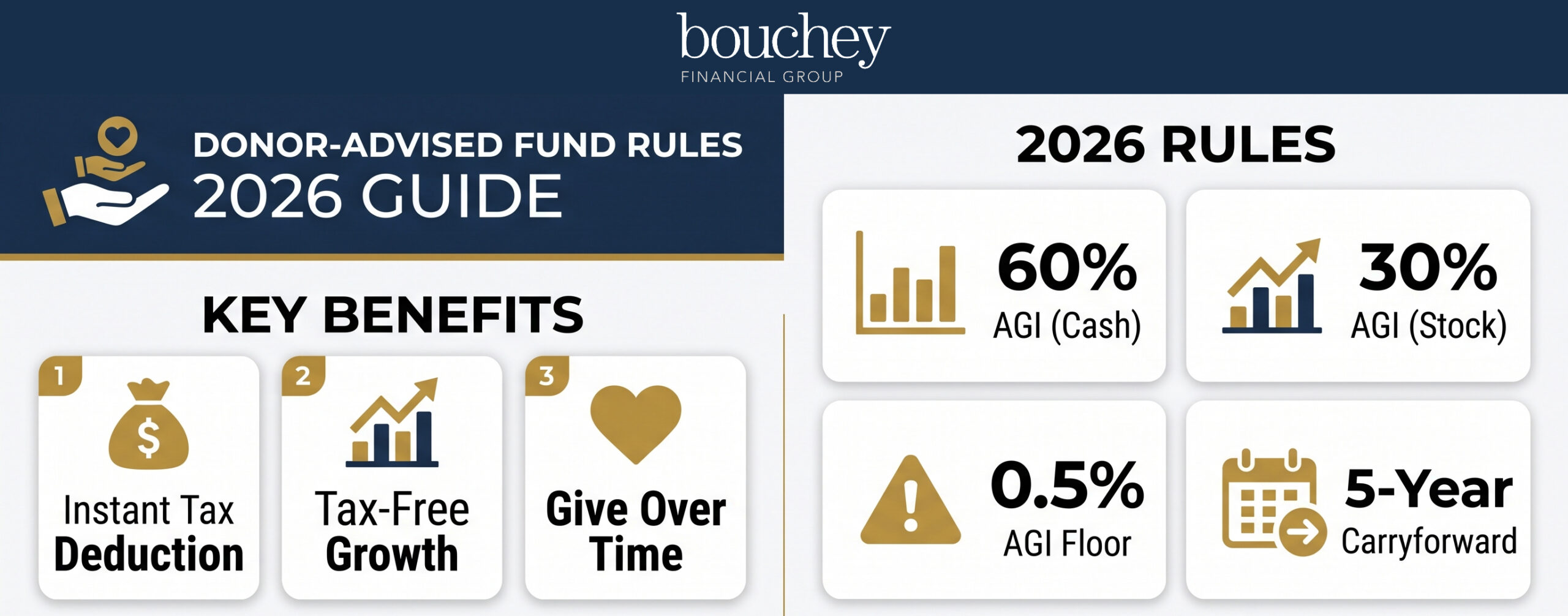
The AGI Deduction Limits
| Asset Type | Deduction Limit | Notes |
| Cash to a DAF | 60% of AGI | Unchanged from prior law |
| Publicly traded appreciated securities (held 1+ year) | 30% of AGI | Deduct full fair market value; no capital gains |
| Closely held stock or business interests | 30% of AGI | Fair market value; requires qualified appraisal |
| Real estate | 30% of AGI | Fair market value; requires qualified appraisal |
| Cash to a private foundation | 30% of AGI | Lower limit than DAF |
| Appreciated property to a private foundation | 20% of AGI | Significantly lower than DAF |
Source: IRS Publication 526
Deductions that exceed the applicable AGI limit in a given year carry forward for up to five tax years, subject to the same percentage limits in each subsequent year.
The 2026 OBBBA Changes
Two new restrictions apply to itemizers starting January 1, 2026:
The 0.5% AGI floor. Only charitable contributions exceeding 0.5% of AGI are deductible. A donor with $500,000 in AGI must give more than $2,500 before seeing any deduction. The floor applies before the 60%/30% ceilings.
The 35% cap for top-bracket taxpayers. Donors in the 37% federal income tax bracket can now deduct only 35 cents per dollar of charitable contributions, rather than 37 cents on a $100,000 contribution; that reduces the tax savings from $37,000 to $35,000.
These changes make the case for accelerating large contributions and using DAFs to front-load multi-year giving stronger than it was under prior law.
Why Appreciated Securities Beat Cash
Most affluent donors default to cash contributions. Contributing appreciated securities instead — stocks, mutual funds, or ETFs held more than one year — is almost always more tax-efficient.
When you donate appreciated stock directly to a DAF, you avoid capital gains tax on the appreciation and deduct the full fair market value. Selling the stock first, then donating the proceeds, eliminates the deduction value of the embedded gain.
Example: Stock worth $100,000 with a $20,000 cost basis. Selling generates an $80,000 long-term capital gain — up to $19,200 in federal tax. Donating the stock directly avoids that tax entirely and still produces a $100,000 deduction. A record 74% of contributions to DAFgiving360 in 2025 were non-cash assets.
Assets That Can Be Contributed
Most DAF sponsors accept a range of assets beyond publicly traded securities:
- Publicly traded stocks, mutual funds, and ETFs
- Restricted stock (subject to sponsor acceptance and holding periods)
- Closely held business interests (S-corp shares, LLC interests, partnership interests)
- Real estate (typically requires a qualified appraisal and sponsor approval)
- Cryptocurrency (accepted by major sponsors including Fidelity Charitable and Schwab Charitable)
- Life insurance policies and annuities (varies by sponsor)
Closely held interests and real estate require more lead time and a qualified appraisal. Initiating these transfers well before year-end is essential — most sponsors require several weeks to process complex assets.
The Bunching Strategy and the 2026 Floor
The 0.5% AGI floor makes bunching more valuable than before. A donor giving $10,000 annually with $400,000 AGI can only deduct $8,000 per gift after the floor. Bunching five years into a single $50,000 DAF contribution applies the floor once, leaving $47,000 deductible. The donor then grants $10,000 annually from the DAF while taking the standard deduction in intervening years.
The 2026 standard deduction is $32,200 for married couples filing jointly. Bunching helps many donors clear the itemization threshold they cannot reach with annual giving alone.
Coordinating a DAF With Other Planning Events
A DAF contribution can offset the tax cost of large income events in the same year.
Business sale: Contributing appreciated business interests to a DAF before the sale closes eliminates capital gains on the donated portion and produces a deduction against the same year's taxable income.
Roth conversion: A large Roth conversion increases taxable income. A DAF contribution in the same year generates an offsetting deduction, reducing the net tax cost of the conversion.
Equity compensation: An executive vesting a large RSU grant can contribute appreciated shares to a DAF, reducing income pushed past the Massachusetts surtax threshold or the federal top bracket.
DAFs in Estate Planning
Assets held in a DAF are not included in the taxable estate — they already belong to the sponsoring organization. Most sponsors allow the account holder to designate a successor advisor who can continue recommending grants after death. Some families use DAFs as multigenerational philanthropic vehicles, with children involved in grant decisions over time.
Bouchey Financial Group's advisory team helps clients integrate DAF planning with estate documents, beneficiary designations, and investment management so the charitable strategy works alongside the broader plan.
DAF vs. Private Foundation
A donor-advised fund is not the only vehicle for structured charitable giving, but it is the simpler and often more tax-efficient one for most donors.
| Feature | Donor-Advised Fund | Private Foundation |
| Cash deduction limit | 60% of AGI | 30% of AGI |
| Appreciated property deduction limit | 30% of AGI | 20% of AGI |
| Annual distribution requirement | None (varies by sponsor) | ~5% of assets annually |
| Administrative burden | Minimal (sponsor handles compliance) | Significant (IRS filings, legal fees) |
| Grantmaking to individuals | Not permitted | Permitted with IRS approval |
| Investment control | Advisory only | Full control |
| Excise taxes | None | 1.39% on net investment income |
| Privacy | Grants can be anonymous | Public record |
A private foundation makes more sense when the donor wants direct control over investments, intends to make grants to individuals, or operates a family philanthropic institution with a public identity. For most affluent donors with straightforward charitable goals, the DAF's higher deduction limits and lower administrative overhead are decisive advantages.
Starting a DAF and Timing Contributions
Contributions must be received or postmarked by December 31 to qualify for a deduction in the current tax year. Securities transfers typically require several business days — initiating by mid-December is essential for year-end planning. Complex assets like closely held stock or real estate require significantly more lead time.
Opening a DAF account is straightforward through major sponsors. For clients with Schwab or Fidelity brokerage accounts, the affiliated charitable accounts often allow direct in-kind transfers of securities without liquidation.
For families integrating charitable giving into a broader financial plan, the Bouchey Financial Group team coordinates these decisions alongside tax planning, estate review, and portfolio management. Contact the team to discuss how a DAF fits into your financial picture, or explore recent planning topics through the firm's Webinars & Videos library.
Frequently Asked Questions
Are DAF contributions irrevocable?
Yes. Once assets are transferred to a donor-advised fund, the sponsoring organization holds legal ownership. You retain advisory privileges to recommend investments and grant recipients, but the contribution cannot be reversed or returned.
Do donor-advised funds have annual distribution requirements?
Federal law imposes no minimum annual distribution requirement on DAFs. Individual sponsoring organizations may set their own policies — some require at least one grant per year or every few years to keep the account active.
Can I contribute cryptocurrency to a donor-advised fund?
Yes, major sponsors including Fidelity Charitable and Schwab Charitable accept cryptocurrency contributions. The deduction equals the fair market value at the time of contribution for assets held more than one year, and the donor avoids capital gains tax on the appreciation — the same tax advantage as appreciated securities.
Can my children become successor advisors after I die?
Yes. Most sponsoring organizations allow you to designate one or more successor advisors who can continue recommending grants after your death. This is a common structure for families who want to involve the next generation in philanthropic decisions.
What changed about DAF deductions in 2026?
The One Big Beautiful Bill Act introduced two new restrictions for itemizers starting in 2026: a 0.5% AGI floor, meaning only contributions exceeding 0.5% of AGI are deductible, and a 35% cap on the value of deductions for donors in the 37% federal bracket. The 60% AGI limit for cash and 30% for appreciated securities remain in place, and the five-year carryforward rule is unchanged.
Can a DAF grant satisfy a legally binding pledge to a charity?
Generally no. If a grant to a charity satisfies a pledge where you have a legal obligation, the IRS may treat that as a prohibited benefit to the donor under IRC Section 4967, potentially making it a taxable distribution. Donors should consult a tax advisor before using DAF grants to fulfill pledges.
How does a DAF interact with a qualified charitable distribution from an IRA?
QCDs cannot be directed to a donor-advised fund under current law. QCDs must go directly to an operating public charity. Bipartisan legislation to allow QCDs to fund DAFs was introduced in 2026 but had not been enacted as of mid-2026. Donors who want to use both strategies must execute them separately.
IMPORTANT DISCLOSURE INFORMATION
Please remember that past performance is no guarantee of future results. Different types of investments involve varying degrees of risk, and there can be no assurance that the future performance of any specific investment, investment strategy, or product (including the investments and/or investment strategies recommended or undertaken by Bouchey Financial Group, Ltd. [“Bouchey Financial”]), or any non-investment related content, made reference to directly or indirectly in this blog will be profitable, equal any corresponding indicated historical performance level(s), be suitable for your portfolio or individual situation, or prove successful. Due to various factors, including changing market conditions and/or applicable laws, the content may no longer be reflective of current opinions or positions. Moreover, no portion of this discussion or information contained in this blog serves as the receipt of, or as a substitute for, personalized investment advice from Bouchey Financial. To the extent that a reader has any questions regarding the applicability of any specific issue discussed above to his/her individual situation, he/she is encouraged to consult with the professional advisor of his/her choosing. Neither Bouchey Financial’s investment adviser registration status, nor any amount of prior experience or success, should be construed that a certain level of results or satisfaction will be achieved if Bouchey Financial is engaged, or continues to be engaged, to provide investment advisory services. Bouchey Financial is neither a law firm nor a certified public accounting firm and no portion of the blog content should be construed as legal or accounting advice. A copy of the Bouchey Financial’s current written disclosure Brochure and Form CRS discussing our advisory services and fees is available for review upon request or at www.bouchey.com. Please Note: Bouchey Financial does not make any representations or warranties as to the accuracy, timeliness, suitability, completeness, or relevance of any information prepared by any unaffiliated third party, whether linked to Bouchey Financial’s web site or blog or incorporated herein, and takes no responsibility for any such content. All such information is provided solely for convenience purposes only and all users thereof should be guided accordingly. Please Remember: If you are a Bouchey Financial client, please contact Bouchey Financial, in writing, if there are any changes in your personal/financial situation or investment objectives for the purpose of reviewing/evaluating/revising our previous recommendations and/or services, or if you would like to impose, add, or to modify any reasonable restrictions to our investment advisory services. Unless, and until, you notify us, in writing, to the contrary, we shall continue to provide services as we do currently. Please Also Remember to advise us if you have not been receiving account statements (at least quarterly) from the account custodian.